72,95 €
72,95 €
inkl. MwSt.
Sofort per Download lieferbar

36 °P sammeln
72,95 €
Als Download kaufen
72,95 €
inkl. MwSt.
Sofort per Download lieferbar
36 °P sammeln
Jetzt verschenken
Alle Infos zum eBook verschenken
72,95 €
inkl. MwSt.
Sofort per Download lieferbar
Alle Infos zum eBook verschenken
36 °P sammeln

Andere Kunden interessierten sich auch für
") Negotiating Terrain in Local Governance (eBook, PDF)104,95 €
Negotiating Terrain in Local Governance (eBook, PDF)104,95 €") Urban Governance and Informal Settlements (eBook, PDF)72,95 €
Urban Governance and Informal Settlements (eBook, PDF)72,95 €") Contemporary Trends in Local Governance (eBook, PDF)112,95 €
Contemporary Trends in Local Governance (eBook, PDF)112,95 €") Governing Cities (eBook, PDF)30,95 €
Governing Cities (eBook, PDF)30,95 €") Land Issues for Urban Governance in Sub-Saharan Africa (eBook, PDF)128,95 €
Land Issues for Urban Governance in Sub-Saharan Africa (eBook, PDF)128,95 €") Territorial Governance and Spatial Transformation in Post-apartheid South Africa (eBook, PDF)104,95 €
Territorial Governance and Spatial Transformation in Post-apartheid South Africa (eBook, PDF)104,95 €") Governance of Social Tipping Points (eBook, PDF)112,95 €
Governance of Social Tipping Points (eBook, PDF)112,95 €


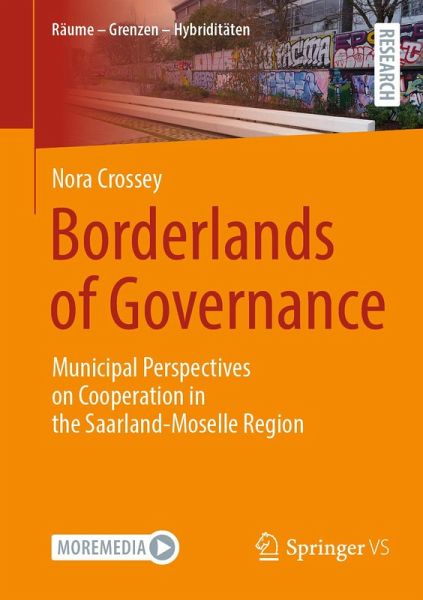
Recognizing European cross-border cooperation as a complex multilevel governance shaped by both bottom-up and top-down processes, and viewing recent border-regional strategies as a catalyst for decentralizing cross-border relations in French-German border regions, this book examines municipal actors' perspectives in the "Greater Region", specifically the département Moselle and the German Saarland. Bridging governance and border studies by adopting a lens of "borderlands of governance", it studies the contributions of intermunicipal cross-border governance to processes of bordering and "place-making" and to systems of multilevel cross-border governance. (In)formal intermunicipal cross-border networks - whose relevance and ingenuity became particularly evident during the Covid-19 pandemic - play a crucial role for the functioning of the borderspaces, in some instances evolving into "quasi-territorial" governance reflecting communities beyond national borders yet remaining bound to logics of territoriality and sovereignty. Here, the conceptualisation of "borderlands of governance" offers a framework for understanding them as contingent elements of multilevel cross-border governance.
Dieser Download kann aus rechtlichen Gründen nur mit Rechnungsadresse in A, B, BG, CY, CZ, D, DK, EW, E, FIN, F, GR, HR, H, IRL, I, LT, L, LR, M, NL, PL, P, R, S, SLO, SK ausgeliefert werden.