38,95 €
38,95 €
inkl. MwSt.
Sofort per Download lieferbar

19 °P sammeln
38,95 €
Als Download kaufen
38,95 €
inkl. MwSt.
Sofort per Download lieferbar
19 °P sammeln
Jetzt verschenken
Alle Infos zum eBook verschenken
38,95 €
inkl. MwSt.
Sofort per Download lieferbar
Alle Infos zum eBook verschenken
19 °P sammeln

Andere Kunden interessierten sich auch für
") Brahms Among Friends (eBook, PDF)24,95 €
Brahms Among Friends (eBook, PDF)24,95 €") The Organ Music of Johannes Brahms (eBook, PDF)27,95 €
The Organ Music of Johannes Brahms (eBook, PDF)27,95 €") Grétry's Operas and the French Public (eBook, PDF)42,95 €
Grétry's Operas and the French Public (eBook, PDF)42,95 €") The German Symphony between Beethoven and Brahms (eBook, PDF)42,95 €
The German Symphony between Beethoven and Brahms (eBook, PDF)42,95 €") The 'Ars musica' Attributed to Magister Lambertus/Aristoteles (eBook, PDF)42,95 €
The 'Ars musica' Attributed to Magister Lambertus/Aristoteles (eBook, PDF)42,95 €") Edward MacDowell's European Piano Music (eBook, PDF)42,95 €
Edward MacDowell's European Piano Music (eBook, PDF)42,95 €") German Lieder in the Nineteenth Century (eBook, PDF)57,95 €
German Lieder in the Nineteenth Century (eBook, PDF)57,95 €




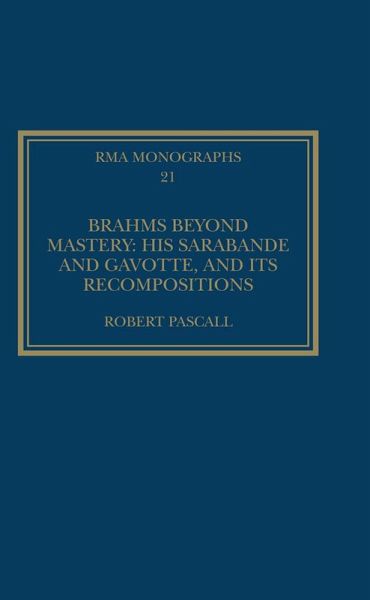
In 1853 Robert Schumann identified fully-formed compositional mastery in the young Brahms, who nevertheless in the years following embarked on a period of intensive further study, producing, among other works, the neo-baroque Sarabande and Gavotte. These dances have not been properly recognized as constituting a distinct Brahms work before now, but manuscript evidence and their performance history indicate that Brahms and his friends thought of them as such in the mid-1850s, when they became the first music of his performed publicly in Gdansk, Vienna, Budapest and London. He later suppressed the dances, using them instead as a thematic quarry for three chamber music masterpieces, from different stages in his life and in distinctly different ways: the Second String Sextet, the First String Quintet and the Clarinet Quintet. This book gives an account of the compositional and performance history, stylistic features and re-uses of the dances, setting these in the wider context of Brahms's developing creative concerns and trajectory. It constitutes therefore a study of alost work, of how a fully-formed master opens himself tothe in-flowing from afar (in Martin Heidegger's terms), and of the transformative reach and concomitant expressive richness of Brahms's creative thought.
Dieser Download kann aus rechtlichen Gründen nur mit Rechnungsadresse in A, B, BG, CY, CZ, D, DK, EW, E, FIN, F, GR, HR, H, IRL, I, LT, L, LR, M, NL, PL, P, R, S, SLO, SK ausgeliefert werden.