169,95 €
inkl. MwSt.
Sofort per Download lieferbar
85 °P sammeln

Andere Kunden interessierten sich auch für
") Practitioner's Guide to Antitrust in China (eBook, PDF)120,95 €
Practitioner's Guide to Antitrust in China (eBook, PDF)120,95 €") Competition Law: Mercosur (eBook, PDF)59,95 €
Competition Law: Mercosur (eBook, PDF)59,95 €") A Practitioner's Guide to European Patent Law (eBook, PDF)158,95 €
A Practitioner's Guide to European Patent Law (eBook, PDF)158,95 €") Practitioner's Guide to Medical Malpractice in South African Law (eBook, PDF)14,95 €
Practitioner's Guide to Medical Malpractice in South African Law (eBook, PDF)14,95 €") A Practitioner's Guide to the Unified Patent Court and Unitary Patent (eBook, PDF)125,95 €
A Practitioner's Guide to the Unified Patent Court and Unitary Patent (eBook, PDF)125,95 €") Social Media and Employment Law: An International Survey (eBook, PDF)165,95 €
Social Media and Employment Law: An International Survey (eBook, PDF)165,95 €") European Labour Law and Social Security Law: Glossary (eBook, PDF)286,95 €
European Labour Law and Social Security Law: Glossary (eBook, PDF)286,95 €




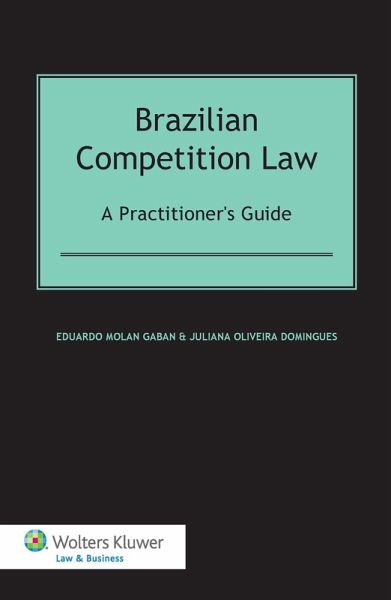
Once Brazil came to a clear awareness of its prodigious global economic power a few short years ago, the government quickly undertook a number of sweeping procedural reforms in its competition system that not only made the Brazilian antitrust enforcement authority a model for newer competition agencies worldwide but also fuelled the propulsion of Brazil to an unprecedented level of trading activity. Now, this thorough and informative volume describes and analyses, from a practitioner's point of view, the procedural details and economic underpinnings of this remarkable new antitrust regime.
With close attention to US and EU comparisons, as well as to the world institutions that incorporate an antitrust dimension, the authors' in-depth coverage encompasses such aspects as the following:
Offering to practitioners, policymakers, researchers, and academics a complete guide - grounded in case law, doctrine, and international experience - to how the Brazilian antitrust regime works, its trends and developments, this book is an important contribution to competition law both in theory and in practice. It is sure to be warmly welcomed.
With close attention to US and EU comparisons, as well as to the world institutions that incorporate an antitrust dimension, the authors' in-depth coverage encompasses such aspects as the following:
- . Brazil's recent achievements in streamlining such crucial business activities as food production and distribution, infra-structure, airlines, and health care;
- . regional and global competition cooperation agreements;
- . Brazilian methodology of analysis (for mergers and behaviours);
- . procedures, agreements, and statistics on merger control (concentration acts);
- . veto (full rejection), partial clearance (remedies), preliminary clearance all under case law approach;
- . economic groups and the challenge of private equity funds;
- . anticompetitive behaviours, boundaries, liabilities, trends, and challenges;
- . collaboration among competitiors: safe harbours and risky areas;
- . Brazilian leniency policy, statistics, updated rules
- . settlement agreements on mergers and behaviours;
- . cartels: types, administrative and criminal spheres, fines, statistics, due process, evidence / proof all under case law;
- . penalties for violations either in mergers or conducts controls;
- . judicial review or challenge of agency decisions: how CADE is succeeding in Courts;
- . private damages in Brazil: evolving trend to be considered in risk analysis
- . competition and intellectual property: general rules, main cases and safety zones.
Offering to practitioners, policymakers, researchers, and academics a complete guide - grounded in case law, doctrine, and international experience - to how the Brazilian antitrust regime works, its trends and developments, this book is an important contribution to competition law both in theory and in practice. It is sure to be warmly welcomed.
Dieser Download kann aus rechtlichen Gründen nur mit Rechnungsadresse in A, B, BG, CY, CZ, D, DK, EW, E, FIN, F, GR, HR, H, IRL, I, LT, L, LR, M, NL, PL, P, R, S, SLO, SK ausgeliefert werden.