38,95 €
38,95 €
inkl. MwSt.
Sofort per Download lieferbar

19 °P sammeln
38,95 €
Als Download kaufen
38,95 €
inkl. MwSt.
Sofort per Download lieferbar
19 °P sammeln
Jetzt verschenken
Alle Infos zum eBook verschenken
38,95 €
inkl. MwSt.
Sofort per Download lieferbar
Alle Infos zum eBook verschenken
19 °P sammeln

Andere Kunden interessierten sich auch für
") British Civilization (eBook, PDF)38,95 €
British Civilization (eBook, PDF)38,95 €") British Civilization (eBook, PDF)31,95 €
British Civilization (eBook, PDF)31,95 €") Europe (eBook, ePUB)48,95 €
Europe (eBook, ePUB)48,95 €") British Jacobin Politics, Desires, and Aftermaths (eBook, ePUB)41,95 €
British Jacobin Politics, Desires, and Aftermaths (eBook, ePUB)41,95 €") Britain since 1688 (eBook, ePUB)39,95 €
Britain since 1688 (eBook, ePUB)39,95 €") The British Jesus, 1850-1970 (eBook, ePUB)38,95 €
The British Jesus, 1850-1970 (eBook, ePUB)38,95 €") British Cultural Identities (eBook, ePUB)37,95 €
British Cultural Identities (eBook, ePUB)37,95 €





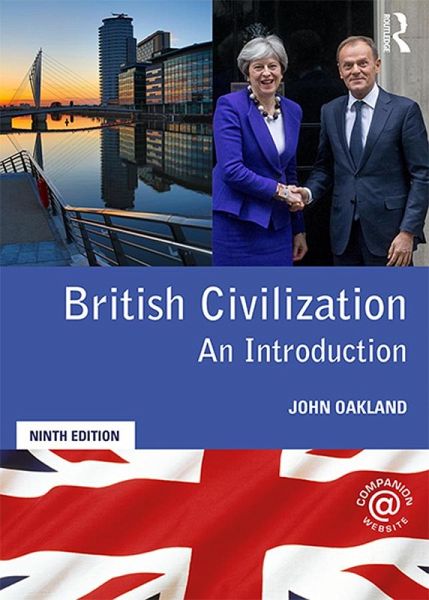
Thoroughly updated and revised, the ninth edition of the highly regarded British Civilization: An Introduction continues to be the ideal textbook on Britain, its country and people, religion, politics and government, international relations, legal system, economy, education, media and culture for students of British studies.
Examining central structural features of British society, the book provides an introduction to British civilization that highlights its history of cultural, geographical and human diversity. The book includes:
Supported by a companion website (www.routledge.com/cw/oakland), a long-ranging chronology, full-colour illustrations, useful figures, exercises and discussion questions, and suggestions for further reading, it is the perfect introduction to the crucial and complex nature of British civilization, culture and society, past and present.
Examining central structural features of British society, the book provides an introduction to British civilization that highlights its history of cultural, geographical and human diversity. The book includes:
- Expanded discussion of Britain's current political climate and international relations through an examination of the 2016 Brexit referendum, the subsequent general election and Brexit negotiations up to April 2019
- Discussion of the ever-shifting economy from a global perspective
- Opinion polls and surveys that provide an insight into the attitudes of British people to the conditions in which they live and operate today
- Exercises, questions, and suggestions for further reading and useful websites that stimulate class discussion and provide a springboard upon which students can develop their own independent study.
Supported by a companion website (www.routledge.com/cw/oakland), a long-ranging chronology, full-colour illustrations, useful figures, exercises and discussion questions, and suggestions for further reading, it is the perfect introduction to the crucial and complex nature of British civilization, culture and society, past and present.
Dieser Download kann aus rechtlichen Gründen nur mit Rechnungsadresse in A, B, BG, CY, CZ, D, DK, EW, E, FIN, F, GR, HR, H, IRL, I, LT, L, LR, M, NL, PL, P, R, S, SLO, SK ausgeliefert werden.
"British Civilization provides the most profound introduction to contemporary Britain ... Oakland presents the most recent information in a very concise and easily accessible writing style. Due to the additional resources, exercises and essay questions the book is perfect for teaching and learning."
Isabell Große, Leipzig University, Germany
"British Civilization: An Introduction is an excellent overview of a number of elements which students will need to know in order to understand British society. It is well-written, concise, and has attractive full-colour pictures and illustrations. It is especially strong on recent developments in British culture."
Mark Marston Norris, Grace College, USA
Isabell Große, Leipzig University, Germany
"British Civilization: An Introduction is an excellent overview of a number of elements which students will need to know in order to understand British society. It is well-written, concise, and has attractive full-colour pictures and illustrations. It is especially strong on recent developments in British culture."
Mark Marston Norris, Grace College, USA
"British Civilization provides the most profound introduction to contemporary Britain ... Oakland presents the most recent information in a very concise and easily accessible writing style. Due to the additional resources, exercises and essay questions the book is perfect for teaching and learning."
Isabell Große, Leipzig University, Germany
"British Civilization: An Introduction is an excellent overview of a number of elements which students will need to know in order to understand British society. It is well-written, concise, and has attractive full-colour pictures and illustrations. It is especially strong on recent developments in British culture."
Mark Marston Norris, Grace College, USA
Isabell Große, Leipzig University, Germany
"British Civilization: An Introduction is an excellent overview of a number of elements which students will need to know in order to understand British society. It is well-written, concise, and has attractive full-colour pictures and illustrations. It is especially strong on recent developments in British culture."
Mark Marston Norris, Grace College, USA