29,95 €
29,95 €
inkl. MwSt.
Sofort per Download lieferbar

15 °P sammeln
29,95 €
Als Download kaufen
29,95 €
inkl. MwSt.
Sofort per Download lieferbar
15 °P sammeln
Jetzt verschenken
Alle Infos zum eBook verschenken
29,95 €
inkl. MwSt.
Sofort per Download lieferbar
Alle Infos zum eBook verschenken
15 °P sammeln

Andere Kunden interessierten sich auch für
") Broken Bodies, Places and Objects (eBook, ePUB)29,95 €
Broken Bodies, Places and Objects (eBook, ePUB)29,95 €") Objects in the Archives (eBook, PDF)0,00 €
Objects in the Archives (eBook, PDF)0,00 €") The Routledge Handbook of Sensory Archaeology (eBook, PDF)46,95 €
The Routledge Handbook of Sensory Archaeology (eBook, PDF)46,95 €") Globalization and Transculturality from Antiquity to the Pre-Modern World (eBook, PDF)39,95 €
Globalization and Transculturality from Antiquity to the Pre-Modern World (eBook, PDF)39,95 €") Iron Age Myth and Materiality (eBook, PDF)39,95 €
Iron Age Myth and Materiality (eBook, PDF)39,95 €") Sites, Traces, and Materiality (eBook, PDF)38,95 €
Sites, Traces, and Materiality (eBook, PDF)38,95 €") Shadow Archaeologies (eBook, PDF)46,95 €
Shadow Archaeologies (eBook, PDF)46,95 €




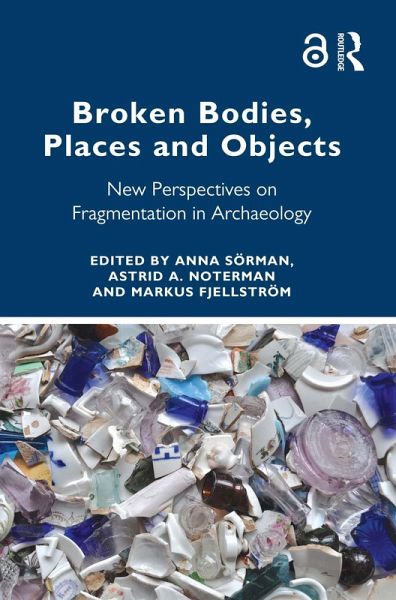
Broken Bodies, Places and Objects demonstrates the breadth of fragmentation and fragment use in prehistory and history and provides an up-to-date insight into current archaeological thinking around the topic.
A seal broken and shared by two trade parties, dog jaws accompanying the dead in Mesolithic burials, fragments of ancient warships commodified as souvenirs, parts of an ancient dynastic throne split up between different colonial collections... Pieces of the past are everywhere around us. Fragments have a special potential precisely because of their incomplete format - as a new matter that can reference its original whole but can also live on with new, unrelated meanings. Deliberate breakage of bodies, places and objects for the use of fragments has been attested from all time periods in the past. It has now been over 20 years since John Chapman's major publication introducing fragmentation studies, and the topic is more present than ever in archaeology. This volume offers the first European-wide review of the concept of fragmentation, collecting case studies from the Neolithic to Modernity and extending the ideas of fragmentation theory in new directions.
The book is written for scholars and students in archaeology, but it is also relevant for neighbouring fields with an interest in material culture, such as anthropology, history, cultural heritage studies, museology, art and architecture.
The Open Access version of this book, available at http://www.taylorfrancis.com, has been made available under a Creative Commons Attribution-Non Commercial-No Derivatives (CC-BY-NC-ND) 4.0 license.
A seal broken and shared by two trade parties, dog jaws accompanying the dead in Mesolithic burials, fragments of ancient warships commodified as souvenirs, parts of an ancient dynastic throne split up between different colonial collections... Pieces of the past are everywhere around us. Fragments have a special potential precisely because of their incomplete format - as a new matter that can reference its original whole but can also live on with new, unrelated meanings. Deliberate breakage of bodies, places and objects for the use of fragments has been attested from all time periods in the past. It has now been over 20 years since John Chapman's major publication introducing fragmentation studies, and the topic is more present than ever in archaeology. This volume offers the first European-wide review of the concept of fragmentation, collecting case studies from the Neolithic to Modernity and extending the ideas of fragmentation theory in new directions.
The book is written for scholars and students in archaeology, but it is also relevant for neighbouring fields with an interest in material culture, such as anthropology, history, cultural heritage studies, museology, art and architecture.
The Open Access version of this book, available at http://www.taylorfrancis.com, has been made available under a Creative Commons Attribution-Non Commercial-No Derivatives (CC-BY-NC-ND) 4.0 license.
Dieser Download kann aus rechtlichen Gründen nur mit Rechnungsadresse in A, B, BG, CY, CZ, D, DK, EW, E, FIN, F, GR, HR, H, IRL, I, LT, L, LR, M, NL, PL, P, R, S, SLO, SK ausgeliefert werden.