Sie sind bereits eingeloggt. Klicken Sie auf 2. tolino select Abo, um fortzufahren.
Bitte loggen Sie sich zunächst in Ihr Kundenkonto ein oder registrieren Sie sich bei bücher.de, um das eBook-Abo tolino select nutzen zu können.
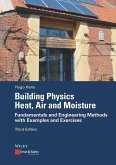
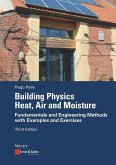
Bad experiences with construction quality, the energy crises of 1973 and 1979, complaints about "sick buildings", thermal, acoustical, visual and olfactory discomfort, the need for good air quality, the move towards energy efficiency, decarbonization and sustainability ? all these have accelerated the development of a discipline that, for a long time, was hardly more than an academic exercise: building physics. The discipline embraces domains such as heat and mass transfer, building acoustics, lighting, indoor environmental quality, energy efficiency, and, in some countries, fire safety.…mehr
Bad experiences with construction quality, the energy crises of 1973 and 1979, complaints about "sick buildings", thermal, acoustical, visual and olfactory discomfort, the need for good air quality, the move towards energy efficiency, decarbonization and sustainability ? all these have accelerated the development of a discipline that, for a long time, was hardly more than an academic exercise: building physics. The discipline embraces domains such as heat and mass transfer, building acoustics, lighting, indoor environmental quality, energy efficiency, and, in some countries, fire safety. Through the application of physical knowledge and its combination with information coming from other disciplines, building physics helps to under-stand the physical phenomena governing building parts, building envelope, whole building and built environment performance ? called urban physics. Today, building physics has be-come a key player on the road to highly performing new buildings and renovations. This book deals with heat, air and moisture transport in building parts or assemblies and whole buildings with emphasis on the building engineering applications. Compared to the third edition, this fourth edition has been expanded in chapter 1 to include the physical determination of the thermal conductivity of materials, together with an in-depth discussion of all the effects of thicker insulation layers. In chapter 2, additional information has been added on wind pressure and the evaluation of condensation inside the building com-ponents, while a new chapter 4 on material properties has been included. The whole book, including the figures, has been revised and restructured where necessary.
Dieser Download kann aus rechtlichen Gründen nur mit Rechnungsadresse in D ausgeliefert werden.
Die Herstellerinformationen sind derzeit nicht verfügbar.
Autorenporträt
Dr. Ir. Hugo S.L.C. Hens is an emeritus professor of the University of Leuven (KULeuven), Belgium. Until 1972, he worked as a structural engineer and site supervisor at a mid-sized architectural office. After the sudden death of his predecessor and promotor Professor A. de Grave in 1975 and after defending his PhD thesis, he stepwise built up the Department of Building Physics at the Department of Civil Engineering. He taught Building Physics from 1975 to 2003, performance based building design from 1975 to 2005 and building services from 1975 to 1977 and 1990 to 2008. He authored and co-authored 68 peer reviewed journal papers and 174 conference papers about the research done, has helped to manage hundreds of building damage cases and acted as coordinator of the CIB W40 working group on Heat and Mass Transfer in Buildings from 1983 to 1993. Between 1986 and 2008, he was operating agent of the Annexes 14, 24, 32 and 41 of the IEA EXCO on Energy in Buildings and Communities. He is a fellow of the American Society of Heating, Refrigeration and Air Conditioning Engineers (ASHRAE).
Inhaltsangabe
Preface Units and Symbols 0 Introduction, History of Building Physics 1 Heat Transfer 1.1 Generalities 1.2 Conduction 1.3 Heat Exchange at Surfaces by Convection and Radiation 1.4 Building Related Applications 1.5 Problems and Solutions 2 Mass Transfer 2.1 Generalities 2.2 Air 2.3 Water Vapour 2.4 Moisture 2.5 Problems and Solutions 3 Heat, Air, and Moisture Combined 3.1 Why? 3.2 Material and Assembly Level 3.3 Whole Building Level 3.4 Problems and Solutions 4 Heat, Air, Moisture Material Properties 4.1 In general 4.2 Dry Air and Water 4.3 Thermal Properties 4.4 Air Properties 4.5 Moisture Properties Postscript PostscriptVorwort Einheiten und Symbole 0 Einführung, Geschichte der Bauphysik 1 Wärmeübertragung 1.1 Allgemeines 1.2 Konduktion 1.3 Wärmeaustausch an Oberflächen durch Konvektion und Strahlung 1.4 Gebäudebezogene Anwendungen 1.5 Problemstellungen 2 Stoffübergang 2.1 Allgemeines 2.2 Luft 2.3 Wasserdampf 2.4 Luftfeuchtigkeit 2.5 Probleme 3 Wärme, Luft und Feuchte in Kombination 3.1 Warum? 3.2 Material- und Montageebene 3.3 Gesamte Gebäudeebene 3.4 Probleme 4 Thermische und Feuchteeigenschaften sowie von Luft 4.1 Allgemein 4.2 Trockene Luft und Wasser 4.3 Thermische Eigenschaften ausgewählter Baustoffe 4.4 Eigenschaften von Luft 4.5 Feuchteeigenschaften Nachwort
Es gelten unsere Allgemeinen Geschäftsbedingungen: www.buecher.de/agb
Impressum
www.buecher.de ist ein Internetauftritt der buecher.de internetstores GmbH
Geschäftsführung: Monica Sawhney | Roland Kölbl | Günter Hilger
Sitz der Gesellschaft: Batheyer Straße 115 - 117, 58099 Hagen
Postanschrift: Bürgermeister-Wegele-Str. 12, 86167 Augsburg
Amtsgericht Hagen HRB 13257
Steuernummer: 321/5800/1497
USt-IdNr: DE450055826