36,95 €
inkl. MwSt.
Sofort per Download lieferbar
18 °P sammeln

Andere Kunden interessierten sich auch für
") Burnout While Working (eBook, PDF)36,95 €
Burnout While Working (eBook, PDF)36,95 €") Resilience in Modern Day Organizations (eBook, ePUB)46,95 €
Resilience in Modern Day Organizations (eBook, ePUB)46,95 €") Diversity Ideologies in Organizations (eBook, ePUB)61,95 €
Diversity Ideologies in Organizations (eBook, ePUB)61,95 €") Maximizing Fulfillment at Work (eBook, ePUB)24,95 €
Maximizing Fulfillment at Work (eBook, ePUB)24,95 €") Healthy High Performance (eBook, ePUB)33,95 €
Healthy High Performance (eBook, ePUB)33,95 €") Examining Creativity in the Workplace (eBook, ePUB)51,95 €
Examining Creativity in the Workplace (eBook, ePUB)51,95 €") The Integration of Employee Assistance, Work/Life, and Wellness Services (eBook, ePUB)49,95 €
The Integration of Employee Assistance, Work/Life, and Wellness Services (eBook, ePUB)49,95 €
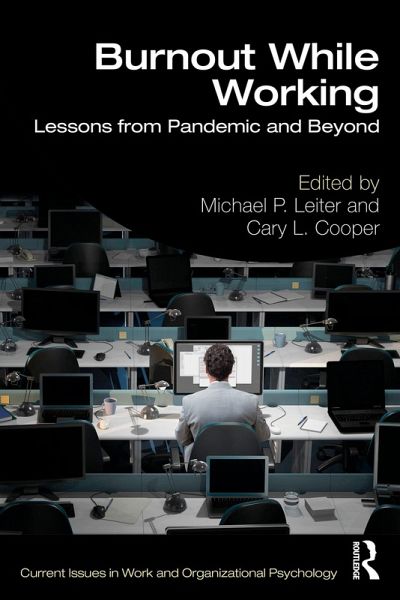
This book offers an extensive look into the ways living through the COVID-19 pandemic has deepened our understanding of the crises people experience in their relationships with work. Leading experts explore burnout as an occupational phenomenon that arises through mismatches between workplace and individuals on the day-to-day patterns in work life.
By disrupting where, when, and how people worked, pandemic measures upset the delicate balances in place regarding core areas of work life. Chapters examine the profound implications of social distancing on the quality and frequency of social encounters among colleagues, with management, and with clientele. The book covers a variety of occupational groups such as those in the healthcare and education sectors, and demonstrates the advantages and strains that come with working from home. The authors also consider the broader social context of working through the pandemic regarding risks and rewards for essential workers. By focusing on changes in organisational structures, policies, and practices, this book looks at effective ways forward in both recovering from this pandemic and preparing for further workplace disruptions.
A wide audience of students and researchers in psychology, management, business, healthcare, and social sciences, as well as policy makers in government and professional organisations, will benefit from this detailed insight into the ways COVID-19 has affected contemporary work attitudes and practices.
By disrupting where, when, and how people worked, pandemic measures upset the delicate balances in place regarding core areas of work life. Chapters examine the profound implications of social distancing on the quality and frequency of social encounters among colleagues, with management, and with clientele. The book covers a variety of occupational groups such as those in the healthcare and education sectors, and demonstrates the advantages and strains that come with working from home. The authors also consider the broader social context of working through the pandemic regarding risks and rewards for essential workers. By focusing on changes in organisational structures, policies, and practices, this book looks at effective ways forward in both recovering from this pandemic and preparing for further workplace disruptions.
A wide audience of students and researchers in psychology, management, business, healthcare, and social sciences, as well as policy makers in government and professional organisations, will benefit from this detailed insight into the ways COVID-19 has affected contemporary work attitudes and practices.
Dieser Download kann aus rechtlichen Gründen nur mit Rechnungsadresse in A, B, BG, CY, CZ, D, DK, EW, E, FIN, F, GR, HR, H, IRL, I, LT, L, LR, M, NL, PL, P, R, S, SLO, SK ausgeliefert werden.
'This is an important, topical and practical book that covers the profound consequences of the Covid-19 pandemic in the workplace. The authors, with their different expertise and backgrounds, offer a thoughtful and well-researched understanding of how the world has changed for people at work. It is comprehensive and critical, well-edited and thorough. I will, I believe, turn out to be a classic that analyses the new world order.' - Adrian Furnham, Professor at the Norwegian Business School, Norway
'A winner for a no-win environment. Two academic stars organize diverse yet complementary chapters into a focused book, coming at an ideal time. Risks factors escalated during COVID while sources of renewal to mitigate burnout were stymied or compromised. Great burnout lessons from the pandemic!' - James Campbell Quick, FSAScot, FAPA, Distinguished University Professor & Professor Emeritus, The University of Texas at Arlington, USA
'A winner for a no-win environment. Two academic stars organize diverse yet complementary chapters into a focused book, coming at an ideal time. Risks factors escalated during COVID while sources of renewal to mitigate burnout were stymied or compromised. Great burnout lessons from the pandemic!' - James Campbell Quick, FSAScot, FAPA, Distinguished University Professor & Professor Emeritus, The University of Texas at Arlington, USA