Sie sind bereits eingeloggt. Klicken Sie auf 2. tolino select Abo, um fortzufahren.
Bitte loggen Sie sich zunächst in Ihr Kundenkonto ein oder registrieren Sie sich bei bücher.de, um das eBook-Abo tolino select nutzen zu können.
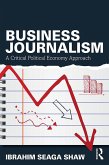
Business Journalism: A Critical Political Economy Approach critically explores the failures of business journalists in striking the balance between the bottom line business model and their role in defending the public interest. Drawing on historical and political economic perspectives and analysing these in relation to critical political economic theory, the book explores failures of business journalism through the dwindling of social responsibility in the business journalist's role in holding political and corporate power to account. Ibrahim Seaga Shaw draws on a diverse range of case…mehr
Business Journalism: A Critical Political Economy Approach critically explores the failures of business journalists in striking the balance between the bottom line business model and their role in defending the public interest.
Drawing on historical and political economic perspectives and analysing these in relation to critical political economic theory, the book explores failures of business journalism through the dwindling of social responsibility in the business journalist's role in holding political and corporate power to account.
Ibrahim Seaga Shaw draws on a diverse range of case studies, including:
investigative journalism in The Standard Oil and Enron Scandals
corporate propaganda in relation to business reporting
financial Journalism and the global financial crises of the late-90s and 2008
public business journalism and subprime mortgage loans, horsemeat and bent iPhone 6 scandals
ethical challenges of business and journalism from developed to emerging BRICS economies
business or financial journalism? Modernity vs postmodernity, macroeconomics vs microeconomics
challenges of business journalism in the digital age
Business Journalism: A Critical Political Economy Approach is essential reading for students and scholars interested in understanding the historical failings and potential futures for business journalism and those wishing to develop specialist financial, economic and business reporting in today's globalised media landscape.
Dieser Download kann aus rechtlichen Gründen nur mit Rechnungsadresse in A, B, BG, CY, CZ, D, DK, EW, E, FIN, F, GR, HR, H, IRL, I, LT, L, LR, M, NL, PL, P, R, S, SLO, SK ausgeliefert werden.
Die Herstellerinformationen sind derzeit nicht verfügbar.
Autorenporträt
Ibrahim Seaga Shaw is Senior Lecturer in Media and Politics at Northumbria University in Newcastle upon Tyne, UK. He is author of Human Rights Journalism (2012) and co-editor of Expanding Peace Journalism (2012). He is also co-editor of Communicating Differences (forthcoming 2016) and obtained his PhD from the Sorbonne. He has a background in journalism spanning 20 years, having worked in Sierra Leone, Britain and France.
Inhaltsangabe
1. Introduction - Background and Rational of the Political Economy of Business Journalism 1.1 Why study the political economy of business journalism? 1.2 What makes this book different from others specialising in business journalism? 1.3 The Triple Political Economic Crisis of Business Journalism Part 1: The crisis in the political economy of global capitalism 2. The Political economy of business and journalism: From paradox to crisis of capitalism 2.1 Political Economy of journalism and Public Business Journalism 2.2 Capitalism, anti-capitalism and the Business model of journalism 3. Crisis in the political economy of journalism and global capitalism 3.1 Corporate Journalism and Public Business Journalism 3.2 A social problem of political economic communication as corporate journalism 4. From Muckraking to Investigative Journalism: The Standard Oil Company and Enron Scandals 4.1 History of watchdog journalism, corporate scandals, and global capitalism 4.2 The Muckraking Movement and Corporate Corruption 4.3 From Muckraking to investigative Journalism-A comparative analysis involving Standard Oil and Enron Scandals Part 2: The crisis in the political economic reporting of financial crisis 5. Reporting Business and Finance in Crisis of Identity! From Business Journalism to Financial Journalism? 5.1 From Business Journalism to Financial Journalism? A critical historical and conceptual exploration 5.2 Modernity and Postmodernity 5.3 Macroeconomics and Microeconomics 6. Reporting Financial Crisis in Crisis! Critical comparative study of the reporting of the Subprime Mortgage Loan and Horsemeat Scandals 6.1 Crisis in the political economic reporting of financial crisis 6.2 A comparative study of the reporting of the Subprime Mortgage crisis and the Horsemeat Scandal in the UK Part 3: The crisis in the political economy of business journalism 7. Comparing ethical challenges of business journalism in the US, UK, China, and India 7.1 Free Speech, Privacy and Watchdog journalism: UK, USA, India and China 7.2 Conflicts of Interest: UK, USA, India and China 8. Challenges of Business Journalism in the Digital Age 8.1 Debates in the challenges of 'digital' and 'convergence journalism': Multi-media/convergence journalism 8.2 New media, service journalism and public business journalism 8.3 Framing the Bent iPhone 6 Scandal in the UK press and blogosphere 9. Conclusion - Towards Public Business Journalism 9.1 The Triple crisis of the political economy of business and journalism 9.2 Some alternative counter-hegemonic models that support Public Business Journalism 9.3 Movements and NGOs working to promote the ideas of public business journalism
Rezensionen
The experience is that many of the NCTJ accredited courses are mostly vocationally driven and do not tend to encourage their students to buy these type of texts. I would instead explore other markets such as business schools and media departments that tend to be overall more academically driven. I think the book can sell well, but the marketing strategy needs to consider wider markets. - Jairo Lugo-Ocando, University of Sheffield, UK
There are several other textbooks available about financial journalism, but none offers the philosophic context this book proposes... I teach [...] a course entitled Reporting on the Economy each winter [...] I can imagine using all or part of this book for the Economy class. - Pam Luecke, Washington and Lee University, USA
This book definitely is useful for my students to understand the complex world of business journalism and how they can better prepare themselves should they choose a career in business journalism. The book's global perspectives would make it popular with students other than those from Britain.- Victor Fung, Hong Kong Baptist University, Hong Kong
Es gelten unsere Allgemeinen Geschäftsbedingungen: www.buecher.de/agb
Impressum
www.buecher.de ist ein Internetauftritt der buecher.de internetstores GmbH
Geschäftsführung: Monica Sawhney | Roland Kölbl | Günter Hilger
Sitz der Gesellschaft: Batheyer Straße 115 - 117, 58099 Hagen
Postanschrift: Bürgermeister-Wegele-Str. 12, 86167 Augsburg
Amtsgericht Hagen HRB 13257
Steuernummer: 321/5800/1497
USt-IdNr: DE450055826