47,95 €
47,95 €
inkl. MwSt.
Sofort per Download lieferbar

24 °P sammeln
47,95 €
Als Download kaufen
47,95 €
inkl. MwSt.
Sofort per Download lieferbar
24 °P sammeln
Jetzt verschenken
Alle Infos zum eBook verschenken
47,95 €
inkl. MwSt.
Sofort per Download lieferbar
Alle Infos zum eBook verschenken
24 °P sammeln

Andere Kunden interessierten sich auch für
") By-Right, By-Design (eBook, PDF)47,95 €
By-Right, By-Design (eBook, PDF)47,95 €") Affordable Housing in the Urban Global South (eBook, ePUB)63,95 €
Affordable Housing in the Urban Global South (eBook, ePUB)63,95 €") Property, Planning and Protest: The Contentious Politics of Housing Supply (eBook, ePUB)36,95 €
Property, Planning and Protest: The Contentious Politics of Housing Supply (eBook, ePUB)36,95 €") The Fight for Fair Housing (eBook, ePUB)39,95 €
The Fight for Fair Housing (eBook, ePUB)39,95 €") Garden Suburbs of Tomorrow? (eBook, ePUB)31,95 €
Garden Suburbs of Tomorrow? (eBook, ePUB)31,95 €") Affordable Housing for Smart Villages (eBook, ePUB)49,95 €
Affordable Housing for Smart Villages (eBook, ePUB)49,95 €") The Affordable Housing Reader (eBook, ePUB)33,95 €
The Affordable Housing Reader (eBook, ePUB)33,95 €

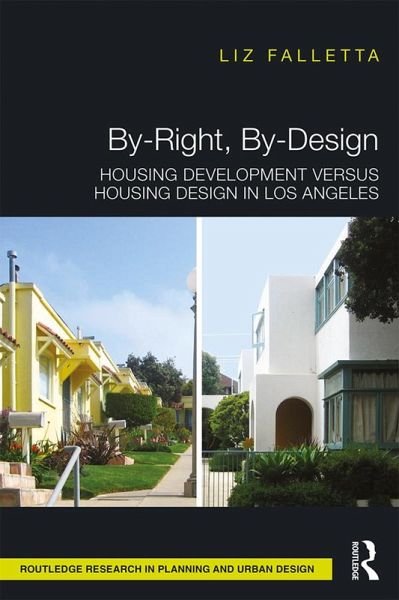
Housing is an essential, but complex, product, so complex that professionals involved in its production, namely, architects, real estate developers and urban planners, have difficulty agreeing on "good" housing outcomes. Less-than-optimal solutions that have resulted from a too narrow focus on one discipline over others are familiar: high design that is costly to build that makes little contribution to the public realm, highly profitable but seemingly identical "cookie-cutter" dwellings with no sense of place and well-planned neighborhoods full of generically designed, unmarketable product types.
Differing roles, languages and criteria for success shape these perspectives, which, in turn, influence attitudes about housing regulation. Real estate developers, for example, prefer projects that can be built "as-of-right" or "by-right," meaning that they can be approved quickly because they meet all current planning, zoning and building code requirements. Design-focused projects, heretofore "by-design," by contrast, often require time to challenge existing regulatory codes, pursuing discretionary modifications meant to maximize design innovation and development potential. Meanwhile, urban planners work to establish and mediate the threshold between by-right and by-design processes by setting housing standards and determining appropriate housing policy. But just what is the right line between "by-right" and "by-design"?
By-Right, By-Design provides a historical perspective, conceptual frameworks and practical strategies that cross and connect the diverse professions involved in housing production. The heart of the book is a set of six cross-disciplinary comparative case studies, each examining a significant Los Angeles housing design precedent approved by-variance and its associated development type approved as of right. Each comparison tells a different story about the often-hidden relationships among the three primary disciplines shaping the built environment, some of which uphold, and others of which transgress, conventional disciplinary stereotypes.
Differing roles, languages and criteria for success shape these perspectives, which, in turn, influence attitudes about housing regulation. Real estate developers, for example, prefer projects that can be built "as-of-right" or "by-right," meaning that they can be approved quickly because they meet all current planning, zoning and building code requirements. Design-focused projects, heretofore "by-design," by contrast, often require time to challenge existing regulatory codes, pursuing discretionary modifications meant to maximize design innovation and development potential. Meanwhile, urban planners work to establish and mediate the threshold between by-right and by-design processes by setting housing standards and determining appropriate housing policy. But just what is the right line between "by-right" and "by-design"?
By-Right, By-Design provides a historical perspective, conceptual frameworks and practical strategies that cross and connect the diverse professions involved in housing production. The heart of the book is a set of six cross-disciplinary comparative case studies, each examining a significant Los Angeles housing design precedent approved by-variance and its associated development type approved as of right. Each comparison tells a different story about the often-hidden relationships among the three primary disciplines shaping the built environment, some of which uphold, and others of which transgress, conventional disciplinary stereotypes.
Dieser Download kann aus rechtlichen Gründen nur mit Rechnungsadresse in A, B, BG, CY, CZ, D, DK, EW, E, FIN, F, GR, HR, H, IRL, I, LT, L, LR, M, NL, PL, P, R, S, SLO, SK ausgeliefert werden.