
2,49 €
inkl. MwSt.
Sofort per Download lieferbar
0 °P sammeln

Andere Kunden interessierten sich auch für
 (eBook, ePUB)") Capital (Das Kapital) (eBook, ePUB)2,49 €
Capital (Das Kapital) (eBook, ePUB)2,49 € (eBook, ePUB)") Capital (Das Kapital) (eBook, ePUB)2,49 €
Capital (Das Kapital) (eBook, ePUB)2,49 € (eBook, ePUB)") Capital (Das Kapital) (eBook, ePUB)2,49 €
Capital (Das Kapital) (eBook, ePUB)2,49 €") A Social Ecology of Capital (eBook, ePUB)20,95 €
A Social Ecology of Capital (eBook, ePUB)20,95 €") Das Kapital (eBook, ePUB)1,99 €
Das Kapital (eBook, ePUB)1,99 € (eBook, ePUB)") Das Kapital (Alle 3 Bände) (eBook, ePUB)1,99 €
Das Kapital (Alle 3 Bände) (eBook, ePUB)1,99 €") Lohnarbeit und Kapital (eBook, ePUB)1,99 €
Lohnarbeit und Kapital (eBook, ePUB)1,99 €


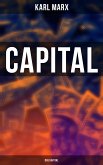




Karl Marx's seminal work, "Capital (Das Kapital)," delves into the intricacies of capitalist society through a rigorous analysis of economic systems, labor, and commodities. With a blend of philosophical discourse and economic theory, Marx employs a dialectical method that challenges contemporary capitalist ideologies. His exploration of concepts such as surplus value, alienation, and class struggle reveals the inherent contradictions within capitalism, making it a foundational text in both economics and political theory, notably influencing subsequent schools of thought, including socialism and critical theory. Marx, born in Prussia in 1818, was profoundly shaped by the socio-economic turbulence of his time, which included the Industrial Revolution and the rise of bourgeois capitalism. An ardent philosopher and economist, Marx spent much of his life analyzing the relationship between labor and capital. His long-standing collaboration with Friedrich Engels, as well as his immersion in contemporary social and political movements, fueled his desire to articulate the struggles of the working class, culminating in this masterwork. "Capital" is more than a profound treatise on economics; it is a clarion call to assess the socio-political structures that govern our lives. Readers interested in understanding the roots of modern capitalism, as well as its critiques, will find this book indispensable. Marx's insights continue to resonate, prompting essential discussions about equity, labor rights, and the future of economic systems. In this enriched edition, we have carefully created added value for your reading experience: - A comprehensive Introduction outlines these selected works' unifying features, themes, or stylistic evolutions. - The Author Biography highlights personal milestones and literary influences that shape the entire body of writing. - A Historical Context section situates the works in their broader era-social currents, cultural trends, and key events that underpin their creation. - A concise Synopsis (Selection) offers an accessible overview of the included texts, helping readers navigate plotlines and main ideas without revealing critical twists. - A unified Analysis examines recurring motifs and stylistic hallmarks across the collection, tying the stories together while spotlighting the different work's strengths. - Reflection questions inspire deeper contemplation of the author's overarching message, inviting readers to draw connections among different texts and relate them to modern contexts. - Lastly, our hand-picked Memorable Quotes distill pivotal lines and turning points, serving as touchstones for the collection's central themes.
Dieser Download kann aus rechtlichen Gründen nur mit Rechnungsadresse in A, B, BG, CY, CZ, D, DK, EW, E, FIN, F, GR, H, IRL, I, LT, L, LR, M, NL, PL, P, R, S, SLO, SK ausgeliefert werden.