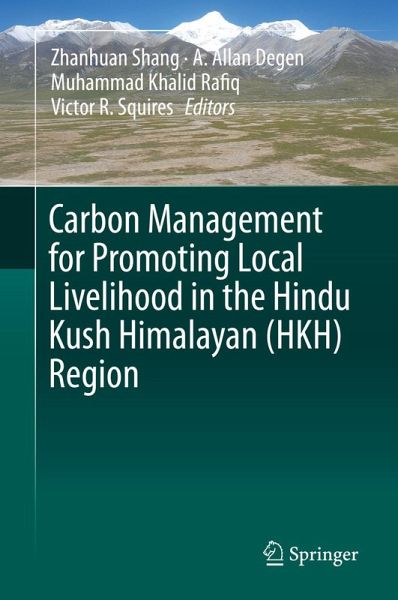
Carbon Management for Promoting Local Livelihood in the Hindu Kush Himalayan (HKH) Region (eBook, PDF)
Redaktion: Shang, Zhanhuan; Squires, Victor R.; Rafiq, Muhammad Khalid; Degen, A. Allan
72,95 €
72,95 €
inkl. MwSt.
Sofort per Download lieferbar

36 °P sammeln
72,95 €
Als Download kaufen
72,95 €
inkl. MwSt.
Sofort per Download lieferbar
36 °P sammeln
Jetzt verschenken
Alle Infos zum eBook verschenken
72,95 €
inkl. MwSt.
Sofort per Download lieferbar
Alle Infos zum eBook verschenken
36 °P sammeln

Carbon Management for Promoting Local Livelihood in the Hindu Kush Himalayan (HKH) Region (eBook, PDF)
Redaktion: Shang, Zhanhuan; Squires, Victor R.; Rafiq, Muhammad Khalid; Degen, A. Allan
- Format: PDF
- Merkliste
- Auf die Merkliste
- Bewerten Bewerten
- Teilen
- Produkt teilen
- Produkterinnerung
- Produkterinnerung

Bitte loggen Sie sich zunächst in Ihr Kundenkonto ein oder registrieren Sie sich bei
bücher.de, um das eBook-Abo tolino select nutzen zu können.
Hier können Sie sich einloggen
Sie sind bereits eingeloggt. Klicken Sie auf 2. tolino select Abo, um fortzufahren.

Bitte loggen Sie sich zunächst in Ihr Kundenkonto ein oder registrieren Sie sich bei bücher.de, um das eBook-Abo tolino select nutzen zu können.
Discusses carbon management and its linkages with livelihood improvement of the fragile communities of the Hindu Kush Himalayan (HKH) region Focuses on a region that has multidimensional ecological, economic, cultural and environmental significance Sheds new light on the social, economic, and policy perspectives associated with carbon management
- Geräte: PC
- ohne Kopierschutz
- eBook Hilfe
- Größe: 12.77MB
Andere Kunden interessierten sich auch für
Promoting Sustainability Through Water Management and Climate Change Adaptation (eBook, PDF)104,95 €
Status of Climate Change Adaptation in Asia and the Pacific (eBook, PDF)104,95 €
Sustainable Development Goals (eBook, PDF)112,95 €
Building Resilience to Climate Change in Selected Districts in Zimbabwe (eBook, PDF)96,95 €
Threatened Medicinal Plants in the Indian Himalayan Region (eBook, PDF)120,95 €
Africa and the Sustainable Development Goals (eBook, PDF)88,95 €
Koyel SamClimate Change in the Forest of Bengal Duars (eBook, PDF)40,95 €-
-
-
Discusses carbon management and its linkages with livelihood improvement of the fragile communities of the Hindu Kush Himalayan (HKH) region
Focuses on a region that has multidimensional ecological, economic, cultural and environmental significance
Sheds new light on the social, economic, and policy perspectives associated with carbon management
Dieser Download kann aus rechtlichen Gründen nur mit Rechnungsadresse in A, B, BG, CY, CZ, D, DK, EW, E, FIN, F, GR, HR, H, IRL, I, LT, L, LR, M, NL, PL, P, R, S, SLO, SK ausgeliefert werden.
Produktdetails
- Produktdetails
- Verlag: Springer International Publishing
- Seitenzahl: 347
- Erscheinungstermin: 23. Juli 2019
- Englisch
- ISBN-13: 9783030205911
- Artikelnr.: 57214883
- Verlag: Springer International Publishing
- Seitenzahl: 347
- Erscheinungstermin: 23. Juli 2019
- Englisch
- ISBN-13: 9783030205911
- Artikelnr.: 57214883
- Herstellerkennzeichnung Die Herstellerinformationen sind derzeit nicht verfügbar.
¿Dr. Zhanhuan Shang is a Professor at the School of Life Sciences, Lanzhou University in China. Dr. Muhammad Khalid Rafiq is a Senior Scientific Officer at the Pakistan Agricultural Research Council in Islamabad, Pakistan. Dr. Victor R. Squires is an Ex-Professor and Consultant at International Dryland Management Consultant, Adelaide University, Australia.
Chapter1: Managing Carbon Cycle Linkage to Livelihood in HKH Region.- Chapter2: Climate Change Mitigation and Pastoral Livelihood in the Hindu Kush Himalaya Region: Research Focuses, Opportunities and Challenges.- Chapter3: Tracking of Vegetation Carbon Dynamics from 2001 to 2016 by MODIS GPP in HKH region.- Chapter4: Livelihood and Carbon Management by Indigenous People in Southern Himalayas.- Chapter5: Effects of Different Grassland Management Patterns on Soil Properties on the Qinghai-Tibetan Plateau.- Chapter6: Carbon Management of the Livestock Industry in the HKH Region.- Chapter7: Wetlands as a Carbon Sink: Insight into the Himalayan Region.- Chapter8: Milk and Dung Production by Yaks (Poephagus grunniens): Important Products for the Livelihood of the Herders and for Carbon Recycling on the Qinghai-Tibetan Plateau.- Chapter9: Interactive Mechanism of Service Function of Ecosystems and the Effect of Climate Change to the Service Function of Ecosystem in Alpine Grassland of Tibetan Plateau.- Chapter10: Prospects of Biochar for Carbon Sequestration and Livelihood Improvement in the Tibetan Grasslands.- Chapter11: Optimizing the Alpine Grazing System to Improve Carbon Management and Livelihood for Tibetan Herders.- Chapter12: Promoting Artificial Grasslands to Improve Carbon Sequestration and Livelihood of Herders.- Chapter13: Prospects for REDD+ Financing in Promoting Forest Sustainable Management in HKH.- Chapter14: Designing Water Resource Use for Poverty Reduction in the HKH Region: Institutional and Policy Perspectives.- Chapter15: Indigenous Practice in Agro-pastoralism and Carbon Management from a Gender Perspective: A Case from Nepal.- Chapter16: Adaptation by Herders on the Qinghai-Tibetan Plateau in Response to Climate Change and Policy Reforms: the Implications for Carbon Sequestration and Livelihoods.- Chapter17: Developing Linkages for Carbon Sequestration, Livelihoods and Ecosystem Service Provision in Mountain Landscapes--Challenges and Opportunities in the Himalaya Hindu Kush (HKH) Region.- Chapter18: Experience for Future Good Practice and Policy of Combined Carbon Management and Livelihood in HKH Region.