40,95 €
inkl. MwSt.
Sofort per Download lieferbar
20 °P sammeln

Andere Kunden interessierten sich auch für
") Care Justice (eBook, ePUB)40,95 €
Care Justice (eBook, ePUB)40,95 €") The United Nations Madrid International Plan of Action on Ageing (eBook, PDF)38,95 €
The United Nations Madrid International Plan of Action on Ageing (eBook, PDF)38,95 €") Elderly People, Their Medicines, and Their Doctors (eBook, PDF)27,95 €
Elderly People, Their Medicines, and Their Doctors (eBook, PDF)27,95 €") Visual Disability in the Elderly (eBook, PDF)30,95 €
Visual Disability in the Elderly (eBook, PDF)30,95 €") Social Work Practice in Home Health Care (eBook, PDF)69,95 €
Social Work Practice in Home Health Care (eBook, PDF)69,95 €") Evidence-Based Treatment with Older Adults (eBook, PDF)32,95 €
Evidence-Based Treatment with Older Adults (eBook, PDF)32,95 €") Caring for a Living (eBook, PDF)28,95 €
Caring for a Living (eBook, PDF)28,95 €





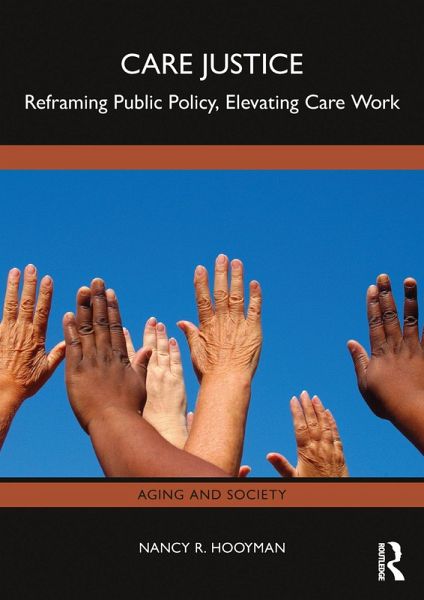
This book develops a care justice framework to critique and disrupt current policies and reframe a policy blueprint for elevating a just organization of care for unpaid family caregivers and underpaid home care workers assisting older adults. In doing so, Hooyman invites readers to envision a society that fully values the essential work of care.
The book is distinctive in its analysis of the interrelationships among both types of care laborers, who often face structural constraints on their decision to care and whose work is devalued and marginalized. Their care work affects every member of society, but it is generally invisible to others, and its economic value is rarely recognized by policymakers. How care work is organized and unrewarded typically has the most financial, physical, and emotional costs for women, people of color, and immigrants across the life course. Inequities for care workers by race, immigrant status, class, and sexual orientation are rooted in systemic racism, sexism, classism, xenophobia, and homophobia. In this book, policy priorities and change strategies are reframed to attain the six core components of a care justice framework, which include fundamental structural changes to elevate care work, ensure meaningful choice to care, and reduce systemic inequities faced by care workers. This framework is informed by feminism, Black feminism, intersectionality, and care theory. By conceptualizing care justice, the author aims to stimulate new discourse and action related to the care of older adults - the most important work in society - and make the seemingly unattainable attainable.
This timely book will be salient to anyone committed to diversity, equity, and inclusion and with an interest in policy, gerontology, disability studies, ethnic studies, feminist studies, social justice, social work, and social welfare.
The book is distinctive in its analysis of the interrelationships among both types of care laborers, who often face structural constraints on their decision to care and whose work is devalued and marginalized. Their care work affects every member of society, but it is generally invisible to others, and its economic value is rarely recognized by policymakers. How care work is organized and unrewarded typically has the most financial, physical, and emotional costs for women, people of color, and immigrants across the life course. Inequities for care workers by race, immigrant status, class, and sexual orientation are rooted in systemic racism, sexism, classism, xenophobia, and homophobia. In this book, policy priorities and change strategies are reframed to attain the six core components of a care justice framework, which include fundamental structural changes to elevate care work, ensure meaningful choice to care, and reduce systemic inequities faced by care workers. This framework is informed by feminism, Black feminism, intersectionality, and care theory. By conceptualizing care justice, the author aims to stimulate new discourse and action related to the care of older adults - the most important work in society - and make the seemingly unattainable attainable.
This timely book will be salient to anyone committed to diversity, equity, and inclusion and with an interest in policy, gerontology, disability studies, ethnic studies, feminist studies, social justice, social work, and social welfare.
Dieser Download kann aus rechtlichen Gründen nur mit Rechnungsadresse in A, B, BG, CY, CZ, D, DK, EW, E, FIN, F, GR, HR, H, IRL, I, LT, L, LR, M, NL, PL, P, R, S, SLO, SK ausgeliefert werden.
"This comprehensive and thought-provoking book, offers new ways of thinking about family caregivers and direct care workers, and their interdependence in providing essential home- and community-based care for older adults. Nancy Hooyman lays out promising and meaningful strategies to promote positive social change and achieve care justice in our country. It is time to respect and address both unpaid and paid care work for older adults in the U.S. and get this right."
Lynn Friss Feinberg, Former Senior Strategic Policy Advisor, AARP Public Policy Institute
"Nancy Hooyman offers an engaging analysis of the profound consequences of society's undervaluing of the essential work of elder care for both unpaid family caregivers and underpaid home care workers. By providing a window into the realities faced by women and persons of color who often bear the strain of devalued care, she illuminates how structural inequities by gender, race, social class, citizenship, and sexual orientation often shape their daily lives. In addition to highlighting the systemic problems underlying the devaluing, Hooyman offers readers the opportunity to explore transformational solutions and envision a society which adopts a care justice paradigm. Care Justice for Unpaid and Underpaid Care Workers is an essential resource for students, scholars, activists, and policymakers who believe we have a collective responsibility to elevate and credit care work."
Judith G. Gonyea, Professor of Social Work, Boston University, USA
"Caregiving is central to the human experience, yet too often marginalized in public discourse and policymaking. Focusing on care for older adults, Nancy Hooyman seeks to redress this historic imbalance by proposing a fundamentally new approach to understanding, valuing, and supporting the labor of care. Drawing on comprehensive research and thoughtful analysis, this important book invites readers to envision a society built around care justice for all care workers (paid and unpaid)-and offers a detailed blueprint for achieving that vision. Care Justice: Reframing Public Policy, Elevating Care Work should be seen as both a reference guide and a call to action for scholars, advocates, and policymakers alike"
Kezia Scales, Vice President of Research & Evaluation, PHI
"In this book, Dr. Nancy Hooyman persuasively argues for social policy transformations that increase support and enhance the value of caregivers in unpaid and underpaid positions. With the rise in both numbers of older adults and the complexity of caregiving needs, Dr. Hooyman provides an insightful and well-researched discourse with the intent to stimulate changes in approaches to home and community care. The six core components of care justice are fundamental to reducing inequalities faced by unpaid and underpaid care providers. As I read the book, I was reminded of the late Rosalynn Carter, herself an advocate for caregiving reform, who famously stated that "there are only four kinds of people in the world: those who have been caregivers, those who are currently caregivers, those who will be caregivers, and those who will need caregivers." Care provision is a ubiquitous role and I hope that we take up Dr. Hooyman's invitation to envision a society that values the essential work of care."
Nancy P. Kropf, Kenneth D. Lewis Distinguished Chair in Interdisciplinary Health Studies and Professor at the Byrdine F. Lewis College of Nursing and Health Professions, Georgia State University, USA
Lynn Friss Feinberg, Former Senior Strategic Policy Advisor, AARP Public Policy Institute
"Nancy Hooyman offers an engaging analysis of the profound consequences of society's undervaluing of the essential work of elder care for both unpaid family caregivers and underpaid home care workers. By providing a window into the realities faced by women and persons of color who often bear the strain of devalued care, she illuminates how structural inequities by gender, race, social class, citizenship, and sexual orientation often shape their daily lives. In addition to highlighting the systemic problems underlying the devaluing, Hooyman offers readers the opportunity to explore transformational solutions and envision a society which adopts a care justice paradigm. Care Justice for Unpaid and Underpaid Care Workers is an essential resource for students, scholars, activists, and policymakers who believe we have a collective responsibility to elevate and credit care work."
Judith G. Gonyea, Professor of Social Work, Boston University, USA
"Caregiving is central to the human experience, yet too often marginalized in public discourse and policymaking. Focusing on care for older adults, Nancy Hooyman seeks to redress this historic imbalance by proposing a fundamentally new approach to understanding, valuing, and supporting the labor of care. Drawing on comprehensive research and thoughtful analysis, this important book invites readers to envision a society built around care justice for all care workers (paid and unpaid)-and offers a detailed blueprint for achieving that vision. Care Justice: Reframing Public Policy, Elevating Care Work should be seen as both a reference guide and a call to action for scholars, advocates, and policymakers alike"
Kezia Scales, Vice President of Research & Evaluation, PHI
"In this book, Dr. Nancy Hooyman persuasively argues for social policy transformations that increase support and enhance the value of caregivers in unpaid and underpaid positions. With the rise in both numbers of older adults and the complexity of caregiving needs, Dr. Hooyman provides an insightful and well-researched discourse with the intent to stimulate changes in approaches to home and community care. The six core components of care justice are fundamental to reducing inequalities faced by unpaid and underpaid care providers. As I read the book, I was reminded of the late Rosalynn Carter, herself an advocate for caregiving reform, who famously stated that "there are only four kinds of people in the world: those who have been caregivers, those who are currently caregivers, those who will be caregivers, and those who will need caregivers." Care provision is a ubiquitous role and I hope that we take up Dr. Hooyman's invitation to envision a society that values the essential work of care."
Nancy P. Kropf, Kenneth D. Lewis Distinguished Chair in Interdisciplinary Health Studies and Professor at the Byrdine F. Lewis College of Nursing and Health Professions, Georgia State University, USA