68,95 €
68,95 €
inkl. MwSt.
Sofort per Download lieferbar

34 °P sammeln
68,95 €
Als Download kaufen
68,95 €
inkl. MwSt.
Sofort per Download lieferbar
34 °P sammeln
Jetzt verschenken
Alle Infos zum eBook verschenken
68,95 €
inkl. MwSt.
Sofort per Download lieferbar
Alle Infos zum eBook verschenken
34 °P sammeln

Andere Kunden interessierten sich auch für
") Stochastic Chemical Kinetics (eBook, PDF)40,95 €
Stochastic Chemical Kinetics (eBook, PDF)40,95 €") Deterministic Kinetics in Chemistry and Systems Biology (eBook, PDF)40,95 €
Deterministic Kinetics in Chemistry and Systems Biology (eBook, PDF)40,95 €") Analysis of Kinetic Reaction Mechanisms (eBook, PDF)72,95 €
Analysis of Kinetic Reaction Mechanisms (eBook, PDF)72,95 €") Advances in Methods and Applications of Quantum Systems in Chemistry, Physics, and Biology (eBook, PDF)112,95 €
Advances in Methods and Applications of Quantum Systems in Chemistry, Physics, and Biology (eBook, PDF)112,95 €") Kekulé Structures in Benzenoid Hydrocarbons (eBook, PDF)40,95 €
Kekulé Structures in Benzenoid Hydrocarbons (eBook, PDF)40,95 €") Supercomputer and Chemistry (eBook, PDF)72,95 €
Supercomputer and Chemistry (eBook, PDF)72,95 €") Molecular Orbitals and their Energies, Studied by the Semiempirical HAM Method (eBook, PDF)40,95 €
Molecular Orbitals and their Energies, Studied by the Semiempirical HAM Method (eBook, PDF)40,95 €


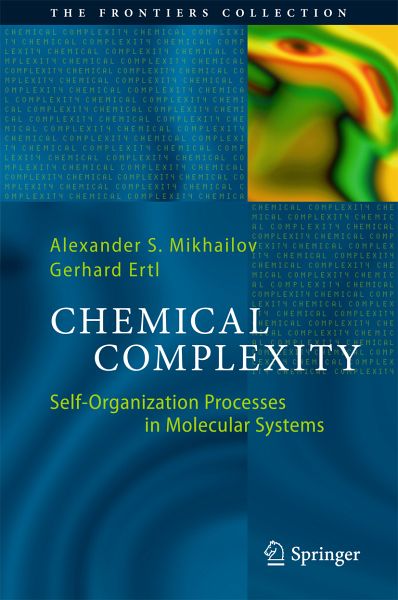
This book provides an outline of theoretical concepts and their experimental verification in studies of self-organization phenomena in chemical systems, as they emerged in the mid-20th century and have evolved since. Presenting essays on selected topics, it was prepared by authors who have made profound contributions to the field.
Traditionally, physical chemistry has been concerned with interactions between atoms and molecules that produce a variety of equilibrium structures - or the 'dead' order - in a stationary state. But biological cells exhibit a different 'living' kind of order, prompting E. Schrödinger to pose his famous question "What is life?" in 1943. Through an unprecedented theoretical and experimental development, it was later revealed that biological self-organization phenomena are in complete agreement with the laws of physics, once they are applied to a special class of thermodynamically open systems and non-equilibrium states. This knowledge has in turn led tothe design and synthesis of simple inorganic systems capable of self-organization effects. These artificial 'living organisms' are able to operate on macroscopic to microscopic scales, even down to single-molecule machines.
In the future, such research could provide a basis for a technological breakthrough, comparable in its impact with the invention of lasers and semiconductors. Its results can be used to control natural chemical processes, and to design artificial complex chemical processes with various functionalities. The book offers an extensive discussion of the history of research on complex chemical systems and its future prospects.
Traditionally, physical chemistry has been concerned with interactions between atoms and molecules that produce a variety of equilibrium structures - or the 'dead' order - in a stationary state. But biological cells exhibit a different 'living' kind of order, prompting E. Schrödinger to pose his famous question "What is life?" in 1943. Through an unprecedented theoretical and experimental development, it was later revealed that biological self-organization phenomena are in complete agreement with the laws of physics, once they are applied to a special class of thermodynamically open systems and non-equilibrium states. This knowledge has in turn led tothe design and synthesis of simple inorganic systems capable of self-organization effects. These artificial 'living organisms' are able to operate on macroscopic to microscopic scales, even down to single-molecule machines.
In the future, such research could provide a basis for a technological breakthrough, comparable in its impact with the invention of lasers and semiconductors. Its results can be used to control natural chemical processes, and to design artificial complex chemical processes with various functionalities. The book offers an extensive discussion of the history of research on complex chemical systems and its future prospects.
Dieser Download kann aus rechtlichen Gründen nur mit Rechnungsadresse in A, B, BG, CY, CZ, D, DK, EW, E, FIN, F, GR, HR, H, IRL, I, LT, L, LR, M, NL, PL, P, R, S, SLO, SK ausgeliefert werden.