
49,95 €
49,95 €
inkl. MwSt.
Sofort per Download lieferbar

25 °P sammeln
49,95 €
Als Download kaufen
49,95 €
inkl. MwSt.
Sofort per Download lieferbar
25 °P sammeln
Jetzt verschenken
Alle Infos zum eBook verschenken
49,95 €
inkl. MwSt.
Sofort per Download lieferbar
Alle Infos zum eBook verschenken
25 °P sammeln

Andere Kunden interessierten sich auch für
") Children's Responses to the Screen (eBook, ePUB)38,95 €
Children's Responses to the Screen (eBook, ePUB)38,95 €") Children's Learning From Educational Television (eBook, PDF)49,95 €
Children's Learning From Educational Television (eBook, PDF)49,95 €") Children and Television Consumption in the Digital Era (eBook, ePUB)37,95 €
Children and Television Consumption in the Digital Era (eBook, ePUB)37,95 €") Television in the Nursing Home (eBook, ePUB)41,95 €
Television in the Nursing Home (eBook, ePUB)41,95 €") How to be an Educational and Developmental Psychologist (eBook, ePUB)21,95 €
How to be an Educational and Developmental Psychologist (eBook, ePUB)21,95 €") Children's Literacy Development (eBook, ePUB)49,95 €
Children's Literacy Development (eBook, ePUB)49,95 €") Developmental and Educational Psychology for Teachers (eBook, ePUB)41,95 €
Developmental and Educational Psychology for Teachers (eBook, ePUB)41,95 €
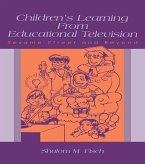


At its best, educational television can provide children with enormous opportunities and can serve as a window to new experiences, enrich academic knowledge, enhance attitudes and motivation, and nurture social skills. This volume documents the impact of educational television in a variety of subject areas and proposes mechanisms to explain its effects. Drawing from a wide variety of research spanning several disciplines, author Shalom M. Fisch analyzes the literature on the impact of educational resources. He focuses on television programs designed for children rather than for adults, although adult literature is included when it is particularly relevant. In addition, much of the discussion concerns the effects of unaided viewing by children, rather than viewing in the context of adult-led follow-up activities. The role of parent-child co-viewing and issues relevant to the use of television in school or child care also receives consideration.
This volume is intended to make the disparate literature on educational television's impact more accessible, by bringing it together into a centralized resource. To that end, the volume draws together empirical data on the impact of educational television programs--both academic and prosocial--on children's knowledge, skills, attitudes, and behavior. In addition to its emphasis on positive effects, this volume addresses a gap in the existing research literature regarding children's learning from exposure to educational television. Acknowledging that little theoretical work has been done to explain why or how these effects occur, Fisch takes a step toward correcting this situation by proposing theoretical models to explore aspects of the mental processing that underlies children's learning from educational television.
With its unique perspective on children's educational television and comprehensive approach to studying the topic, this volume is required reading for scholars, researchers, and students working in the area of children and television. It offers crucial insights to scholars in developmental psychology, family studies, educational psychology, and related areas.
This volume is intended to make the disparate literature on educational television's impact more accessible, by bringing it together into a centralized resource. To that end, the volume draws together empirical data on the impact of educational television programs--both academic and prosocial--on children's knowledge, skills, attitudes, and behavior. In addition to its emphasis on positive effects, this volume addresses a gap in the existing research literature regarding children's learning from exposure to educational television. Acknowledging that little theoretical work has been done to explain why or how these effects occur, Fisch takes a step toward correcting this situation by proposing theoretical models to explore aspects of the mental processing that underlies children's learning from educational television.
With its unique perspective on children's educational television and comprehensive approach to studying the topic, this volume is required reading for scholars, researchers, and students working in the area of children and television. It offers crucial insights to scholars in developmental psychology, family studies, educational psychology, and related areas.
Dieser Download kann aus rechtlichen Gründen nur mit Rechnungsadresse in A, B, BG, CY, CZ, D, DK, EW, E, FIN, F, GR, HR, H, IRL, I, LT, L, LR, M, NL, PL, P, R, S, SLO, SK ausgeliefert werden.