Sie sind bereits eingeloggt. Klicken Sie auf 2. tolino select Abo, um fortzufahren.
Bitte loggen Sie sich zunächst in Ihr Kundenkonto ein oder registrieren Sie sich bei bücher.de, um das eBook-Abo tolino select nutzen zu können.
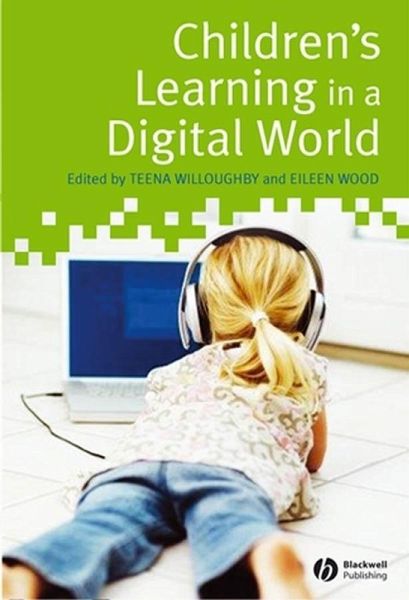
Children's Learning in a Digital World presents exciting and challenging new ideas from international scholars on the impact of computers, the Internet, and video games on children's learning. * Features exciting new research which reassesses the threats posed by technology to the social, emotional, and physical development of children * Examines the impact of technology in both formal and informal learning contexts, covering a range of technologies relevant to students and researchers, as well as professional educators * Presents key information on the social and cultural issues that affect…mehr
Children's Learning in a Digital World presents exciting and challenging new ideas from international scholars on the impact of computers, the Internet, and video games on children's learning. * Features exciting new research which reassesses the threats posed by technology to the social, emotional, and physical development of children * Examines the impact of technology in both formal and informal learning contexts, covering a range of technologies relevant to students and researchers, as well as professional educators * Presents key information on the social and cultural issues that affect technology use, in addition to the impact on children's learning * Includes research from an international range of contributors
Dieser Download kann aus rechtlichen Gründen nur mit Rechnungsadresse in D ausgeliefert werden.
Die Herstellerinformationen sind derzeit nicht verfügbar.
Autorenporträt
Teena Willoughby is Professor of Child and Youth Studies at Brock University, and Director of their Research Institute for Youth Studies. She is the winner of Brock's Research Award for 2003-5, and of the Book of the Year Award for Shaffer, Wood, & Willoughby; Developmental Psychology: Childhood and Adolescence, First Canadian Edition (2002). Eileen Wood is Professor in the Department of Psychology, Wilfrid Laurier University. She is winner of the Book of the Year Award for Shaffer, Wood, & Willoughby; Developmental psychology: Childhood and Adolescence, First Canadian Edition (2002) and for The World Of Psychology (Third Canadian Edition).
Inhaltsangabe
Foreword: Seven Criteria for Investigating Children's Learning in a Digital World: Richard E. Mayer (University of California). Part I: Informal Learning with Technologies: Opportunities and Challenges:. Introduction to informal learning with technologies: Opportunities and challenges: Teena Willoughby (Brock University) and Eileen Wood (Wilfred Laurier University). 1. Media literacy: Who needs it?: Henry Jenkins (MIT). 2. Good video games, the human mind, and good learning: James Paul Gee (University of Wisconsin-Madison). 3. How and what do video games teach?: Edward L. Swing (Iowa State University) and Craig A. Anderson (Iowa State University). 4. Videogame addiction: Fact or fiction: Mark Griffiths (Nottingham Trent University). 5. Meeting the needs of the vulnerable learner: The role of the teacher in bridging the gap between informal and formal learning using digital technologies: Laurence Peters (Temple University). Part II: Formal Learning with Technologies: Opportunities and Challenges:. Introduction to formal learning with technologies: Exploring the role of digital technologies: Teena Willoughby (Brock University), Bowen Hui (University of Toronto) and Eileen Wood (Wilfred Laurier University). 6. Using technology to assist children learning to read and write: Philip Abrami (Corncordia University), Robert Savage (McGill University), Anne Wade (Concordia University), Geoffrey Hipps (Concordia University) & Monica Lopez (Concordia University). 7. Tools for learning in an information society: John Nesbit (Simon Fraser University) & Philip Winne (Simon Fraser University). 8. Virtual playgrounds: Children's multi-user virtual environments for playing and learning with science: Yasmin Kafai (UCLA) & Michael Giang (UCLA). 9. Can students re-invent fundamental scientific principles: Evaluating the promise of new-media literacies: Andy diSessa (University of California, Berkeley). 10. Domain knowledge and learning from the Internet: Malinda Desjarlais (Brock University), Teena Willoughby (Brock University), and Eileen Wood (Wilfred Laurier University). 11. The integration of computer technology in the classroom: Julie Mueller (Wilfred Laurier University), Eileen Wood (Wilfred Laurier University) and Teena Willoughby (Brock University). Children's learning in a digital world: A summary and looking ahead: Eileen Wood (Wilfred Laurier University) and Teena Willoughby (Brock University). Index
Foreword: Seven Criteria for Investigating Children's Learning in a Digital World: Richard E. Mayer (University of California). Part I: Informal Learning with Technologies: Opportunities and Challenges:. Introduction to informal learning with technologies: Opportunities and challenges: Teena Willoughby (Brock University) and Eileen Wood (Wilfred Laurier University). 1. Media literacy: Who needs it?: Henry Jenkins (MIT). 2. Good video games, the human mind, and good learning: James Paul Gee (University of Wisconsin-Madison). 3. How and what do video games teach?: Edward L. Swing (Iowa State University) and Craig A. Anderson (Iowa State University). 4. Videogame addiction: Fact or fiction: Mark Griffiths (Nottingham Trent University). 5. Meeting the needs of the vulnerable learner: The role of the teacher in bridging the gap between informal and formal learning using digital technologies: Laurence Peters (Temple University). Part II: Formal Learning with Technologies: Opportunities and Challenges:. Introduction to formal learning with technologies: Exploring the role of digital technologies: Teena Willoughby (Brock University), Bowen Hui (University of Toronto) and Eileen Wood (Wilfred Laurier University). 6. Using technology to assist children learning to read and write: Philip Abrami (Corncordia University), Robert Savage (McGill University), Anne Wade (Concordia University), Geoffrey Hipps (Concordia University) & Monica Lopez (Concordia University). 7. Tools for learning in an information society: John Nesbit (Simon Fraser University) & Philip Winne (Simon Fraser University). 8. Virtual playgrounds: Children's multi-user virtual environments for playing and learning with science: Yasmin Kafai (UCLA) & Michael Giang (UCLA). 9. Can students re-invent fundamental scientific principles: Evaluating the promise of new-media literacies: Andy diSessa (University of California, Berkeley). 10. Domain knowledge and learning from the Internet: Malinda Desjarlais (Brock University), Teena Willoughby (Brock University), and Eileen Wood (Wilfred Laurier University). 11. The integration of computer technology in the classroom: Julie Mueller (Wilfred Laurier University), Eileen Wood (Wilfred Laurier University) and Teena Willoughby (Brock University). Children's learning in a digital world: A summary and looking ahead: Eileen Wood (Wilfred Laurier University) and Teena Willoughby (Brock University). Index
Rezensionen
"I found this volume to be easily accessible, and broad in scope." (Metapsychology, November 2008)"This well-written book provides valuable resources for those whorequire a deeper understanding of the impact of computer-basedsoftware on children's learning. The authors present currentstrategies and research that will be useful to both practitionersand to those who are interested in a more theoreticalfoundation." -Jim Kerr, Brock University
Es gelten unsere Allgemeinen Geschäftsbedingungen: www.buecher.de/agb
Impressum
www.buecher.de ist ein Internetauftritt der buecher.de internetstores GmbH
Geschäftsführung: Monica Sawhney | Roland Kölbl | Günter Hilger
Sitz der Gesellschaft: Batheyer Straße 115 - 117, 58099 Hagen
Postanschrift: Bürgermeister-Wegele-Str. 12, 86167 Augsburg
Amtsgericht Hagen HRB 13257
Steuernummer: 321/5800/1497
USt-IdNr: DE450055826