41,95 €
41,95 €
inkl. MwSt.
Sofort per Download lieferbar

21 °P sammeln
41,95 €
Als Download kaufen
41,95 €
inkl. MwSt.
Sofort per Download lieferbar
21 °P sammeln
Jetzt verschenken
Alle Infos zum eBook verschenken
41,95 €
inkl. MwSt.
Sofort per Download lieferbar
Alle Infos zum eBook verschenken
21 °P sammeln

Andere Kunden interessierten sich auch für
") China's Four Modernizations: The New Technological Revolution (eBook, ePUB)41,95 €
China's Four Modernizations: The New Technological Revolution (eBook, ePUB)41,95 €") Sustainable Reform and Development in Post-Olympic China (eBook, PDF)51,95 €
Sustainable Reform and Development in Post-Olympic China (eBook, PDF)51,95 €") Privatization in Malaysia (eBook, PDF)45,95 €
Privatization in Malaysia (eBook, PDF)45,95 €") State Fragility and Resilience in sub-Saharan Africa (eBook, PDF)41,95 €
State Fragility and Resilience in sub-Saharan Africa (eBook, PDF)41,95 €") Routledge Library Editions: Aid (eBook, PDF)417,95 €
Routledge Library Editions: Aid (eBook, PDF)417,95 €") Unions and Economic Crisis (eBook, PDF)39,95 €
Unions and Economic Crisis (eBook, PDF)39,95 €") Deconstructing Human Development (eBook, PDF)19,95 €
Deconstructing Human Development (eBook, PDF)19,95 €







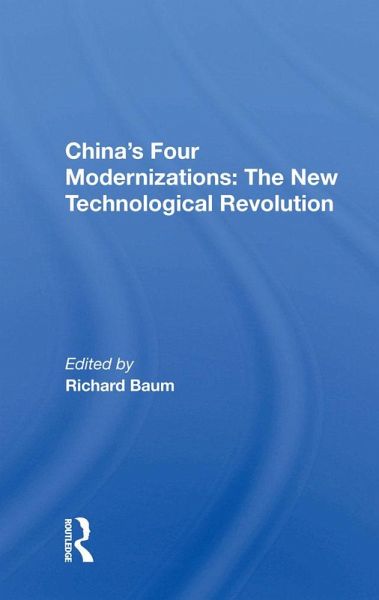
With the death of Mao Tse-tung and the subsequent purge of the "Gang of Four," China's new pragmatic leaders have embarked on a crash program of national development known as the Four Modernizations, This program is geared to the primary objective of turning China into a major world economic and military power by the year 2000. In this book, the outgrowth of a major international conference on China's post-Maoist development, ten distinguished analysts examine one of the core issues in China's current modernization drive: the acquisition and use of modern industrial science and technology. The authors address the politics of China's technological modernization, the institutional structure of technological research, the purchase of foreign technology, constraints on technological absorption, the growth potential of China's critical energy sector, and the modernization of China's military establishment. Supplemented with brief commentaries by leading academic, government, and private sector contributors, their chapters provide an in-depth look at the process, problems, and prospects of China's widely heralded technological revolution.
Dieser Download kann aus rechtlichen Gründen nur mit Rechnungsadresse in A, B, BG, CY, CZ, D, DK, EW, E, FIN, F, GR, HR, H, IRL, I, LT, L, LR, M, NL, PL, P, R, S, SLO, SK ausgeliefert werden.