Sie sind bereits eingeloggt. Klicken Sie auf 2. tolino select Abo, um fortzufahren.
Bitte loggen Sie sich zunächst in Ihr Kundenkonto ein oder registrieren Sie sich bei bücher.de, um das eBook-Abo tolino select nutzen zu können.
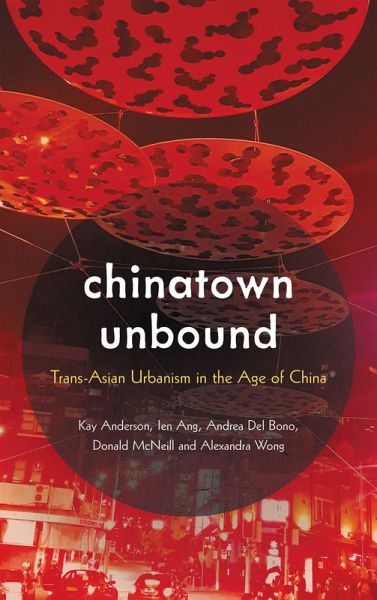
'Chinatowns' are familiar places in almost all major cities in the world. In popular Western wisdom, the restaurants, pagodas, and red lanterns are intrinsically equated with a self-contained, immigrant Chinese district, an alien enclave of 'the East' in 'the West'. By the 1980s, when these Western societies had largely given up their racially discriminatory immigration policies and opened up to Asian immigration, the dominant conception of Chinatown was no longer that of an abject ethnic ghetto: rather, Chinatown was now seen as a positive expression of multicultural heritage and difference.…mehr
'Chinatowns' are familiar places in almost all major cities in the world. In popular Western wisdom, the restaurants, pagodas, and red lanterns are intrinsically equated with a self-contained, immigrant Chinese district, an alien enclave of 'the East' in 'the West'. By the 1980s, when these Western societies had largely given up their racially discriminatory immigration policies and opened up to Asian immigration, the dominant conception of Chinatown was no longer that of an abject ethnic ghetto: rather, Chinatown was now seen as a positive expression of multicultural heritage and difference. By the early 21st century, however, these spatial and cultural constructions of Chinatown as an 'other' space - whether negative or positive - have been thoroughly destabilised by the impacts of accelerating globalisation and transnational migration. This book provides a timely and much-needed paradigm shift in this regard, through an in-depth case study of Sydney's Chinatown. It speaks to the growing multilateral connections that link Australia and Asia (and especially China) together; not just economically, but also socially and culturally, as a consequence of increasing transnational flows of people, money, ideas and things. Further, the book elicits a particular sense of a place in Sydney's Chinatown: that of an interconnected world in which Western and Asian realms inhabit each other, and in which the orientalist legacy is being reconfigured in new deployments and more complex delimitations. As such, Chinatown Unbound engages with, and contributes to making sense of, the epochal shift in the global balance of power towards Asia, especially China.
Die Herstellerinformationen sind derzeit nicht verfügbar.
Autorenporträt
Kay Anderson, Professorial Research Fellow at the Institute for Culture and Society, Western Sydney University, Australia.
Ien Ang, Distinguished Professor of Cultural Studies, Western Sydney University, Australia.
Andrea Del Bono, PhD Graduate, Institute for Culture and Society, Western Sydney University, Australia.
Donald McNeill, Professor of Urban and Cultural Geography, Institute for Culture and Society, Western Sydney University, Australia.
Alexandra Wong, Research Fellow, Institute for Culture and Society, Western Sydney University, Australia.
Inhaltsangabe
1. Introduction: Chinatown Unbound 2. Chinatown in Australia's Asian Century: From Enclave to Global Hub 3. Building Chinatown: Commercial Vernaculars, Urban Governance and Asian Spatial Templates 4. China's Town? Chinatown's Shifting Demography 5. Towards 'Asia-Town'? Chinatown's Cultural Diversity 6. Doing Business in Chinatown: Beyond the 'Ethnic Sub-Economy' 7. Branding Chinatown: From Flexible Chineseness to Multi-Asianness 8. Consuming Chinatown: The Rise of a Trans-Asian Urban Youth Culture 9. Curating Chinatown: Public Art beyond Orientalism 10. Conclusion: Chinatown's Future and the Prefiguration of an Australian Trans-Asian Metropolis
1. Introduction: Chinatown Unbound 2. Chinatown in Australia's Asian Century: From Enclave to Global Hub 3. Building Chinatown: Commercial Vernaculars, Urban Governance and Asian Spatial Templates 4. China's Town? Chinatown's Shifting Demography 5. Towards 'Asia-Town'? Chinatown's Cultural Diversity 6. Doing Business in Chinatown: Beyond the 'Ethnic Sub-Economy' 7. Branding Chinatown: From Flexible Chineseness to Multi-Asianness 8. Consuming Chinatown: The Rise of a Trans-Asian Urban Youth Culture 9. Curating Chinatown: Public Art beyond Orientalism 10. Conclusion: Chinatown's Future and the Prefiguration of an Australian Trans-Asian Metropolis
Es gelten unsere Allgemeinen Geschäftsbedingungen: www.buecher.de/agb
Impressum
www.buecher.de ist ein Internetauftritt der buecher.de internetstores GmbH
Geschäftsführung: Monica Sawhney | Roland Kölbl | Günter Hilger
Sitz der Gesellschaft: Batheyer Straße 115 - 117, 58099 Hagen
Postanschrift: Bürgermeister-Wegele-Str. 12, 86167 Augsburg
Amtsgericht Hagen HRB 13257
Steuernummer: 321/5800/1497
USt-IdNr: DE450055826