Sie sind bereits eingeloggt. Klicken Sie auf 2. tolino select Abo, um fortzufahren.
Bitte loggen Sie sich zunächst in Ihr Kundenkonto ein oder registrieren Sie sich bei bücher.de, um das eBook-Abo tolino select nutzen zu können.
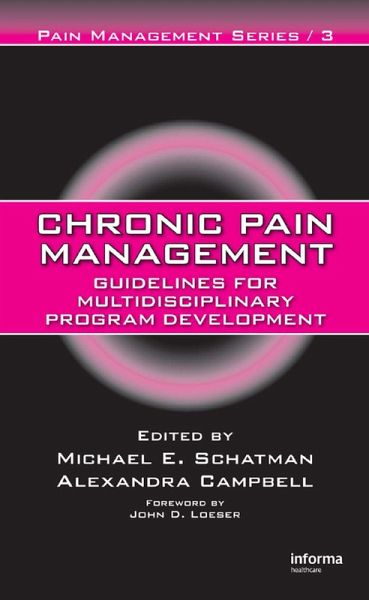
Chronic Pain Management: Guidelines for Multidisciplinary Program Development is the most comprehensive textbook to date on the multidisciplinary approach to chronic pain management. Written by an illustrious group of contributors, this volume serves as a must-have armamentarium of guidelines for the development of a successful pain management prog
Chronic Pain Management: Guidelines for Multidisciplinary Program Development is the most comprehensive textbook to date on the multidisciplinary approach to chronic pain management. Written by an illustrious group of contributors, this volume serves as a must-have armamentarium of guidelines for the development of a successful pain management prog
Dieser Download kann aus rechtlichen Gründen nur mit Rechnungsadresse in A, B, BG, CY, CZ, D, DK, EW, E, FIN, F, GR, HR, H, IRL, I, LT, L, LR, M, NL, PL, P, R, S, SLO, SK ausgeliefert werden.
Die Herstellerinformationen sind derzeit nicht verfügbar.
Autorenporträt
MICHAEL E. SCHATMAN is a Consulting Clinical Psychologist, Bellevue, Washington, a member of the American Psychological Association, the American Pain Society, and the American Society of Pain Educators. Dr. Schatman serves on the editorial advisory board of Practical Pain Management, and is on the Board of Directors of the Western Pain Society. He was the editor of Ethical Issues and Chronic Pain Management (Informa Healthcare, 2007), and is the author of numerous published articles, textbook chapters, and nationally-presented papers on various aspects of pain management practice. Dr. Schatman received his B.A. from Columbia University, New York, and his M.S. and Ph.D. degrees from the University of North Texas, Denton. ALEXANDRA CAMPBELL is Director of Pain Program Accreditation and Outcomes Measurement American Academy of Pain Management, Sonora, California. A member of the American Pain Society, the International Association for the Study of Pain, and the California Psychological Association, she is the author or editor of numerous book chapters, articles, and abstracts on pain. Dr. Campbell received her M.A. and Ph.D. degrees from the State University of New York, Stony Brook, trained in clinical pain research at the NIH, and completed a post-doctoral fellowship in behavioral medicine and pain management at the University of California San Francisco Medical Center.
Inhaltsangabe
History and Theory of Multidisciplinary Pain Management. Research on the Efficacy and Cost-Efficiency of Multidisciplinary Chronic Pain Management: Recognizing an Evidence-Based Approach. Problems Associated With "Carving Out" Services from Multidisciplinary Chronic Pain Management: Impact on Efficacy. Approaches to Psychological Assessment Prior to Multidisciplinary Chronic Pain Treatment. Multidisciplinary Chronic Pain Management as an Alternative to Chronic Opioid Therapy. Multidisciplinary Chronic Pain Management as an Alterative to Surgery. Interventional Chronic Pain Management: The Benefit of a Multidisciplinary Approach. The Potential Role of CAM within the Context of Multidisciplinary Chronic Pain Management. Issues of Special Populations Receiving Multidisciplinary Chronic Pain Management Services. Developing a Multidisciplinary Chronic Pain Management Program: Nuts and Bolts. Development of Policies and Procedures: Assurance of Consistent Chronic Pain Management Practice. Chronic Pain Management Program Accreditation: Providing Standards for Excellence. Outcomes Measurement in Multidisciplinary Chronic Pain Management: Data Collection as a Means of Quality Improvement. Chronic Pain Management in the Era of Managed Care. Strategies for Obtaining Reimbursement for Multidisciplinary Chronic Pain Management. Multidisciplinary Chronic Pain Management: A Patient's Experience
History and Theory of Multidisciplinary Pain Management. Research on the Efficacy and Cost-Efficiency of Multidisciplinary Chronic Pain Management: Recognizing an Evidence-Based Approach. Problems Associated With "Carving Out" Services from Multidisciplinary Chronic Pain Management: Impact on Efficacy. Approaches to Psychological Assessment Prior to Multidisciplinary Chronic Pain Treatment. Multidisciplinary Chronic Pain Management as an Alternative to Chronic Opioid Therapy. Multidisciplinary Chronic Pain Management as an Alterative to Surgery. Interventional Chronic Pain Management: The Benefit of a Multidisciplinary Approach. The Potential Role of CAM within the Context of Multidisciplinary Chronic Pain Management. Issues of Special Populations Receiving Multidisciplinary Chronic Pain Management Services. Developing a Multidisciplinary Chronic Pain Management Program: Nuts and Bolts. Development of Policies and Procedures: Assurance of Consistent Chronic Pain Management Practice. Chronic Pain Management Program Accreditation: Providing Standards for Excellence. Outcomes Measurement in Multidisciplinary Chronic Pain Management: Data Collection as a Means of Quality Improvement. Chronic Pain Management in the Era of Managed Care. Strategies for Obtaining Reimbursement for Multidisciplinary Chronic Pain Management. Multidisciplinary Chronic Pain Management: A Patient's Experience
Es gelten unsere Allgemeinen Geschäftsbedingungen: www.buecher.de/agb
Impressum
www.buecher.de ist ein Internetauftritt der buecher.de internetstores GmbH
Geschäftsführung: Monica Sawhney | Roland Kölbl | Günter Hilger
Sitz der Gesellschaft: Batheyer Straße 115 - 117, 58099 Hagen
Postanschrift: Bürgermeister-Wegele-Str. 12, 86167 Augsburg
Amtsgericht Hagen HRB 13257
Steuernummer: 321/5800/1497
USt-IdNr: DE450055826