37,95 €
37,95 €
inkl. MwSt.
Sofort per Download lieferbar

19 °P sammeln
37,95 €
Als Download kaufen
37,95 €
inkl. MwSt.
Sofort per Download lieferbar
19 °P sammeln
Jetzt verschenken
Alle Infos zum eBook verschenken
37,95 €
inkl. MwSt.
Sofort per Download lieferbar
Alle Infos zum eBook verschenken
19 °P sammeln

Andere Kunden interessierten sich auch für
") Water and Sacred Architecture (eBook, PDF)38,95 €
Water and Sacred Architecture (eBook, PDF)38,95 €") Architectural Excellence in Islamic Societies (eBook, PDF)39,95 €
Architectural Excellence in Islamic Societies (eBook, PDF)39,95 €") The Poetics of Arabian Suqs (eBook, PDF)39,95 €
The Poetics of Arabian Suqs (eBook, PDF)39,95 €") Cities and Islamisms (eBook, ePUB)37,95 €
Cities and Islamisms (eBook, ePUB)37,95 €") Thin Place Design (eBook, PDF)32,95 €
Thin Place Design (eBook, PDF)32,95 €") The Politics of Architectural Pedagogy in Iran (eBook, PDF)42,95 €
The Politics of Architectural Pedagogy in Iran (eBook, PDF)42,95 €") Hans van der Laan's Instruments of Thought (eBook, PDF)38,95 €
Hans van der Laan's Instruments of Thought (eBook, PDF)38,95 €




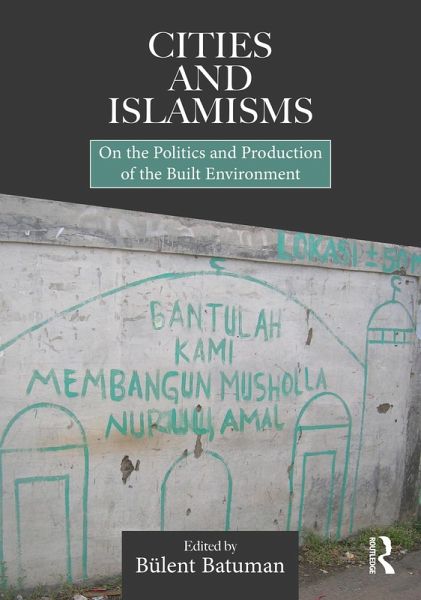
This book sheds light on a particular facet of the link between politics and Islam through the analysis of the relationship between Islamism and the built environment. The relationship between Islam and politics has always been controversial, yet it has possibly never been as controversial as it is at the time of writing. This new edited volume sets out to explore the interactions between Islamisms and the built environment through issues such as:
It expands on these issues through case studies analysing the role of the built environment and the urban realm as major media in the making of Islamist politics. The case studies incorporate manifestations in Muslim-dominated countries, including those where Islam has been at the heart of state ideology (Pakistan and Brunei), those with influential grassroots Islamist networks (pre-revolutionary Iran and Indonesia), those that identify with Islam through global exchanges (United Arab Emirates, Kazakhstan and Turkey) and countries where Islam is an increasingly significant reference utilized by political actors (Algeria and Lebanon).
This book will appeal to students and scholars of architecture, urban studies and cultural studies, as well as those interested in the social and political aspects of the built environment.
- spatial negotiations between nation and Islam in the definition of national identity;
- everyday spaces and the making of Islamic milieus;
- the role of Islam in the making (and/or remaking) of state ideology via architecture and urban planning;
- the influence of globalization and transnational links on the spatial manifestations of Islam(ism); and
- transnational architectural exchanges through global Islam.
It expands on these issues through case studies analysing the role of the built environment and the urban realm as major media in the making of Islamist politics. The case studies incorporate manifestations in Muslim-dominated countries, including those where Islam has been at the heart of state ideology (Pakistan and Brunei), those with influential grassroots Islamist networks (pre-revolutionary Iran and Indonesia), those that identify with Islam through global exchanges (United Arab Emirates, Kazakhstan and Turkey) and countries where Islam is an increasingly significant reference utilized by political actors (Algeria and Lebanon).
This book will appeal to students and scholars of architecture, urban studies and cultural studies, as well as those interested in the social and political aspects of the built environment.
Dieser Download kann aus rechtlichen Gründen nur mit Rechnungsadresse in A, B, BG, CY, CZ, D, DK, EW, E, FIN, F, GR, HR, H, IRL, I, LT, L, LR, M, NL, PL, P, R, S, SLO, SK ausgeliefert werden.