39,95 €
inkl. MwSt.
Sofort per Download lieferbar
20 °P sammeln

Andere Kunden interessierten sich auch für
") Cities and Metaphors (eBook, PDF)39,95 €
Cities and Metaphors (eBook, PDF)39,95 €") Mapping Urban Spaces (eBook, ePUB)0,00 €
Mapping Urban Spaces (eBook, ePUB)0,00 €") Representing Landscapes (eBook, ePUB)28,95 €
Representing Landscapes (eBook, ePUB)28,95 €") Shrinking Cities in Reunified East Germany (eBook, ePUB)39,95 €
Shrinking Cities in Reunified East Germany (eBook, ePUB)39,95 €") Landscape Architecture as Storytelling (eBook, ePUB)36,95 €
Landscape Architecture as Storytelling (eBook, ePUB)36,95 €") Reflective Planning Practice (eBook, ePUB)33,95 €
Reflective Planning Practice (eBook, ePUB)33,95 €") The Emerging Public Realm of the Greater Bay Area (eBook, ePUB)41,95 €
The Emerging Public Realm of the Greater Bay Area (eBook, ePUB)41,95 €
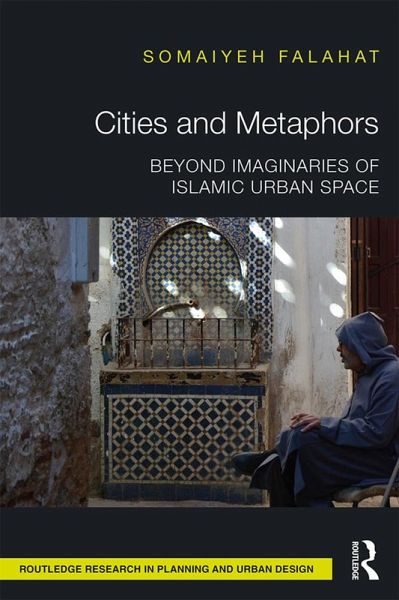
Introducing a new concept of urban space, Cities and Metaphors encourages a theoretical realignment of how the city is experienced, thought and discussed.
In the context of 'Islamic city' studies, relying on reasoning and rational thinking has reduced descriptive, vivid features of the urban space into a generic scientific framework. Phenomenological characteristics have consequently been ignored rather than integrated into theoretical components. The book argues that this results from a lack of appropriate conceptual vocabulary in our global body of scholarly literature. It challenges existing theories, introduces and applies the concept of Hezar-tu ('a thousand insides') to rethink the spaces in historic cores of Fez, Isfahan and Tunis. This tool constructs a staging post towards a different articulation of urban space based on spatial, physical, virtual, symbolic and social edges and thresholds; nodes of sociospatial relationships; zones of containment; state of intermediacy; and, thus, a logic of ambiguity rather than determinacy. Presenting alternative narrations of paths through sequential discovery of spaces, this book brings the sensual features of urban space into the focus.
The book finally shows that concepts derived from local contexts enable us to tailor our methods and theoretical structures to the idiosyncrasies of each city while retaining the global commonalities of all. Hence, in broader terms, it contributes to a growing awareness that urban studies should be more inclusive by bringing the diverse global contexts of cities into the body of our urban knowledge.
In the context of 'Islamic city' studies, relying on reasoning and rational thinking has reduced descriptive, vivid features of the urban space into a generic scientific framework. Phenomenological characteristics have consequently been ignored rather than integrated into theoretical components. The book argues that this results from a lack of appropriate conceptual vocabulary in our global body of scholarly literature. It challenges existing theories, introduces and applies the concept of Hezar-tu ('a thousand insides') to rethink the spaces in historic cores of Fez, Isfahan and Tunis. This tool constructs a staging post towards a different articulation of urban space based on spatial, physical, virtual, symbolic and social edges and thresholds; nodes of sociospatial relationships; zones of containment; state of intermediacy; and, thus, a logic of ambiguity rather than determinacy. Presenting alternative narrations of paths through sequential discovery of spaces, this book brings the sensual features of urban space into the focus.
The book finally shows that concepts derived from local contexts enable us to tailor our methods and theoretical structures to the idiosyncrasies of each city while retaining the global commonalities of all. Hence, in broader terms, it contributes to a growing awareness that urban studies should be more inclusive by bringing the diverse global contexts of cities into the body of our urban knowledge.
Dieser Download kann aus rechtlichen Gründen nur mit Rechnungsadresse in A, B, BG, CY, CZ, D, DK, EW, E, FIN, F, GR, HR, H, IRL, I, LT, L, LR, M, NL, PL, P, R, S, SLO, SK ausgeliefert werden.
"In this book, Somaiyeh Falahat engages in a deep analysis of space in Fez, Tunis and Isfahan. Using the Persian concept of 'Hezar-to', she shows us how the relationship between spaces and in-between spaces constitutes a unique nature that reveals and conceals reflecting continuity and separation simultaneously. The work provides a significant contribution to the study of abstract space in the 'Islamic City'."
Nezar AlSayyad, University of California, Berkeley, USA
"This book is an invitation to take a fresh look at the historic Islamic cities, change our perspective and think about them in a new way. It explores the cities of Fez, Isfahan and Tunis from a phenomenological perspective to capture and describe the experiential and sensual aspects of the urban space, and to become sensitive to their interiority, ambiguity and liminality."
Ali Madanipour, Newcastle University, UK.
"The importance of this book lies in its author's carefully substantiated argument that the sensually perceived, spatial characteristics of premodern Islamic urbanism have been neglected in scholarship; an oversight she attributes to an excessive reliance on cartographic methods for the comprehension of urban space and an inadequate conceptualisation of this space. Avoiding the first error by proceeding phenomenologically, and the second by unpicking and simultaneously developing, from an emic perspective, the etic concept of the labyrinth, Somaiyeh Falahat opens up new ways of knowing historic Islamic cities."
Simon O'Meara, School of Arts, SOAS, University of London
Nezar AlSayyad, University of California, Berkeley, USA
"This book is an invitation to take a fresh look at the historic Islamic cities, change our perspective and think about them in a new way. It explores the cities of Fez, Isfahan and Tunis from a phenomenological perspective to capture and describe the experiential and sensual aspects of the urban space, and to become sensitive to their interiority, ambiguity and liminality."
Ali Madanipour, Newcastle University, UK.
"The importance of this book lies in its author's carefully substantiated argument that the sensually perceived, spatial characteristics of premodern Islamic urbanism have been neglected in scholarship; an oversight she attributes to an excessive reliance on cartographic methods for the comprehension of urban space and an inadequate conceptualisation of this space. Avoiding the first error by proceeding phenomenologically, and the second by unpicking and simultaneously developing, from an emic perspective, the etic concept of the labyrinth, Somaiyeh Falahat opens up new ways of knowing historic Islamic cities."
Simon O'Meara, School of Arts, SOAS, University of London