22,95 €
inkl. MwSt.
Sofort per Download lieferbar
11 °P sammeln

Andere Kunden interessierten sich auch für
") Cities, Economic Inequality and Justice (eBook, ePUB)22,95 €
Cities, Economic Inequality and Justice (eBook, ePUB)22,95 €") Creative Cluster Development (eBook, PDF)44,95 €
Creative Cluster Development (eBook, PDF)44,95 €") Creating Smart Cities (eBook, PDF)41,95 €
Creating Smart Cities (eBook, PDF)41,95 €") The Unequal City (eBook, PDF)55,95 €
The Unequal City (eBook, PDF)55,95 €") Shrinking Cities (eBook, PDF)56,95 €
Shrinking Cities (eBook, PDF)56,95 €") Territorial Development, Cohesion and Spatial Planning (eBook, PDF)39,95 €
Territorial Development, Cohesion and Spatial Planning (eBook, PDF)39,95 €") The Political Economy of City Branding (eBook, PDF)45,95 €
The Political Economy of City Branding (eBook, PDF)45,95 €
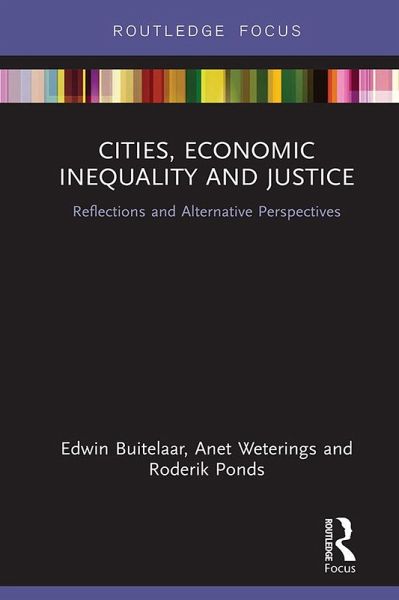
Increasing economic inequality in cities, and the spatial translation of that into more segregated neighbourhoods, is top of the political agenda in developed countries. While the overall living standards have increased in the last century, the focus has now shifted from poverty to economic differences, with a particular focus on the gap between the very poor and the (ultra-)rich.
The authors observe a common view among policy-makers and researchers alike: that urban-economic inequality and segregation are increasing; that this increase is bad; and that money and people (in the case of segregation) need to be redistributed in response. In six compact chapters, this book enriches and broadens the debate. Chapters bring together the literature on the social effects of economic inequality and segregation and question whether there are sizable effects and what their direction (positive or negative) is. The often conflated concepts of economic inequality (and segregation) and social injustice is disentangled and the moral implications are reflected on.
The book is essential reading for students and academics of Planning Theory, Planning Ethics, Urban Geography, Urban Economics, Economic Geography and Urban Sociology.
The authors observe a common view among policy-makers and researchers alike: that urban-economic inequality and segregation are increasing; that this increase is bad; and that money and people (in the case of segregation) need to be redistributed in response. In six compact chapters, this book enriches and broadens the debate. Chapters bring together the literature on the social effects of economic inequality and segregation and question whether there are sizable effects and what their direction (positive or negative) is. The often conflated concepts of economic inequality (and segregation) and social injustice is disentangled and the moral implications are reflected on.
The book is essential reading for students and academics of Planning Theory, Planning Ethics, Urban Geography, Urban Economics, Economic Geography and Urban Sociology.
Dieser Download kann aus rechtlichen Gründen nur mit Rechnungsadresse in A, B, BG, CY, CZ, D, DK, EW, E, FIN, F, GR, HR, H, IRL, I, LT, L, LR, M, NL, PL, P, R, S, SLO, SK ausgeliefert werden.
'I love the scope and ambition of this brave, well written and thoughtful book... Truly useful scholarship on the subject will find rich supporting ideas in this book, which offer intellectual scaffolding to help design specific institutions. The book gives direction for addressing those spatial inequalities that, for evidence-based reasons, need to be addressed, while leaving others to take their natural course. It is essential reading for policy-makers and urban professionals and for students studying cities from disciplinary perspectives of geography, economics, sociology, political science, planning and architecture and other fields.' - Professor Chris Webster, The University of Hong Kong.
'This book by three experts gives a much-needed boost to the research on the increasing inequality and segregation in cities. A topic that is not only of great academic relevance but also crucial for the future of cities. Highly recommended reading for researchers and policymakers alike.' - Harry Garretsen, Professor of International Economics & Business, University of Groningen, The Netherlands.
'This book by three experts gives a much-needed boost to the research on the increasing inequality and segregation in cities. A topic that is not only of great academic relevance but also crucial for the future of cities. Highly recommended reading for researchers and policymakers alike.' - Harry Garretsen, Professor of International Economics & Business, University of Groningen, The Netherlands.