Sie sind bereits eingeloggt. Klicken Sie auf 2. tolino select Abo, um fortzufahren.
Bitte loggen Sie sich zunächst in Ihr Kundenkonto ein oder registrieren Sie sich bei bücher.de, um das eBook-Abo tolino select nutzen zu können.
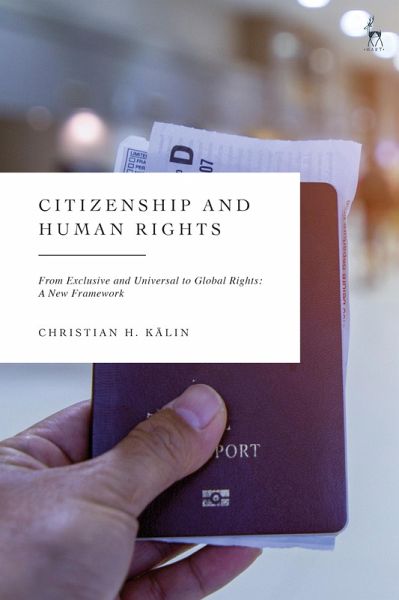
Can universal human rights and different national citizenship regimes ever be compatible? This book argues that they can't, setting out a legal-philosophical critique of the tension between both. It explores whether the emergence of postnational models of citizenship that aim at decoupling human rights and citizenship succeed in overcoming tensions between the universal (multiculturalism; universal human rights; postnational values) and the particular (citizenship; borders; national values and diverse local narratives). As a result of this exploration, the author argues that it is illegitimate…mehr
Can universal human rights and different national citizenship regimes ever be compatible? This book argues that they can't, setting out a legal-philosophical critique of the tension between both. It explores whether the emergence of postnational models of citizenship that aim at decoupling human rights and citizenship succeed in overcoming tensions between the universal (multiculturalism; universal human rights; postnational values) and the particular (citizenship; borders; national values and diverse local narratives). As a result of this exploration, the author argues that it is illegitimate to speak of universal human rights, universal human dignity, or universal social justice. It is only by recognising this reality that a much needed transformation of human rights and citizenship can be undertaken in a meaningful way. This provocative and compelling work will appeal to both human rights and citizenship lawyers, as well as others involved in human rights law at NGOs, governments, international organisations - and indeed anyone with an interest in the subject of how human rights evolved and new concepts for the future.
Die Herstellerinformationen sind derzeit nicht verfügbar.
Autorenporträt
Christian H. Kälin is the chairman of Henley & Partners and one of the world's foremost experts in immigration and citizenship policy. Holding masters and PhD degrees in law as well as a PhD in philosophy, he advises governments and international organizations. He is the author, co-author, and editor of many publications, including standard works such as the Global Residence and Citizenship Handbook, Ius Doni: The Acquisition of Citizenship by Investment, and the Kälin - Kochenov Quality of Nationality Index. Dr. Kälin is also the founder and chairman of the Andan Foundation, a Swiss non-profit humanitarian organization, which deals with human rights issues on a daily basis. It focuses on supporting displaced people and has established important partnerships, including with the UNHCR and UNICEF. The Foundation also established the annual Innovation for Refugee Inclusion Prize in collaboration with the Massachusetts Institute of Technology.
Inhaltsangabe
Table of Legislation Introduction 1. Philosophical Roots of the Concept of Humanity I. Ancient Greek Ideas Regarding Humanity and Citizenship II. Stoic Ideas of Humanity III. The Christian Idea of Humanity IV. The Enlightenment, Abstract Humanity and Universalism V. Kant's Conception of Humanity VI. Marx, Nietzsche and Freud: Towards a New Idea of Humanity and Political Subjectivity? 2. Foundations of Dignity and Human Rights I. Introduction II. The Human Soul in Greek Philosophy III. Dignity in the Christian Tradition IV. The Enlightenment, Kant and Human Dignity V. The Early French and US Declarations of Human Rights VI. Human Dignity in the Modern Human Rights Discourse 3. Ideas of Universal Human Rights versus Citizenship I. Introduction II. The Problem with Decoupling Human Rights and Citizenship III. Human Rights Dichotomies IV. Questioning the Universality of Human Rights 4. Ideas of World Citizenship: Attempting to Overcome the Conflict between the Exclusive and the Universal I. Introduction II. The Origins of Cosmopolitanism III. Global Citizenship and Human Rights 5. A New Framework of Global Human Rights I. Introduction II. A Postmodern Global Society without Borders? III. New Conceptions of Global Human Rights IV. A Theory of Global Human Rights Bibliography Index
Table of Legislation Introduction 1. Philosophical Roots of the Concept of Humanity I. Ancient Greek Ideas Regarding Humanity and Citizenship II. Stoic Ideas of Humanity III. The Christian Idea of Humanity IV. The Enlightenment, Abstract Humanity and Universalism V. Kant's Conception of Humanity VI. Marx, Nietzsche and Freud: Towards a New Idea of Humanity and Political Subjectivity? 2. Foundations of Dignity and Human Rights I. Introduction II. The Human Soul in Greek Philosophy III. Dignity in the Christian Tradition IV. The Enlightenment, Kant and Human Dignity V. The Early French and US Declarations of Human Rights VI. Human Dignity in the Modern Human Rights Discourse 3. Ideas of Universal Human Rights versus Citizenship I. Introduction II. The Problem with Decoupling Human Rights and Citizenship III. Human Rights Dichotomies IV. Questioning the Universality of Human Rights 4. Ideas of World Citizenship: Attempting to Overcome the Conflict between the Exclusive and the Universal I. Introduction II. The Origins of Cosmopolitanism III. Global Citizenship and Human Rights 5. A New Framework of Global Human Rights I. Introduction II. A Postmodern Global Society without Borders? III. New Conceptions of Global Human Rights IV. A Theory of Global Human Rights Bibliography Index
Es gelten unsere Allgemeinen Geschäftsbedingungen: www.buecher.de/agb
Impressum
www.buecher.de ist ein Internetauftritt der buecher.de internetstores GmbH
Geschäftsführung: Monica Sawhney | Roland Kölbl | Günter Hilger
Sitz der Gesellschaft: Batheyer Straße 115 - 117, 58099 Hagen
Postanschrift: Bürgermeister-Wegele-Str. 12, 86167 Augsburg
Amtsgericht Hagen HRB 13257
Steuernummer: 321/5800/1497
USt-IdNr: DE450055826