49,95 €
49,95 €
inkl. MwSt.
Sofort per Download lieferbar

25 °P sammeln
49,95 €
Als Download kaufen
49,95 €
inkl. MwSt.
Sofort per Download lieferbar
25 °P sammeln
Jetzt verschenken
Alle Infos zum eBook verschenken
49,95 €
inkl. MwSt.
Sofort per Download lieferbar
Alle Infos zum eBook verschenken
25 °P sammeln

Andere Kunden interessierten sich auch für
") Citizenship Inclusion and Intellectual Disability (eBook, ePUB)49,95 €
Citizenship Inclusion and Intellectual Disability (eBook, ePUB)49,95 €") Disability and Citizenship Studies (eBook, PDF)38,95 €
Disability and Citizenship Studies (eBook, PDF)38,95 €") The New Political Economy of Disability (eBook, PDF)38,95 €
The New Political Economy of Disability (eBook, PDF)38,95 €") The Routledge International Handbook of Children's Rights and Disability (eBook, PDF)43,95 €
The Routledge International Handbook of Children's Rights and Disability (eBook, PDF)43,95 €") Disability and Shopping (eBook, PDF)39,95 €
Disability and Shopping (eBook, PDF)39,95 €") Disability, Intersectional Agency, and Latinx Identity (eBook, PDF)37,95 €
Disability, Intersectional Agency, and Latinx Identity (eBook, PDF)37,95 €") Contemporary Issues in Health and Social Care Policy and Practice (eBook, PDF)39,95 €
Contemporary Issues in Health and Social Care Policy and Practice (eBook, PDF)39,95 €



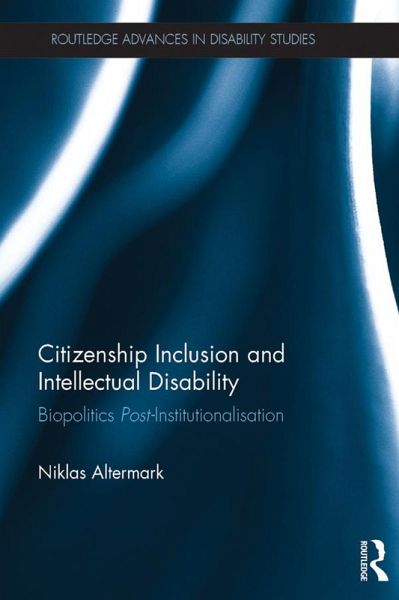
What happens when a group traditionally defined as lacking the necessary capacities of citizenship is targeted by government programs that have made 'citizenship inclusion' their main goal? Combining theoretical perspectives of political philosophy, social theory, and disability studies, this book untangles the current state of Western intellectual disability politics following the replacement of state institutionalisation by independent and supported living, individual rights, and self-determination.
Taking its cue from Foucault's conception of 'biopolitics', denoting the government of the individuals and the totality of the population, its overarching argument is that the ambiguous positioning of people with intellectual disabilities with respect to the ideals of citizenship results in a regime of government that simultaneously includes and excludes people of this group. On the one hand, its members are projected to become ideal-citizens via the cultivation of citizenship capacities. On the other, the right to live independently and by their own choices is curtailed as soon as they are seen as failing with respect to the ideals of reason and rationality. Therefore, coercion, restraints, and paternalism, which were all supposed to end with deinstitutionalisation, are still ingrained in services targeting the group.
In equal parts a theoretical work, advancing debates of critical disability theory, social theory, and post-structural philosophy, as well as an empirical engagement with the history of intellectual disability politics and the ways in which present day politics target the group, this book will be of interest to all students and scholars of disability studies, disability politics, and political theory.
Taking its cue from Foucault's conception of 'biopolitics', denoting the government of the individuals and the totality of the population, its overarching argument is that the ambiguous positioning of people with intellectual disabilities with respect to the ideals of citizenship results in a regime of government that simultaneously includes and excludes people of this group. On the one hand, its members are projected to become ideal-citizens via the cultivation of citizenship capacities. On the other, the right to live independently and by their own choices is curtailed as soon as they are seen as failing with respect to the ideals of reason and rationality. Therefore, coercion, restraints, and paternalism, which were all supposed to end with deinstitutionalisation, are still ingrained in services targeting the group.
In equal parts a theoretical work, advancing debates of critical disability theory, social theory, and post-structural philosophy, as well as an empirical engagement with the history of intellectual disability politics and the ways in which present day politics target the group, this book will be of interest to all students and scholars of disability studies, disability politics, and political theory.
Dieser Download kann aus rechtlichen Gründen nur mit Rechnungsadresse in A, B, BG, CY, CZ, D, DK, EW, E, FIN, F, GR, HR, H, IRL, I, LT, L, LR, M, NL, PL, P, R, S, SLO, SK ausgeliefert werden.