42,95 €
42,95 €
inkl. MwSt.
Sofort per Download lieferbar

21 °P sammeln
42,95 €
Als Download kaufen
42,95 €
inkl. MwSt.
Sofort per Download lieferbar
21 °P sammeln
Jetzt verschenken
Alle Infos zum eBook verschenken
42,95 €
inkl. MwSt.
Sofort per Download lieferbar
Alle Infos zum eBook verschenken
21 °P sammeln

Andere Kunden interessierten sich auch für
") The Language of Mineralogy (eBook, PDF)52,95 €
The Language of Mineralogy (eBook, PDF)52,95 €") Women and Power at the French Court, 1483-1563 (eBook, PDF)0,00 €
Women and Power at the French Court, 1483-1563 (eBook, PDF)0,00 €") Sanskrit and the British Empire (eBook, PDF)37,95 €
Sanskrit and the British Empire (eBook, PDF)37,95 €") Portuguese Merchants and Missionaries in Feudal Japan, 1543-1640 (eBook, PDF)52,95 €
Portuguese Merchants and Missionaries in Feudal Japan, 1543-1640 (eBook, PDF)52,95 €") Geography, Cartography and Nautical Science in the Renaissance (eBook, PDF)52,95 €
Geography, Cartography and Nautical Science in the Renaissance (eBook, PDF)52,95 €") Disciplining History (eBook, PDF)42,95 €
Disciplining History (eBook, PDF)42,95 €") Nation and Region in Grierson's Linguistic Survey of India (eBook, PDF)41,95 €
Nation and Region in Grierson's Linguistic Survey of India (eBook, PDF)41,95 €






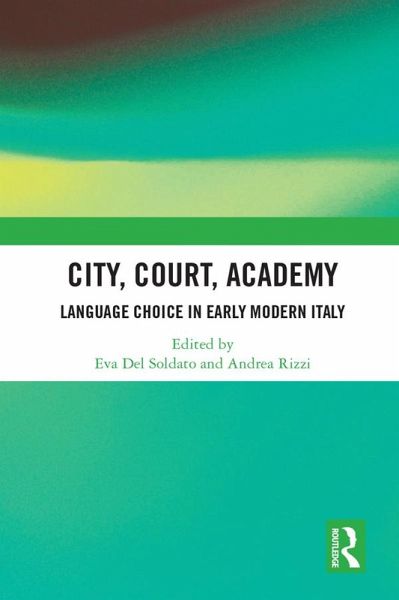
This volume focuses on early modern Italy and some of its key multilingual zones: Venice, Florence, and Rome. It offers a novel insight into the interplay and dynamic exchange of languages in the Italian peninsula, from the early fifteenth to the early seventeenth centuries. In particular, it examines the flexible linguistic practices of both the social and intellectual elite, and the men and women from the street.
The point of departure of this project is the realization that most of the early modern speakers and authors demonstrate strong self-awareness as multilingual communicators. From the foul-mouthed gondolier to the learned humanist, language choice and use were carefully performed, and often justified, in order to overcome (or affirm) linguistic and social differences. The urban social spaces, the princely court, and the elite centres of learning such as universities and academies all shared similar concerns about the value, effectiveness, and impact of languages. As the contributions in this book demonstrate, early modern communicators - including gondoliers, preachers, humanists, architects, doctors of medicine, translators, and teachers-made explicit and argued choices about their use of language. The textual and oral performance of languages-and self-aware discussions on languages-consolidated the identity of early modern Italian multilingual communities.
The point of departure of this project is the realization that most of the early modern speakers and authors demonstrate strong self-awareness as multilingual communicators. From the foul-mouthed gondolier to the learned humanist, language choice and use were carefully performed, and often justified, in order to overcome (or affirm) linguistic and social differences. The urban social spaces, the princely court, and the elite centres of learning such as universities and academies all shared similar concerns about the value, effectiveness, and impact of languages. As the contributions in this book demonstrate, early modern communicators - including gondoliers, preachers, humanists, architects, doctors of medicine, translators, and teachers-made explicit and argued choices about their use of language. The textual and oral performance of languages-and self-aware discussions on languages-consolidated the identity of early modern Italian multilingual communities.
Dieser Download kann aus rechtlichen Gründen nur mit Rechnungsadresse in A, B, BG, CY, CZ, D, DK, EW, E, FIN, F, GR, HR, H, IRL, I, LT, L, LR, M, NL, PL, P, R, S, SLO, SK ausgeliefert werden.