38,95 €
38,95 €
inkl. MwSt.
Sofort per Download lieferbar

19 °P sammeln
38,95 €
Als Download kaufen
38,95 €
inkl. MwSt.
Sofort per Download lieferbar
19 °P sammeln
Jetzt verschenken
Alle Infos zum eBook verschenken
38,95 €
inkl. MwSt.
Sofort per Download lieferbar
Alle Infos zum eBook verschenken
19 °P sammeln

Andere Kunden interessierten sich auch für
") Civil Disobedience from Nepal to Norway (eBook, PDF)38,95 €
Civil Disobedience from Nepal to Norway (eBook, PDF)38,95 €") Wittgenstein and the Nature of Violence (eBook, ePUB)35,95 €
Wittgenstein and the Nature of Violence (eBook, ePUB)35,95 €") Protest and Democracy (eBook, ePUB)39,95 €
Protest and Democracy (eBook, ePUB)39,95 €") Religion and Secularism in France Today (eBook, ePUB)41,95 €
Religion and Secularism in France Today (eBook, ePUB)41,95 €") Political Violence and the Imagination (eBook, ePUB)41,95 €
Political Violence and the Imagination (eBook, ePUB)41,95 €") The Kantian Subject (eBook, ePUB)42,95 €
The Kantian Subject (eBook, ePUB)42,95 €") Gandhi and the Contemporary World (eBook, ePUB)37,95 €
Gandhi and the Contemporary World (eBook, ePUB)37,95 €







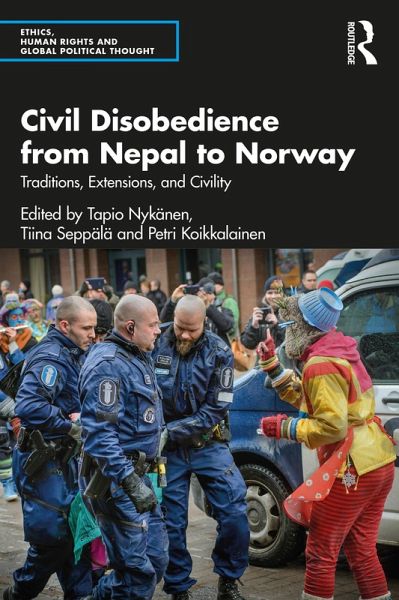
This volume explores the shifts in how civil disobedience has come to be theorized, defined, understood, and practised in contemporary politics. As social activism takes increasingly global forms, the goals of individuals and groups who view themselves as disobedient activists today can be defined in broader cultural terms than before, and their relationship to law and violence can be ambiguous.
Civil disobedience may no longer be entirely nonviolent, its purposes no longer necessarily serve progressive or emancipatory agendas. Its manifestations often blur the lines established in "classic", philosophically justified, and self-regulatory forms as epitomised in mass nonviolent protests of Mahatma Gandhi and Martin Luther King and theories of Arendt, Rawls and Dworkin. How civil disobedience operates has changed over the years, and this volume unpacks its many contemporary lives. It discusses new theoretical and political dilemmas and paradoxes through empirical cases and practical examples from Europe, the United States, and South Asia, which enables a "mirroring" perspective for the challenges and complexities of civil disobedience in different parts of the world.
Bringing together innovative and introspective perspectives on people and protests in contemporary political contexts, this volume will be of great interest to scholars and philosophers of political science, international relations theory, political philosophy, peace and conflict studies, sociology, and cultural studies.
Civil disobedience may no longer be entirely nonviolent, its purposes no longer necessarily serve progressive or emancipatory agendas. Its manifestations often blur the lines established in "classic", philosophically justified, and self-regulatory forms as epitomised in mass nonviolent protests of Mahatma Gandhi and Martin Luther King and theories of Arendt, Rawls and Dworkin. How civil disobedience operates has changed over the years, and this volume unpacks its many contemporary lives. It discusses new theoretical and political dilemmas and paradoxes through empirical cases and practical examples from Europe, the United States, and South Asia, which enables a "mirroring" perspective for the challenges and complexities of civil disobedience in different parts of the world.
Bringing together innovative and introspective perspectives on people and protests in contemporary political contexts, this volume will be of great interest to scholars and philosophers of political science, international relations theory, political philosophy, peace and conflict studies, sociology, and cultural studies.
Dieser Download kann aus rechtlichen Gründen nur mit Rechnungsadresse in A, B, BG, CY, CZ, D, DK, EW, E, FIN, F, GR, HR, H, IRL, I, LT, L, LR, M, NL, PL, P, R, S, SLO, SK ausgeliefert werden.