22,95 €
inkl. MwSt.
Sofort per Download lieferbar
11 °P sammeln

Andere Kunden interessierten sich auch für
") Edinburgh (eBook, ePUB)10,95 €
Edinburgh (eBook, ePUB)10,95 €") The Celts (eBook, ePUB)25,95 €
The Celts (eBook, ePUB)25,95 €") A People's History of Scotland (eBook, ePUB)10,95 €
A People's History of Scotland (eBook, ePUB)10,95 €") Tanks on the Streets? (eBook, ePUB)18,18 €
Tanks on the Streets? (eBook, ePUB)18,18 €") Rebel Orkney (eBook, ePUB)4,99 €
Rebel Orkney (eBook, ePUB)4,99 €") Bannockburn (eBook, ePUB)13,95 €
Bannockburn (eBook, ePUB)13,95 €") Window on the Forth (eBook, ePUB)2,99 €
Window on the Forth (eBook, ePUB)2,99 €







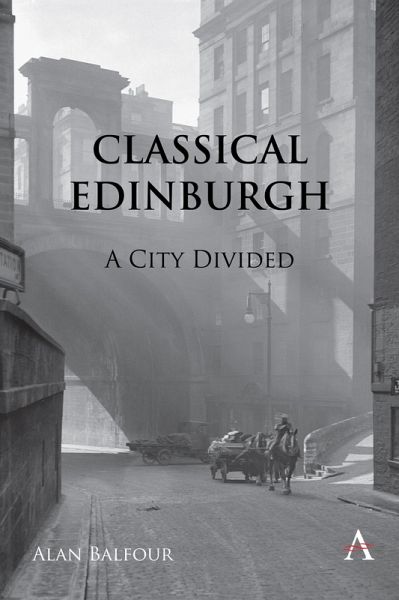
This work is both a family history and asocial history of Scotland with a particular focus on Edinburgh. The families are traced from their roots in the seventeenthcentury into the twentieth. However, all their wandering and failures, and births and marriages, are in themselves of no importance - they are merely the actions of helpless actors (one not so helpless) caught in the midst of changing worlds and realities. The book embeds their lives into the larger forces shaping the Scottish culture, climaxing in the creation of the New Town of Edinburgh, one of the eighteenthand nineteenth century's most extravagant romantic fantasies. It was a reality shaped by the leaders of the Scottish Enlightenment to give identity to a capital of a nation in name only, after the closing of the Scottish parliament with the Union of the Crowns in 1707.
This New Town became a vast idealised reality, which could only have been achieved in a Scotland that was and remains essentially feudal. All the lands surrounding the walls of the old city were the inherited properties of a few aristocratic families who were able, free of constraint, to sustain a succession of developments for over 80years, creating a continual stream of wealth for the landowners and their successors, and in the process producing extreme poverty for those left behind.
By the mid-nineteenth century, a very different reality emerged out of the need to accommodate the poor and the rising workforce in the city's new industries. This resulted in street after street of monotonous, identical tenements, a joyless demeaning world in stark contrast to the lively grandeur of the housing in the New Town. The medieval tenements of city's old High Street were once called 'slums built to last a thousand years', and in many ways the extensive tenements of the industrial city from the nineteenth and twentieth century can equally be said to represent the prospect of people divided for a thousand years. It will be argued that such division are unavoidable and can be found in many cities, but it is the extent and the willfulness of the planning that makes the Edinburgh example so potent.
This New Town became a vast idealised reality, which could only have been achieved in a Scotland that was and remains essentially feudal. All the lands surrounding the walls of the old city were the inherited properties of a few aristocratic families who were able, free of constraint, to sustain a succession of developments for over 80years, creating a continual stream of wealth for the landowners and their successors, and in the process producing extreme poverty for those left behind.
By the mid-nineteenth century, a very different reality emerged out of the need to accommodate the poor and the rising workforce in the city's new industries. This resulted in street after street of monotonous, identical tenements, a joyless demeaning world in stark contrast to the lively grandeur of the housing in the New Town. The medieval tenements of city's old High Street were once called 'slums built to last a thousand years', and in many ways the extensive tenements of the industrial city from the nineteenth and twentieth century can equally be said to represent the prospect of people divided for a thousand years. It will be argued that such division are unavoidable and can be found in many cities, but it is the extent and the willfulness of the planning that makes the Edinburgh example so potent.
Dieser Download kann aus rechtlichen Gründen nur mit Rechnungsadresse in A, D ausgeliefert werden.