
31,95 €
31,95 €
inkl. MwSt.
Sofort per Download lieferbar

16 °P sammeln
31,95 €
Als Download kaufen
31,95 €
inkl. MwSt.
Sofort per Download lieferbar
16 °P sammeln
Jetzt verschenken
Alle Infos zum eBook verschenken
31,95 €
inkl. MwSt.
Sofort per Download lieferbar
Alle Infos zum eBook verschenken
16 °P sammeln

Andere Kunden interessierten sich auch für
") Collaboration in Education (eBook, ePUB)54,95 €
Collaboration in Education (eBook, ePUB)54,95 €") Technology-enabled Mathematics Education (eBook, ePUB)39,95 €
Technology-enabled Mathematics Education (eBook, ePUB)39,95 €") Linguistic Justice (eBook, ePUB)32,95 €
Linguistic Justice (eBook, ePUB)32,95 €") Moving from the Primary Classroom (eBook, ePUB)27,95 €
Moving from the Primary Classroom (eBook, ePUB)27,95 €") The Teaching of Science (eBook, ePUB)29,95 €
The Teaching of Science (eBook, ePUB)29,95 €") Progress and Performance in the Primary Classroom (eBook, ePUB)27,95 €
Progress and Performance in the Primary Classroom (eBook, ePUB)27,95 €") Mixed Ability Teaching (eBook, ePUB)30,95 €
Mixed Ability Teaching (eBook, ePUB)30,95 €



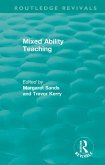
Originally published in 1984, this is an account of a two-year study of four comprehensive school classrooms, where teachers were fostering collaborative learning methods. The authors draw on their joint knowledge and experience as a psychologist and a teacher to give an insight into pupils' perceptions of their schooling, and a dynamic analysis of the process of education that they experienced.
Working on the premise that successful collaboration demands common goals and mutual understanding, the author observed pupils at work, transcribed their talk, and carried out interviews with both pupils and their teachers. They show how individual children can support and learn from each other, document the social and psychological features underlying the use, or non-use, of collaboration, and take the teachers' own frames of reference as a standpoint in evaluating success.
The authors' findings were intended to encourage teachers to move away from the traditional view of education as the transmission of knowledge to passive pupils. Social relationships within the classroom can potentially be, not merely a source of disruption, but the basis of learning itself. This possibility is particularly significant in the context of inner-city schools where there is often mutual mistrust and hostility across lines of race, class, gender or ability.
Working on the premise that successful collaboration demands common goals and mutual understanding, the author observed pupils at work, transcribed their talk, and carried out interviews with both pupils and their teachers. They show how individual children can support and learn from each other, document the social and psychological features underlying the use, or non-use, of collaboration, and take the teachers' own frames of reference as a standpoint in evaluating success.
The authors' findings were intended to encourage teachers to move away from the traditional view of education as the transmission of knowledge to passive pupils. Social relationships within the classroom can potentially be, not merely a source of disruption, but the basis of learning itself. This possibility is particularly significant in the context of inner-city schools where there is often mutual mistrust and hostility across lines of race, class, gender or ability.
Dieser Download kann aus rechtlichen Gründen nur mit Rechnungsadresse in A, B, BG, CY, CZ, D, DK, EW, E, FIN, F, GR, HR, H, IRL, I, LT, L, LR, M, NL, PL, P, R, S, SLO, SK ausgeliefert werden.