52,95 €
52,95 €
inkl. MwSt.
Sofort per Download lieferbar

26 °P sammeln
52,95 €
Als Download kaufen
52,95 €
inkl. MwSt.
Sofort per Download lieferbar
26 °P sammeln
Jetzt verschenken
Alle Infos zum eBook verschenken
52,95 €
inkl. MwSt.
Sofort per Download lieferbar
Alle Infos zum eBook verschenken
26 °P sammeln

Andere Kunden interessierten sich auch für
") Food Security, Food Prices and Climate Variability (eBook, ePUB)51,95 €
Food Security, Food Prices and Climate Variability (eBook, ePUB)51,95 €") Climate Change and Disadvantaged Communities (eBook, PDF)52,95 €
Climate Change and Disadvantaged Communities (eBook, PDF)52,95 €") Gender-Based Violence and Layered Disasters (eBook, ePUB)36,95 €
Gender-Based Violence and Layered Disasters (eBook, ePUB)36,95 €") The Routledge Handbook of Disaster Risk Reduction Including Climate Change Adaptation (eBook, ePUB)45,95 €
The Routledge Handbook of Disaster Risk Reduction Including Climate Change Adaptation (eBook, ePUB)45,95 €") Climate Change, Gender Roles and Hierarchies (eBook, ePUB)41,95 €
Climate Change, Gender Roles and Hierarchies (eBook, ePUB)41,95 €") Engendering Climate Change (eBook, ePUB)0,00 €
Engendering Climate Change (eBook, ePUB)0,00 €") Climate, Environmental Hazards and Migration in Bangladesh (eBook, ePUB)41,95 €
Climate, Environmental Hazards and Migration in Bangladesh (eBook, ePUB)41,95 €


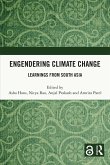

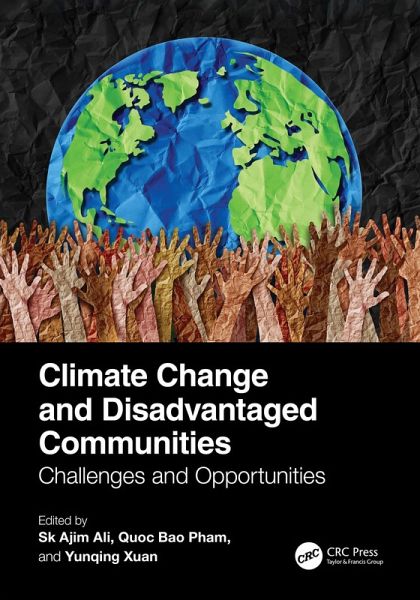
As climate change accelerates, so does the urgency to understand and address its unequal impacts. This book explores the uneven impacts of climate change and how it affects the lives and livelihoods of climate-disadvantaged communities by highlighting the specific challenges they face, such as heatwaves, droughts, flooding, health issues, and economic losses. It explains why vulnerable populations are more at risk due to factors such as lack of infrastructure, poverty, and limited access to resources. This book offers insights on conceptual frameworks to help vulnerable communities adapt and become more resilient to climate impacts. Real-life examples with challenges and actionable suggestions aim to inform policymakers and the public about the urgent need for targeted initiatives.
Features:
This book serves as a valuable resource for a wide audience, including climate scientists, geographers, ecologists, geologists, urban planners, environmentalists, research scholars, and policymakers engaged in the fields of environmental management, climate justice, and sustainable development. By featuring the voices and experiences of disadvantaged communities, this book contributes meaningfully to the ongoing debates of climate justice, sustainable development, and equitable adaptation pathways.
Features:
- Provides a comprehensive examination of how marginalized groups, from indigenous populations in the Niyamgiri Hills to urban slum dwellers in Asia, are disproportionately affected by climate change and what can be done to mitigate these impacts.
- Includes practical examples from different countries to help understand the intersection between climate change and social inequality.
- Utilizes advanced technologies and provides cutting-edge tools such as geospatial maps and diagrams for modelling climate threats and predicting climate-related challenges.
- Provides a roadmap for more resilient and inclusive future strategies.
- Highlights interdisciplinary discussions and contributions by various stakeholders to reach different audiences and offer regional problem-solving opportunities.
This book serves as a valuable resource for a wide audience, including climate scientists, geographers, ecologists, geologists, urban planners, environmentalists, research scholars, and policymakers engaged in the fields of environmental management, climate justice, and sustainable development. By featuring the voices and experiences of disadvantaged communities, this book contributes meaningfully to the ongoing debates of climate justice, sustainable development, and equitable adaptation pathways.
Dieser Download kann aus rechtlichen Gründen nur mit Rechnungsadresse in A, B, BG, CY, CZ, D, DK, EW, E, FIN, F, GR, HR, H, IRL, I, LT, L, LR, M, NL, PL, P, R, S, SLO, SK ausgeliefert werden.