37,95 €
37,95 €
inkl. MwSt.
Sofort per Download lieferbar

19 °P sammeln
37,95 €
Als Download kaufen
37,95 €
inkl. MwSt.
Sofort per Download lieferbar
19 °P sammeln
Jetzt verschenken
Alle Infos zum eBook verschenken
37,95 €
inkl. MwSt.
Sofort per Download lieferbar
Alle Infos zum eBook verschenken
19 °P sammeln

Andere Kunden interessierten sich auch für
") Coastal Architectures and Politics of Tourism (eBook, ePUB)37,95 €
Coastal Architectures and Politics of Tourism (eBook, ePUB)37,95 €") ICT, the Business Sector and Smart Cities (eBook, PDF)52,95 €
ICT, the Business Sector and Smart Cities (eBook, PDF)52,95 €") Planning, Housing and Infrastructure for Smart Villages (eBook, PDF)47,95 €
Planning, Housing and Infrastructure for Smart Villages (eBook, PDF)47,95 €") The Economics of Property and Planning (eBook, PDF)51,95 €
The Economics of Property and Planning (eBook, PDF)51,95 €") Real Property in Australia (eBook, PDF)49,95 €
Real Property in Australia (eBook, PDF)49,95 €") Routledge Handbook of Sustainable Real Estate (eBook, PDF)47,95 €
Routledge Handbook of Sustainable Real Estate (eBook, PDF)47,95 €") Resilient Building Retrofits (eBook, PDF)39,95 €
Resilient Building Retrofits (eBook, PDF)39,95 €






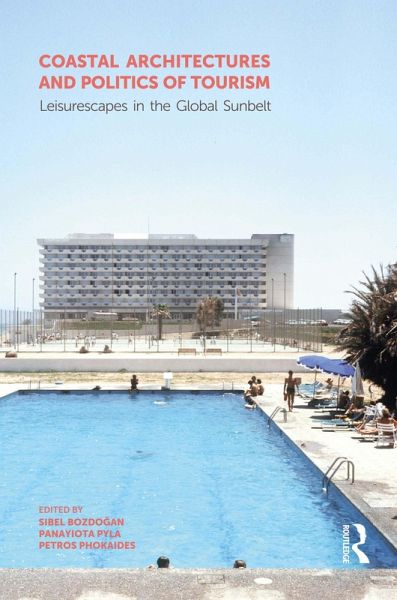
This volume offers a critical and complicated picture of how leisure tourism connected the world after the World War II, transforming coastal lands, traditional societies, and national economies in new ways.
The 21 chapters in this book analyze selected case studies of architectures and landscapes around the world, contextualizing them within economic geographies of national development, the geopolitics of the Cold War, the legacies of colonialism, and the international dynamics of decolonization. Postwar leisure tourism evokes a rich array of architectural spaces and altered coastal landscapes, which is explored in this collection through discussions of tourism developments in the Mediterranean littoral, such as Greece, Turkey, and southern France, as well as compelling analyses of Soviet bloc seaside resorts along the Black Sea and Baltic coasts, and in beachscapes and tourism architectures of western and eastern hemispheres, from Southern California to Sri Lanka, South Korea, and Egypt.
This collection makes a compelling argument that "leisurescapes," far from being supra-ideological and apolitical spatial expressions of modernization, development, and progress, have often concealed histories of conflict, violence, social inequalities, and environmental degradation. It will be of interest to architectural and urban historians, architects and planners, as well as urban geographers, economic and environmental historians.
The 21 chapters in this book analyze selected case studies of architectures and landscapes around the world, contextualizing them within economic geographies of national development, the geopolitics of the Cold War, the legacies of colonialism, and the international dynamics of decolonization. Postwar leisure tourism evokes a rich array of architectural spaces and altered coastal landscapes, which is explored in this collection through discussions of tourism developments in the Mediterranean littoral, such as Greece, Turkey, and southern France, as well as compelling analyses of Soviet bloc seaside resorts along the Black Sea and Baltic coasts, and in beachscapes and tourism architectures of western and eastern hemispheres, from Southern California to Sri Lanka, South Korea, and Egypt.
This collection makes a compelling argument that "leisurescapes," far from being supra-ideological and apolitical spatial expressions of modernization, development, and progress, have often concealed histories of conflict, violence, social inequalities, and environmental degradation. It will be of interest to architectural and urban historians, architects and planners, as well as urban geographers, economic and environmental historians.
Dieser Download kann aus rechtlichen Gründen nur mit Rechnungsadresse in A, B, BG, CY, CZ, D, DK, EW, E, FIN, F, GR, HR, H, IRL, I, LT, L, LR, M, NL, PL, P, R, S, SLO, SK ausgeliefert werden.
"This book is an outstanding collaboration with unforeseen innovations. On the one hand, it is a unique global history of the Cold-War that follows the path of the sun-belt from the Caribbean to Mediterranean, Black Sea and Indian Ocean. On the other hand, it demonstrates the architecture of tourism in all its complexity. Reading the essays together, we understand how building hotels and going on vacation could be a political act against austerity impositions or an infrastructure to lure investors; a rebellion against former colonizers or a settler colonial violence that dispossessed indigenous habitants; a force that globalized western bourgeois standards or an impetus for an identifiable local aesthetic; a cultural tranquilizer or a declaration of the right to rest; a competition with oil industry or a policy to occupy countries with oil-dependent highway networks."
Esra Akcan, Author of Architecture in Translation; Turkey: Modern Architectures in History (with S. Bozdogan); Open Architecture and Abolish Human Bans.
"Sun, sea and sand, the token features of leisurely holidays, represent much more than just the bounty of nature. The sunbelt came into being as a result of geopolitical forces, architectural formations and socio-economic evolutions, which produced not only beach resorts but also political tensions, racial hierarchies and environmental degradation. Built on detailed case studies, this volume offers a thorough analysis of the phenomenon."
Hilde Heynen, University of Leuven, Belgium
"A highly innovative book that expands our understanding of the role played by modern architecture in shaping the contours of the post WWII geopolitical arena. This collection is a a must read for anyone interested in not only the global history of modernism, but also how its scale and materiality allowed for new ways of imagining and managing power, modes which are still very much in play in the emerging politics of global climate change and pandemics."
Ijlal Muzaffar, Associate Professor of Modern Architecture, Rhode Island School of Design
Esra Akcan, Author of Architecture in Translation; Turkey: Modern Architectures in History (with S. Bozdogan); Open Architecture and Abolish Human Bans.
"Sun, sea and sand, the token features of leisurely holidays, represent much more than just the bounty of nature. The sunbelt came into being as a result of geopolitical forces, architectural formations and socio-economic evolutions, which produced not only beach resorts but also political tensions, racial hierarchies and environmental degradation. Built on detailed case studies, this volume offers a thorough analysis of the phenomenon."
Hilde Heynen, University of Leuven, Belgium
"A highly innovative book that expands our understanding of the role played by modern architecture in shaping the contours of the post WWII geopolitical arena. This collection is a a must read for anyone interested in not only the global history of modernism, but also how its scale and materiality allowed for new ways of imagining and managing power, modes which are still very much in play in the emerging politics of global climate change and pandemics."
Ijlal Muzaffar, Associate Professor of Modern Architecture, Rhode Island School of Design