43,95 €
43,95 €
inkl. MwSt.
Sofort per Download lieferbar

22 °P sammeln
43,95 €
Als Download kaufen
43,95 €
inkl. MwSt.
Sofort per Download lieferbar
22 °P sammeln
Jetzt verschenken
Alle Infos zum eBook verschenken
43,95 €
inkl. MwSt.
Sofort per Download lieferbar
Alle Infos zum eBook verschenken
22 °P sammeln

Andere Kunden interessierten sich auch für
") Cultural Competency for Emergency and Crisis Management (eBook, ePUB)43,95 €
Cultural Competency for Emergency and Crisis Management (eBook, ePUB)43,95 €") Service-Learning for Disaster Resilience (eBook, ePUB)39,95 €
Service-Learning for Disaster Resilience (eBook, ePUB)39,95 €") Building Resilient Energy Systems (eBook, ePUB)32,95 €
Building Resilient Energy Systems (eBook, ePUB)32,95 €") Introduction to Emergency Management and Disaster Science (eBook, ePUB)57,95 €
Introduction to Emergency Management and Disaster Science (eBook, ePUB)57,95 €") Disaster Recovery (eBook, ePUB)67,95 €
Disaster Recovery (eBook, ePUB)67,95 €") Preventing Nuclear War (eBook, ePUB)41,95 €
Preventing Nuclear War (eBook, ePUB)41,95 €") Fighting With FEMA (eBook, ePUB)97,95 €
Fighting With FEMA (eBook, ePUB)97,95 €





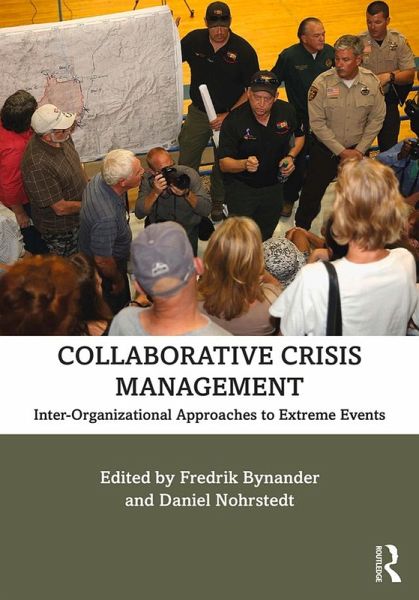
Public organizations are increasingly expected to cope with crisis under the same resource constraints and mandates that make up their normal routines, reinforced only through collaboration. Collaborative Crisis Management introduces readers to how collaboration shapes societies' capacity to plan for, respond to, and recover from extreme and unscheduled events.
Placing emphasis on five conceptual dimensions, this book teaches students how this panacea works out on the ground and in the boardrooms, and how insights on collaborative practices can shed light on the outcomes of complex inter-organizational challenges across cases derived from different problem areas, administrative cultures, and national systems. Written in a concise, accessible style by experienced teachers and scholars, it places modes of collaboration under an analytical microscope by assessing not only the collaborative tools available to actors but also how they are used, to what effect, and with which adaptive capacity. Ten empirical chapters span different international cases and contexts discussing:
Collaborative Crisis Management is essential reading for those involved in researching and teaching crisis management.
Placing emphasis on five conceptual dimensions, this book teaches students how this panacea works out on the ground and in the boardrooms, and how insights on collaborative practices can shed light on the outcomes of complex inter-organizational challenges across cases derived from different problem areas, administrative cultures, and national systems. Written in a concise, accessible style by experienced teachers and scholars, it places modes of collaboration under an analytical microscope by assessing not only the collaborative tools available to actors but also how they are used, to what effect, and with which adaptive capacity. Ten empirical chapters span different international cases and contexts discussing:
- Natural and "man-made" hazards: earthquakes, hurricanes, wildfires, terrorism, migration flows, and violent protests
- Different examples of collaborative institutions, such as regional economic communities in Africa, and multi-level arrangements in Canada, the Netherlands, Turkey, and Switzerland
- Application of a multimethod approach, including single case studies, comparative case studies, process-tracing, and "large-n" designs.
Collaborative Crisis Management is essential reading for those involved in researching and teaching crisis management.
Dieser Download kann aus rechtlichen Gründen nur mit Rechnungsadresse in A, B, BG, CY, CZ, D, DK, EW, E, FIN, F, GR, HR, H, IRL, I, LT, L, LR, M, NL, PL, P, R, S, SLO, SK ausgeliefert werden.