40,95 €
inkl. MwSt.
Sofort per Download lieferbar
20 °P sammeln

Andere Kunden interessierten sich auch für
") ECOOP - Object-Oriented Programming (eBook, PDF)72,95 €
ECOOP - Object-Oriented Programming (eBook, PDF)72,95 €") Early Aspects: Current Challenges and Future Directions (eBook, PDF)40,95 €
Early Aspects: Current Challenges and Future Directions (eBook, PDF)40,95 €") Fundamental Approaches to Software Engineering (eBook, PDF)40,95 €
Fundamental Approaches to Software Engineering (eBook, PDF)40,95 €") Transactions on Aspect-Oriented Software Development II (eBook, PDF)40,95 €
Transactions on Aspect-Oriented Software Development II (eBook, PDF)40,95 €") Object-Oriented Application Development Using the Caché Postrelational Database (eBook, PDF)40,95 €
Object-Oriented Application Development Using the Caché Postrelational Database (eBook, PDF)40,95 €") Software Composition (eBook, PDF)40,95 €
Software Composition (eBook, PDF)40,95 €") FM 2005: Formal Methods (eBook, PDF)40,95 €
FM 2005: Formal Methods (eBook, PDF)40,95 €




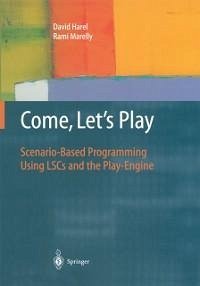
The play-in/play-out method and tool presented in this book is a powerful new approach to software and systems engineering and modeling based on formal methods and program semantics. The life sequence charts (LSC) as the language of this approach generalize the message sequence charts of UML and are presented in this book for the first time in a coherent and systematic way.
The method described is fascinating from the scientific point of view. The associated play-engine tool available from the authors' Web site has broad appeal to professionals in software engineering, systems engineering, and modeling and simulation.
The method described is fascinating from the scientific point of view. The associated play-engine tool available from the authors' Web site has broad appeal to professionals in software engineering, systems engineering, and modeling and simulation.
Dieser Download kann aus rechtlichen Gründen nur mit Rechnungsadresse in A, B, BG, CY, CZ, D, DK, EW, E, FIN, F, GR, HR, H, IRL, I, LT, L, LR, M, NL, PL, P, R, S, SLO, SK ausgeliefert werden.
"The design of reactive systems is one of the most challenging problems in computer science. This books starts with a critical insight to explain the difficulty of this problem: there is a fundamental gap between the scenario-based way in which people think about such systems and the state-based way in which these systems are implemented. The book then offers a radical proposal to bridge this gap by means of playing scenarios. Systems can be specified by playing in scenarios and implemented by means of a Play-Engine that plays out scenarios. This idea is carried out and developed, lucidly, formally and playfully, to its fullest. The result is a compelling proposal, accompanied by a prototype software engine, for reactive systems design, which is bound to cause a splash in the software-engineering community." -- Moshe Y. Vardi, Rice University, Houston, Texas, USA
"Scenarios are a primary exchange tool in explaining system behavior to others, but their limited expressive power never made them able to fully describe systems, thus limiting their use. The language of Live Sequence Charts (LSCs) presented in this beautifully written book achieves this goal, and the attached Play-Engine software makes these LSCs really come alive. This is undoubtedly a key breakthrough that will start long-awaited and exciting new directions in systems specification, synthesis, and analysis." -- Gérard Berry, Esterel Technologies and INRIA, Sophia-Antipolis, France
"The approach of David Harel and Rami Marelly is a fascinating way of combining prototyping techniques with techniques for identifying behavior and user interfaces." -- Manfred Broy, Technical University of Munich, Germany
"Scenarios are a primary exchange tool in explaining system behavior to others, but their limited expressive power never made them able to fully describe systems, thus limiting their use. The language of Live Sequence Charts (LSCs) presented in this beautifully written book achieves this goal, and the attached Play-Engine software makes these LSCs really come alive. This is undoubtedly a key breakthrough that will start long-awaited and exciting new directions in systems specification, synthesis, and analysis." -- Gérard Berry, Esterel Technologies and INRIA, Sophia-Antipolis, France
"The approach of David Harel and Rami Marelly is a fascinating way of combining prototyping techniques with techniques for identifying behavior and user interfaces." -- Manfred Broy, Technical University of Munich, Germany
The design of reactive systems is one of the most challenging problems in computer science. This books starts with a critical insight to explain the difficulty of this problem: there is a fundamental gap between the scenario-based way in which people think about such systems and the state-based way in which these systems are implemented. The book then offers a radical proposal to bridge this gap by means of playing scenarios. Systems can be specified by playing in scenarios and implemented by means of a Play-Engine that plays out scenarios. This idea is carried out and developed, lucidly, formally and playfully, to its fullest. The result is a compelling proposal, accompanied by a prototype software engine, for reactive systems design, which is bound to cause a splash in the software-engineering community. Moshe Y. Vardi, Rice University, Houston, Texas, USA
Scenarios are a primary exchange tool in explaining system behavior to others, but their limited expressive power never made them able to fully describe systems, thus limiting their use. The language of Live Sequence Charts (LSCs) presented in this beautifully written book achieves this goal, and the attached Play-Engine software makes these LSCs really come alive. This is undoubtedly a key breakthrough that will start long-awaited and exciting new directions in systems specification, synthesis, and analysis. Gérard Berry, Esterel Technologies and INRIA, Sophia-Antipolis, France
The approach of David Harel and Rami Marelly is a fascinating way of combining prototyping techniques with techniques for identifying behavior and user interfaces. Manfred Broy, Technical University of Munich, Germany
Scenarios are a primary exchange tool in explaining system behavior to others, but their limited expressive power never made them able to fully describe systems, thus limiting their use. The language of Live Sequence Charts (LSCs) presented in this beautifully written book achieves this goal, and the attached Play-Engine software makes these LSCs really come alive. This is undoubtedly a key breakthrough that will start long-awaited and exciting new directions in systems specification, synthesis, and analysis. Gérard Berry, Esterel Technologies and INRIA, Sophia-Antipolis, France
The approach of David Harel and Rami Marelly is a fascinating way of combining prototyping techniques with techniques for identifying behavior and user interfaces. Manfred Broy, Technical University of Munich, Germany
The design of reactive systems is one of the most challenging problems in computer science. This books starts with a critical insight to explain the difficulty of this problem: there is a fundamental gap between the scenario-based way in which people think about such systems and the state-based way in which these systems are implemented. The book then offers a radical proposal to bridge this gap by means of playing scenarios. Systems can be specified by playing in scenarios and implemented by means of a Play-Engine that plays out scenarios. This idea is carried out and developed, lucidly, formally and playfully, to its fullest. The result is a compelling proposal, accompanied by a prototype software engine, for reactive systems design, which is bound to cause a splash in the software-engineering community. Moshe Y. Vardi, Rice University, Houston, Texas, USA
Scenarios are a primary exchange tool in explaining system behavior to others, but their limited expressive power never made them able to fully describe systems, thus limiting their use. The language of Live Sequence Charts (LSCs) presented in this beautifully written book achieves this goal, and the attached Play-Engine software makes these LSCs really come alive. This is undoubtedly a key breakthrough that will start long-awaited and exciting new directions in systems specification, synthesis, and analysis. Gérard Berry, Esterel Technologies and INRIA, Sophia-Antipolis, France
The approach of David Harel and Rami Marelly is a fascinating way of combining prototyping techniques with techniques for identifying behavior and user interfaces. Manfred Broy, Technical University of Munich, Germany
Scenarios are a primary exchange tool in explaining system behavior to others, but their limited expressive power never made them able to fully describe systems, thus limiting their use. The language of Live Sequence Charts (LSCs) presented in this beautifully written book achieves this goal, and the attached Play-Engine software makes these LSCs really come alive. This is undoubtedly a key breakthrough that will start long-awaited and exciting new directions in systems specification, synthesis, and analysis. Gérard Berry, Esterel Technologies and INRIA, Sophia-Antipolis, France
The approach of David Harel and Rami Marelly is a fascinating way of combining prototyping techniques with techniques for identifying behavior and user interfaces. Manfred Broy, Technical University of Munich, Germany