11,95 €
inkl. MwSt.
Sofort per Download lieferbar
6 °P sammeln

Andere Kunden interessierten sich auch für
") The Commander-in-Chief Test (eBook, ePUB)22,95 €
The Commander-in-Chief Test (eBook, ePUB)22,95 €") Unfit Commander (eBook, ePUB)13,99 €
Unfit Commander (eBook, ePUB)13,99 € (eBook, ePUB)") Commander in Chief (Presidents of the United States, #2) (eBook, ePUB)0,00 €
Commander in Chief (Presidents of the United States, #2) (eBook, ePUB)0,00 €") Commander in Chief (eBook, ePUB)5,99 €
Commander in Chief (eBook, ePUB)5,99 €") Fan in Chief (eBook, ePUB)22,95 €
Fan in Chief (eBook, ePUB)22,95 €") Moms in Chief (eBook, ePUB)40,95 €
Moms in Chief (eBook, ePUB)40,95 €") Author in Chief (eBook, ePUB)13,84 €
Author in Chief (eBook, ePUB)13,84 €




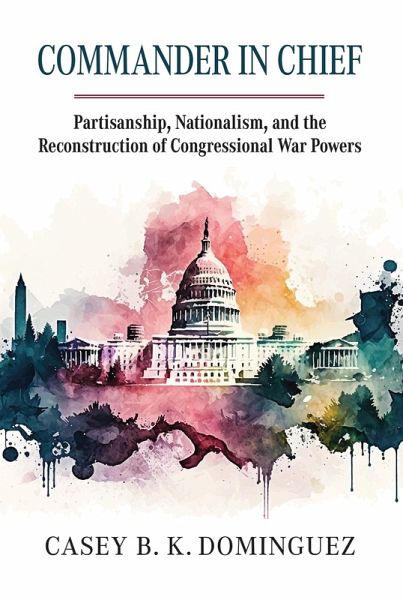
The constitutional balance of war powers has shifted from Congress to the president over time. Today, presidents broadly define their constitutional authority as commander in chief. In the nineteenth century, however, Congress was the institution that claimed and defended expansive war powers authority. This discrepancy raises important questions: How, specifically, did Congress define the boundaries between presidential and congressional war powers in the early republic? Did that definition change, and if so, when, how, and why did it do so?
Based on an original, comprehensive dataset of every congressional reference to the commander-in-chief clause from the Founding through 1917, Casey Dominguez's Commander in Chief systematically analyzes the authority that members of Congress ascribe to the president as commander in chief and the boundaries they put around that authority.
Dominguez shows that for more than a century members of Congress defined the commander in chief's authority narrowly, similar to that of any high-ranking military officer. But in a wave of nationalism during the Spanish-American War, members of Congress began to argue that Congress owed deference to the commander in chief. They also tended to argue that a president of their own party should have broad war powers, while the powers of a president in the other party should be defined narrowly. Together, these two dynamics suggest that the conditions for presidentially dominated modern constitutional war powers were set at the turn of the twentieth century, far earlier than is often acknowledged.
Based on an original, comprehensive dataset of every congressional reference to the commander-in-chief clause from the Founding through 1917, Casey Dominguez's Commander in Chief systematically analyzes the authority that members of Congress ascribe to the president as commander in chief and the boundaries they put around that authority.
Dominguez shows that for more than a century members of Congress defined the commander in chief's authority narrowly, similar to that of any high-ranking military officer. But in a wave of nationalism during the Spanish-American War, members of Congress began to argue that Congress owed deference to the commander in chief. They also tended to argue that a president of their own party should have broad war powers, while the powers of a president in the other party should be defined narrowly. Together, these two dynamics suggest that the conditions for presidentially dominated modern constitutional war powers were set at the turn of the twentieth century, far earlier than is often acknowledged.
Dieser Download kann aus rechtlichen Gründen nur mit Rechnungsadresse in A, D ausgeliefert werden.