Sie sind bereits eingeloggt. Klicken Sie auf 2. tolino select Abo, um fortzufahren.
Bitte loggen Sie sich zunächst in Ihr Kundenkonto ein oder registrieren Sie sich bei bücher.de, um das eBook-Abo tolino select nutzen zu können.
In Communicated Stereotypes at Work , the editors and contributors posit that stereotypes communicated in the workplace remain a pervasive issue due to the dichotomy between the discriminatory and functional roles that these stereotypes can play in a range of professional settings. Contributors demonstrate that while the use of stereotypes in the workplace is distasteful and exclusionary, communicating these stereotypes can also appear-on the surface-to provide a pathway toward bonding with others, giving advice, and reducing uncertainty. The result of this dichotomy is that those who…mehr
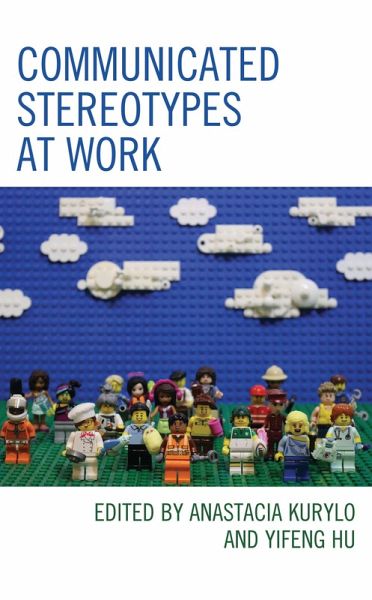
In Communicated Stereotypes at Work, the editors and contributors posit that stereotypes communicated in the workplace remain a pervasive issue due to the dichotomy between the discriminatory and functional roles that these stereotypes can play in a range of professional settings. Contributors demonstrate that while the use of stereotypes in the workplace is distasteful and exclusionary, communicating these stereotypes can also appear-on the surface-to provide a pathway toward bonding with others, giving advice, and reducing uncertainty. The result of this dichotomy is that those who communicate stereotypes in the workplace may not view this communication from themselves or others as being problematic. With an emphasis on qualitative methods and analyses, contributors deconstruct stereotypes by exploring the theoretical, empirical, and pragmatic roles they play in communication. In doing so, authors expose the underpinnings of stereotypes and why they are communicated, focus on the role all of us play in perpetuating stereotypes, and suggest alternative modes of productive discourse. Scholars of interpersonal and organizational communication, cultural studies, and sociology as well as practitioners of various professions will find this book particularly useful.
Die Herstellerinformationen sind derzeit nicht verfügbar.
Autorenporträt
Anastacia Kurylo is adjunct assistant professor of communication at Brooklyn College. Yifeng Hu is associate professor of communication studies at The College of New Jersey.
Inhaltsangabe
Chapter 1: Introduction Part I: Education Institutions Chapter 2: Calling In and Calling Out: Human Resource DEI Strategies and Interpersonally Communicated Stereotypes in Academic Settings by Anastacia Kurylo and Karthi Veeramani Chapter 3: Dirty, Dumb, and Inarticulate: Communicating Stereotypes in Janitorial Work by Wilfredo Alvarez Chapter 4: Stereotypes and Subtle Slights: Exploring Microaggressive Behavior as a Barrier to Inclusive Library Services by Marie L. Radford Chapter 5: The 'Typical Black Woman' and the Rhetoric of Diversity, Equity, and Inclusion: Stereotyping as the Status Quo by D. L. Stephenson Chapter 6: New Red Scare: The China Initiative by Steven Pei, Jeremy Wu, and Alex Liang Part II: Civil and Public Service Organizations Chapter 7: "I Don't Want to Work with Her Anyway Because She's Some Asian": Racially Stereotyping Asian American Healthcare Providers During the COVID-19 Pandemic by Yifeng Hu and Vincent Pham Chapter 8: Kamala Harris: A Case of Identity Negotiation and Respectability Politics for Black Female Politicians in the Race-Conscious U.S. by Tina M. Harris and Meghan S. Sanders Chapter 9: Police Stereotypes: How Social Status Shapes our Communication by Shawn L. Hill and Howard Giles Chapter 10: Stereotypes in Conducting Interactional Disputes in Civil Service Contexts by Jessica S. Robles and Jack. B. Joyce Chapter 11: Doctors, Patients, and Stereotypes by Alice B. Krueger Part III: The Media and Entertainment Industry Chapter 12: Sword with a Dual Edge: Membership Categorization and Stereotyping in Elite European Club Football Commentary by Alan Hansen and Trudy Milburn Chapter 13: Humor Theory and Gender Stereotypes: Disparagement as a Dominant Mode of Humor in U.S. Sitcoms by Koji Fuse and Leah E. Waters Chapter 14: "Hell, he was even more punk than me!": Stereotypes Communicated in Punk Music Scenes by Brian Cogan Chapter 15: Carrying Stereotypes in the Virtual World: Creating Understanding Through the Experience of Intersectional Avatar Identity Among People with Disability by Donna Davis and Sumita Louis Part IV: Private Business Entities Chapter 16: The Oldest Japanese American Family Mortuary: Stereotypes Situated from World War II, the Pandemic, and Beyond by Precious Yamaguchi Chapter 17: Manufacturing Limitations: Stereotypes of Chinese and American Workers in American Factory by Alberto González, Xinxin Jiang, and Amanda Grace Taylor Chapter 18: Effective Use of Stereotypes by Japanese Businesswomen: A Story of Japanese Women Who are No Longer "Madame Butterfly" by Nobutake Matsushita Chapter 19: "It's a Design God Built": Gender Essentialism and Organizational Identification in an Evangelical Church by Mark Ward Sr. Chapter 20: "There Is No Room for You Here": Stereotypes of Racists and Anti-Racists on Starbucks' Public Facebook Page by Tabitha Hart and Deanna L. Fassett
Es gelten unsere Allgemeinen Geschäftsbedingungen: www.buecher.de/agb
Impressum
www.buecher.de ist ein Internetauftritt der buecher.de internetstores GmbH
Geschäftsführung: Monica Sawhney | Roland Kölbl | Günter Hilger
Sitz der Gesellschaft: Batheyer Straße 115 - 117, 58099 Hagen
Postanschrift: Bürgermeister-Wegele-Str. 12, 86167 Augsburg
Amtsgericht Hagen HRB 13257
Steuernummer: 321/5800/1497
USt-IdNr: DE450055826