47,95 €
47,95 €
inkl. MwSt.
Sofort per Download lieferbar

24 °P sammeln
47,95 €
Als Download kaufen
47,95 €
inkl. MwSt.
Sofort per Download lieferbar
24 °P sammeln
Jetzt verschenken
Alle Infos zum eBook verschenken
47,95 €
inkl. MwSt.
Sofort per Download lieferbar
Alle Infos zum eBook verschenken
24 °P sammeln

Andere Kunden interessierten sich auch für
") Biodiversity, Access and Benefit-Sharing (eBook, PDF)47,95 €
Biodiversity, Access and Benefit-Sharing (eBook, PDF)47,95 €") Balancing the Commons in Switzerland (eBook, PDF)0,00 €
Balancing the Commons in Switzerland (eBook, PDF)0,00 €") Adaptive Collaborative Management in Forest Landscapes (eBook, PDF)0,00 €
Adaptive Collaborative Management in Forest Landscapes (eBook, PDF)0,00 €") Managing Forests as Complex Adaptive Systems (eBook, PDF)51,95 €
Managing Forests as Complex Adaptive Systems (eBook, PDF)51,95 €") Just Conservation (eBook, PDF)43,95 €
Just Conservation (eBook, PDF)43,95 €") Creating Resilient Landscapes in an Era of Climate Change (eBook, PDF)0,00 €
Creating Resilient Landscapes in an Era of Climate Change (eBook, PDF)0,00 €") UNESCO Biosphere Reserves (eBook, PDF)49,95 €
UNESCO Biosphere Reserves (eBook, PDF)49,95 €





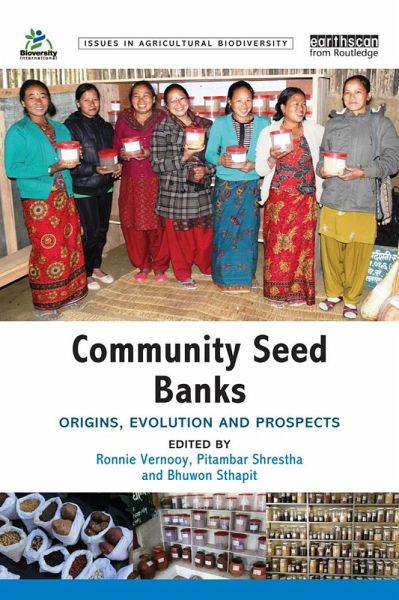
Community seed banks first appeared towards the end of the 1980s, established with the support of international and national non-governmental organizations. This book is the first to provide a global review of their development and includes a wide range of case studies.
Countries that pioneered various types of community seed banks include Bangladesh, Brazil, Ethiopia, India, Nepal, Nicaragua, the Philippines and Zimbabwe. In the North, a particular type of community seed bank emerged known as a seed-savers network. Such networks were first established in Australia, Canada, the UK and the USA before spreading to other countries. Over time, the number and diversity of seed banks has grown. In Nepal, for example, there are now more than 100 self-described community seed banks whose functions range from pure conservation to commercial seed production. In Brazil, community seed banks operate in various regions of the country.
Surprisingly, despite 25 years of history and the rapid growth in number, organizational diversity and geographical coverage of community seed banks, recognition of their roles and contributions has remained scanty. The book reviews their history, evolution, experiences, successes and failures (and reasons why), challenges and prospects. It fills a significant gap in the literature on agricultural biodiversity and conservation, and their contribution to food sovereignty and security.
Countries that pioneered various types of community seed banks include Bangladesh, Brazil, Ethiopia, India, Nepal, Nicaragua, the Philippines and Zimbabwe. In the North, a particular type of community seed bank emerged known as a seed-savers network. Such networks were first established in Australia, Canada, the UK and the USA before spreading to other countries. Over time, the number and diversity of seed banks has grown. In Nepal, for example, there are now more than 100 self-described community seed banks whose functions range from pure conservation to commercial seed production. In Brazil, community seed banks operate in various regions of the country.
Surprisingly, despite 25 years of history and the rapid growth in number, organizational diversity and geographical coverage of community seed banks, recognition of their roles and contributions has remained scanty. The book reviews their history, evolution, experiences, successes and failures (and reasons why), challenges and prospects. It fills a significant gap in the literature on agricultural biodiversity and conservation, and their contribution to food sovereignty and security.
Dieser Download kann aus rechtlichen Gründen nur mit Rechnungsadresse in A, B, BG, CY, CZ, D, DK, EW, E, FIN, F, GR, HR, H, IRL, I, LT, L, LR, M, NL, PL, P, R, S, SLO, SK ausgeliefert werden.