36,99 €
36,99 €
inkl. MwSt.
Sofort per Download lieferbar

0 °P sammeln
36,99 €
Als Download kaufen
36,99 €
inkl. MwSt.
Sofort per Download lieferbar
0 °P sammeln
Jetzt verschenken
Alle Infos zum eBook verschenken
36,99 €
inkl. MwSt.
Sofort per Download lieferbar
Alle Infos zum eBook verschenken
0 °P sammeln

Andere Kunden interessierten sich auch für
") The Finnish Education Mystery (eBook, PDF)44,95 €
The Finnish Education Mystery (eBook, PDF)44,95 €") Effective Schools in Developing Countries (eBook, PDF)49,95 €
Effective Schools in Developing Countries (eBook, PDF)49,95 €") Globalisation and Teacher Education in the BRICS Countries (eBook, PDF)41,95 €
Globalisation and Teacher Education in the BRICS Countries (eBook, PDF)41,95 €") School and Community in Less Developed Areas (eBook, PDF)52,95 €
School and Community in Less Developed Areas (eBook, PDF)52,95 €") Entrepreneurship Education and Pedagogy in Central and Eastern European Countries (eBook, PDF)38,95 €
Entrepreneurship Education and Pedagogy in Central and Eastern European Countries (eBook, PDF)38,95 €") Faculty Development in Developing Countries (eBook, PDF)35,95 €
Faculty Development in Developing Countries (eBook, PDF)35,95 €") Open and Distance Non-formal Education in Developing Countries (eBook, PDF)40,95 €
Open and Distance Non-formal Education in Developing Countries (eBook, PDF)40,95 €






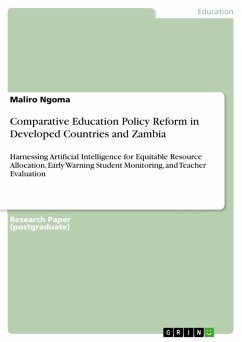
Research Paper (postgraduate) from the year 2025 in the subject Pedagogy / Educational Science, , course: Education Management and Administration, language: English, abstract: This study offers a comparative, mixed methods investigation into how artificial intelligence (AI) can strengthen data informed decision making across three core administrative domains which include: resource allocation, student early warning systems, and teacher evaluation under contrasting policy regimes. By juxtaposing reform trajectories and governance practices in selected developed countries with Zambia's policy context, the research evaluates technical performance, fairness trade offs, and institutional readiness. The empirical core comprises AI prototype development and fairness audits in Zambian partner institutions, complemented by comparative policy analysis and stakeholder interviews in developed country cases. The thesis integrates quantitative model evaluation (discrimination, calibration, lead time, and subgroup fairness), prescriptive optimisation scenarios for equitable resource distribution, and qualitative process tracing of governance, legitimacy, and capacity. Outcomes include evidence on where AI improves administrative outcomes, a tested governance playbook for responsible deployment in low resource settings, and policy recommendations that reconcile technical trade offs with normative choices about equity and accountability.
Dieser Download kann aus rechtlichen Gründen nur mit Rechnungsadresse in A, B, BG, CY, CZ, D, DK, EW, E, FIN, F, GR, HR, H, IRL, I, LT, L, LR, M, NL, PL, P, R, S, SLO, SK ausgeliefert werden.