Sie sind bereits eingeloggt. Klicken Sie auf 2. tolino select Abo, um fortzufahren.
Bitte loggen Sie sich zunächst in Ihr Kundenkonto ein oder registrieren Sie sich bei bücher.de, um das eBook-Abo tolino select nutzen zu können.
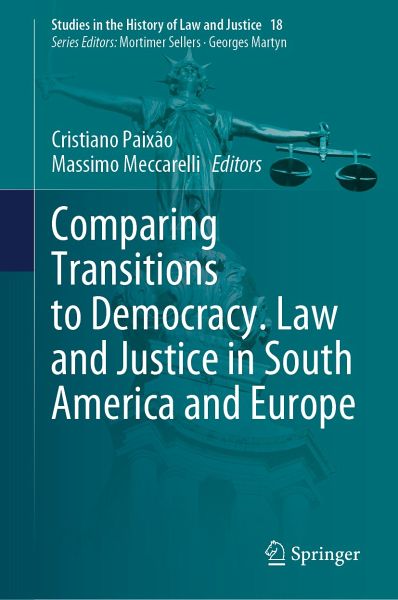
Presents the role of law and legal mechanisms in the transition Describes the role of legal actors and institutions during transition Outlines a comparative perspective on legal consequences of political transition
Presents the role of law and legal mechanisms in the transition
Describes the role of legal actors and institutions during transition
Outlines a comparative perspective on legal consequences of political transition
Dieser Download kann aus rechtlichen Gründen nur mit Rechnungsadresse in A, B, BG, CY, CZ, D, DK, EW, E, FIN, F, GR, HR, H, IRL, I, LT, L, LR, M, NL, PL, P, R, S, SLO, SK ausgeliefert werden.
Die Herstellerinformationen sind derzeit nicht verfügbar.
Autorenporträt
Cristiano Paixão in Professor of legal history at the University of Brasília Law School. Doctor in Law degree from Federal University of Minas Gerais, with post-doctoral studies in historiography at Ecole des Hautes Etudes en Sciences Sociales de Paris and in modern history at Scuola Normale Superiore di Pisa. He was a visiting professor at Macerata University School of Law and at the Master's Program in Constitutional Law at Seville University, and has published extensively about constitutional history. He was a member of the Brazilian Amnesty Committee (Ministry of Justice), was one of the coordinators of the Anísio Teixeira Memory and Truth Commission (University of Brasília). His main research interests are constitutional history, law and literature, and interdisciplinary studies in law. Massimo Meccarelli is Professor of Legal History at the University of Macerata (Italy), and affiliate researcher of the Max Planck Institute for European Legal History(Frankfurt am Main). He was visiting professor at: Universidad Autónoma de Madrid, Johann Wolfgang Goethe-Universität in Frankfurt am Main, Universität Wien, Universität Luzern. He is author of several works on history of legal thought, history of justice, historiography and methodology of legal history. Most recently research interests: law and diversity, legal pluralism, constitution making process, time and law, law and humanities.
Inhaltsangabe
Part 1: Brazil.- Chapter 1 Constitutional History and Transitional Justice in Contemporary Brazil: Towards a Politics of Time; Cristiano Paixão.- Chapter 2 Constitutional Politics during the Brazilian Civil-military Dictatorship and the Transition: the Constitution as a Tool for Political Reform; Leonardo Barbosa.- Chapter 3 Social Conflict and the Brazilian Transacted Transition: the Criminal Case n. 453/8; Maria Pia Guerra.- Chapter 4 Transitional Justice and Violation of the Indian Rights during the Brazilian Dictatorship (1964-1985); Juliana Neuenschwander Magalhães.- Part 2: Comparative Perspectives.- Chapter 5 Claudia Paiva Carvalho.- Chapter 6 Domestic Rule of Law Gaps and the Uses of International Human Rights in Post-Atrocity Prosecutions: Argentina, Brazil, and Chile Transitional Justice Experiences; Marcelo Torelly.- Chapter 7 Accountability for Operation Condor Atrocities: the Enduring Search for Truth and Justice in the Southern Cone and Brazil; Francesca Lessa.- Part 3: Comparative Case Studies.- Chapter 8 Lawyers and Transition in Chile; Cath Collins.- Chapter 9 The Protagonism of Judicial System in the Argentinian Transition; Valeria Barbuto.- Chapter 10 Truth and Justice or Legal Oblivion? Transitional Justice and Remembrance of Francoism in Spain; Alfons Aragoneses.- Chapter 11 The Failed Reconciliation. The "Togliatti Amnesty" and the role of the Judiciary in the Post-fascist Italy; Antonella Meniconi.- Chapter 12 Revolutionary and Democratic Legitimacy during Portugal's Transitional Justice Process; António Costa Pinto, Filipa Raimundo.- Part 4: Transitional Time: Theoretical Approaches.- Chapter 13 A verdade é filha do tempo" and "O costume é como que uma outra natureza". The Creative Nature of the Legal Tradition; Antonio Manuel Hespanha.- Chapter 14 Ascriptive Times in the Legal Experience: Transition, Crisis, Emergenc; Massimo Meccarelli.- Chapter 15 Action Times and Time Actions: Between Justice and History; José Otávio Guimarães.
Part 1: Brazil.- Chapter 1 Constitutional History and Transitional Justice in Contemporary Brazil: Towards a Politics of Time; Cristiano Paixão.- Chapter 2 Constitutional Politics during the Brazilian Civil-military Dictatorship and the Transition: the Constitution as a Tool for Political Reform; Leonardo Barbosa.- Chapter 3 Social Conflict and the Brazilian Transacted Transition: the Criminal Case n. 453/8; Maria Pia Guerra.- Chapter 4 Transitional Justice and Violation of the Indian Rights during the Brazilian Dictatorship (1964-1985); Juliana Neuenschwander Magalhães.- Part 2: Comparative Perspectives.- Chapter 5 Claudia Paiva Carvalho.- Chapter 6 Domestic Rule of Law Gaps and the Uses of International Human Rights in Post-Atrocity Prosecutions: Argentina, Brazil, and Chile Transitional Justice Experiences; Marcelo Torelly.- Chapter 7 Accountability for Operation Condor Atrocities: the Enduring Search for Truth and Justice in the Southern Cone and Brazil; Francesca Lessa.- Part 3: Comparative Case Studies.- Chapter 8 Lawyers and Transition in Chile; Cath Collins.- Chapter 9 The Protagonism of Judicial System in the Argentinian Transition; Valeria Barbuto.- Chapter 10 Truth and Justice or Legal Oblivion? Transitional Justice and Remembrance of Francoism in Spain; Alfons Aragoneses.- Chapter 11 The Failed Reconciliation. The "Togliatti Amnesty" and the role of the Judiciary in the Post-fascist Italy; Antonella Meniconi.- Chapter 12 Revolutionary and Democratic Legitimacy during Portugal's Transitional Justice Process; António Costa Pinto, Filipa Raimundo.- Part 4: Transitional Time: Theoretical Approaches.- Chapter 13 A verdade é filha do tempo" and "O costume é como que uma outra natureza". The Creative Nature of the Legal Tradition; Antonio Manuel Hespanha.- Chapter 14 Ascriptive Times in the Legal Experience: Transition, Crisis, Emergenc; Massimo Meccarelli.- Chapter 15 Action Times and Time Actions: Between Justice and History; José Otávio Guimarães.
Es gelten unsere Allgemeinen Geschäftsbedingungen: www.buecher.de/agb
Impressum
www.buecher.de ist ein Internetauftritt der buecher.de internetstores GmbH
Geschäftsführung: Monica Sawhney | Roland Kölbl | Günter Hilger
Sitz der Gesellschaft: Batheyer Straße 115 - 117, 58099 Hagen
Postanschrift: Bürgermeister-Wegele-Str. 12, 86167 Augsburg
Amtsgericht Hagen HRB 13257
Steuernummer: 321/5800/1497
USt-IdNr: DE450055826