36,95 €
36,95 €
inkl. MwSt.
Sofort per Download lieferbar

18 °P sammeln
36,95 €
Als Download kaufen
36,95 €
inkl. MwSt.
Sofort per Download lieferbar
18 °P sammeln
Jetzt verschenken
Alle Infos zum eBook verschenken
36,95 €
inkl. MwSt.
Sofort per Download lieferbar
Alle Infos zum eBook verschenken
18 °P sammeln

Andere Kunden interessierten sich auch für
") Time and the Rhythms of Emancipatory Education (eBook, PDF)0,00 €
Time and the Rhythms of Emancipatory Education (eBook, PDF)0,00 €") Modern Schooling and Trajectories of Exclusion (eBook, PDF)38,95 €
Modern Schooling and Trajectories of Exclusion (eBook, PDF)38,95 €") QuantCrit (eBook, PDF)39,95 €
QuantCrit (eBook, PDF)39,95 €") Teaching Values (eBook, PDF)37,95 €
Teaching Values (eBook, PDF)37,95 €") Not Light, but Fire (eBook, PDF)28,95 €
Not Light, but Fire (eBook, PDF)28,95 €") School Education in India (eBook, PDF)41,95 €
School Education in India (eBook, PDF)41,95 €") Religion, Education, Dialogue and Conflict (eBook, PDF)49,95 €
Religion, Education, Dialogue and Conflict (eBook, PDF)49,95 €
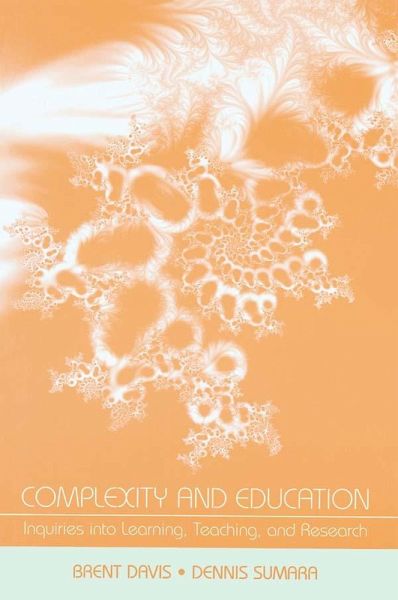
This book explores the contributions, actual and potential, of complexity thinking to educational research and practice. While its focus is on the theoretical premises and the methodology, not specific applications, the aim is pragmatic--to present complexity thinking as an important and appropriate attitude for educators and educational researchers. Part I is concerned with global issues around complexity thinking, as read through an educational lens. Part II cites a diversity of practices and studies that are either explicitly informed by or that might be aligned with complexity research, and offers focused and practiced advice for structuring projects in ways that are consistent with complexity thinking.
Complexity thinking offers a powerful alternative to the linear, reductionist approaches to inquiry that have dominated the sciences for hundreds of years and educational research for more than a century. It has captured the attention of many researchers whose studies reach across traditional disciplinary boundaries to investigate phenomena such as: How does the brain work? What is consciousness? What is intelligence? What is the role of emergent technologies in shaping personalities and possibilities? How do social collectives work? What is knowledge? Complexity research posits that a deep similarity among these phenomena is that each points toward some sort of system that learns. The authors' intent is not to offer a complete account of the relevance of complexity thinking to education, not to prescribe and delimit, but to challenge readers to examine their own assumptions and theoretical commitments--whether anchored by commonsense, classical thought or any of the posts (such as postmodernism, poststructuralism, postcolonialism, postpositivism, postformalism, postepistemology) that mark the edges of current discursive possibility.
Complexity and Education is THE introduction to the emerging field of complexity thinking for the education community. It is specifically relevant for educational researchers, graduate students, and inquiry-oriented teacher practitioners.
Complexity thinking offers a powerful alternative to the linear, reductionist approaches to inquiry that have dominated the sciences for hundreds of years and educational research for more than a century. It has captured the attention of many researchers whose studies reach across traditional disciplinary boundaries to investigate phenomena such as: How does the brain work? What is consciousness? What is intelligence? What is the role of emergent technologies in shaping personalities and possibilities? How do social collectives work? What is knowledge? Complexity research posits that a deep similarity among these phenomena is that each points toward some sort of system that learns. The authors' intent is not to offer a complete account of the relevance of complexity thinking to education, not to prescribe and delimit, but to challenge readers to examine their own assumptions and theoretical commitments--whether anchored by commonsense, classical thought or any of the posts (such as postmodernism, poststructuralism, postcolonialism, postpositivism, postformalism, postepistemology) that mark the edges of current discursive possibility.
Complexity and Education is THE introduction to the emerging field of complexity thinking for the education community. It is specifically relevant for educational researchers, graduate students, and inquiry-oriented teacher practitioners.
Dieser Download kann aus rechtlichen Gründen nur mit Rechnungsadresse in A, B, BG, CY, CZ, D, DK, EW, E, FIN, F, GR, HR, H, IRL, I, LT, L, LR, M, NL, PL, P, R, S, SLO, SK ausgeliefert werden.