175,95 €
175,95 €
inkl. MwSt.
Sofort per Download lieferbar

88 °P sammeln
175,95 €
Als Download kaufen
175,95 €
inkl. MwSt.
Sofort per Download lieferbar
88 °P sammeln
Jetzt verschenken
Alle Infos zum eBook verschenken
175,95 €
inkl. MwSt.
Sofort per Download lieferbar
Alle Infos zum eBook verschenken
88 °P sammeln

Andere Kunden interessierten sich auch für
") Advances and Applications of Artificial Intelligence & Machine Learning (eBook, PDF)191,95 €
Advances and Applications of Artificial Intelligence & Machine Learning (eBook, PDF)191,95 €") Computational History and Data-Driven Humanities (eBook, PDF)40,95 €
Computational History and Data-Driven Humanities (eBook, PDF)40,95 €") Advancements in Machine Learning and Natural Language Processing: Innovations and Applications (eBook, PDF)152,95 €
Advancements in Machine Learning and Natural Language Processing: Innovations and Applications (eBook, PDF)152,95 €") Systems and Frameworks for Computational Morphology (eBook, PDF)40,95 €
Systems and Frameworks for Computational Morphology (eBook, PDF)40,95 €") Modern Approaches in Machine Learning & Cognitive Science: A Walkthrough (eBook, PDF)136,95 €
Modern Approaches in Machine Learning & Cognitive Science: A Walkthrough (eBook, PDF)136,95 €") Procedural Content Generation via Machine Learning (eBook, PDF)32,95 €
Procedural Content Generation via Machine Learning (eBook, PDF)32,95 €") New Trends and Challenges in Information Science and Information Seeking Behaviour (eBook, PDF)96,95 €
New Trends and Challenges in Information Science and Information Seeking Behaviour (eBook, PDF)96,95 €







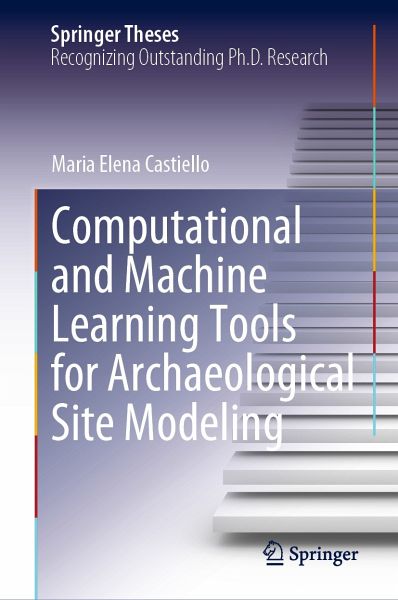
This book describes a novel machine-learning based approach to answer some traditional archaeological problems, relating to archaeological site detection and site locational preferences. Institutional data collected from six Swiss regions (Zurich, Aargau, Grisons, Vaud, Geneva and Fribourg) have been analyzed with an original conceptual framework based on the Random Forest algorithm. It is shown how the algorithm can assist in the modelling process in connection with heterogeneous, incomplete archaeological datasets and related cultural heritage information. Moreover, an in-depth review of past and more recent works of quantitative methods for archaeological predictive modelling is provided. The book guides the readers to set up their own protocol for: i) dealing with uncertain data, ii) predicting archaeological site location, iii) establishing environmental features importance, iv) and suggest a model validation procedure. It addresses both academics and professionals in archaeology and cultural heritage management, and offers a source of inspiration for future research directions in the field of digital humanities and computational archaeology.
Dieser Download kann aus rechtlichen Gründen nur mit Rechnungsadresse in A, B, BG, CY, CZ, D, DK, EW, E, FIN, F, GR, HR, H, IRL, I, LT, L, LR, M, NL, PL, P, R, S, SLO, SK ausgeliefert werden.