Sie sind bereits eingeloggt. Klicken Sie auf 2. tolino select Abo, um fortzufahren.
Bitte loggen Sie sich zunächst in Ihr Kundenkonto ein oder registrieren Sie sich bei bücher.de, um das eBook-Abo tolino select nutzen zu können.
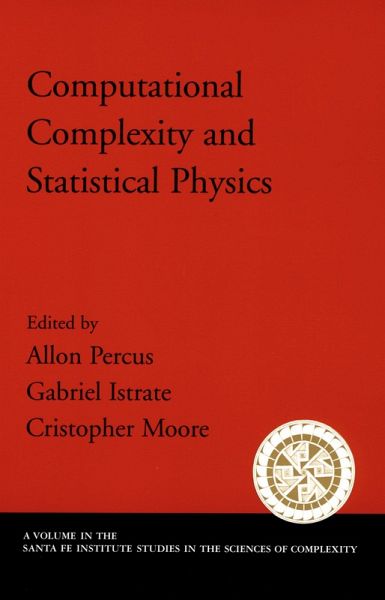
Computer science and physics have been closely linked since the birth of modern computing. In recent years, an interdisciplinary area has blossomed at the junction of these fields, connecting insights from statistical physics with basic computational challenges. Researchers have successfully applied techniques from the study of phase transitions to analyze NP-complete problems such as satisfiability and graph coloring. This is leading to a new understanding of the structure of these problems, and of how algorithms perform on them. Computational Complexity and Statistical Physics will serve as…mehr
Computer science and physics have been closely linked since the birth of modern computing. In recent years, an interdisciplinary area has blossomed at the junction of these fields, connecting insights from statistical physics with basic computational challenges. Researchers have successfully applied techniques from the study of phase transitions to analyze NP-complete problems such as satisfiability and graph coloring. This is leading to a new understanding of the structure of these problems, and of how algorithms perform on them. Computational Complexity and Statistical Physics will serve as a standard reference and pedagogical aid to statistical physics methods in computer science, with a particular focus on phase transitions in combinatorial problems. Addressed to a broad range of readers, the book includes substantial background material along with current research by leading computer scientists, mathematicians, and physicists. It will prepare students and researchers from all of these fields to contribute to this exciting area.
Dieser Download kann aus rechtlichen Gründen nur mit Rechnungsadresse in A, B, BG, CY, CZ, D, DK, EW, E, FIN, F, GR, HR, H, IRL, I, LT, L, LR, M, NL, PL, P, R, S, SLO, SK ausgeliefert werden.
Die Herstellerinformationen sind derzeit nicht verfügbar.
Autorenporträt
Allon Percus is Associate Director of the Institute for Pure and Applied Mathematics at UCLA, and a scientist at Los Alamos National Laboratory. He received his Ph.D. in Theoretical Physics from the University of Paris, Orsay, in 1997. His research has combined statistical physics, discrete mathematics, and computer science, focusing primarily on local search algorithms in combinatorial optimization. He has organized numerous conferences and workshops on combinatorics, phase transitions, and algorithmic complexity. Gabriel Istrate is a scientist at Los Alamos National Laboratory, in the Basic and Applied Simulation Science group. He received his Ph.D. in Computer Science from the University of Rochester in 1999. His primary research interests are in combinatorial, game theoretic, and probabilistic aspects of complex systems. His work in the area of phase transitions has focused on the interplay between threshold properties and computational complexity. Cristopher Moore is an Associate Professor at the University of New Mexico, and holds a joint appointment in the Computer Science and Physics departments. He received his Ph.D. in Physics from Cornell University in 1991. He has published 80 papers at the interface between these two fields, on topics ranging from statistical physics and phase transitions to quantum algorithms and mapping the internet.
Inhaltsangabe
* Preface * Part 1: Fundamentals * 1: Allon G. Percus, Gabriel Istrate, and Cristopher Moore: Introduction: Where Statistical Physics Meets Computation * 2: Gil Kalai and Shmuel Safra: Threshold Phenomena and Influence: Perspectives from Mathematics, Computer Science, and Economics * Part 2: Statistical Physics and Algorithms * 3: Simona Cocco, Remi Monasson, Andrea Montanari, and Guilhem Semerjian: Analyzing Search Algorithms with Physical Methods * 4: Alfredo Braunstein, Marc Mezard, Martin Weigt, and Riccardo Zecchina: Constraint Satisfaction by Survey Propagation * 5: Stephan Mertens: The Easiest Hard Problem: Number Partitioning * 6: Sigismund Kobe and Jarek Krawczyk: Ground States, Energy Landscape and Low-Temperature Dynamics of plus/minus Spin Glasses * Part 3: Identifying the Threshold * 7: Lefteris M. Kirousis, Yannis C. Stamatiou, and Michele Zito: The Satisfiability Threshold Conjecture: Techniques Behind Upper Bound Improvements * 8: Alexis C. Kaporis, Lefteris M. Kirousis, and Yannis C. Stamatiou: Proving Conditional Randomness Using the Principle of Deferred Decisions * 9: Demetrios D. Demopoulos, and Moshe Y. Vardi: The Phase Transition in the Random HornSAT Problem * Part 4: Extensions and Applications * 10: Tad Hogg: Phase Transitions for Quantum Search Algorithms * 11: Zoltan Toroczkai, Gyorgy Korniss, Mark A. Novotny, and Hasan Guclu: Scalability, Random Surfaces and Synchronized Computing Networks * 12: Christian M. Reidys: Combinatorics of Genotype-Phenotype Maps: An RNA Case Study * 13: Harry B. Hunt III, Madhav V. Marathe, Daniel J. Rosenkrantz, and Richard E. Stearns: Towards a Predictive Computational Complexity Theory for Periodically Specified Problems: A Survey * Bibliography * Index
* Preface * Part 1: Fundamentals * 1: Allon G. Percus, Gabriel Istrate, and Cristopher Moore: Introduction: Where Statistical Physics Meets Computation * 2: Gil Kalai and Shmuel Safra: Threshold Phenomena and Influence: Perspectives from Mathematics, Computer Science, and Economics * Part 2: Statistical Physics and Algorithms * 3: Simona Cocco, Remi Monasson, Andrea Montanari, and Guilhem Semerjian: Analyzing Search Algorithms with Physical Methods * 4: Alfredo Braunstein, Marc Mezard, Martin Weigt, and Riccardo Zecchina: Constraint Satisfaction by Survey Propagation * 5: Stephan Mertens: The Easiest Hard Problem: Number Partitioning * 6: Sigismund Kobe and Jarek Krawczyk: Ground States, Energy Landscape and Low-Temperature Dynamics of plus/minus Spin Glasses * Part 3: Identifying the Threshold * 7: Lefteris M. Kirousis, Yannis C. Stamatiou, and Michele Zito: The Satisfiability Threshold Conjecture: Techniques Behind Upper Bound Improvements * 8: Alexis C. Kaporis, Lefteris M. Kirousis, and Yannis C. Stamatiou: Proving Conditional Randomness Using the Principle of Deferred Decisions * 9: Demetrios D. Demopoulos, and Moshe Y. Vardi: The Phase Transition in the Random HornSAT Problem * Part 4: Extensions and Applications * 10: Tad Hogg: Phase Transitions for Quantum Search Algorithms * 11: Zoltan Toroczkai, Gyorgy Korniss, Mark A. Novotny, and Hasan Guclu: Scalability, Random Surfaces and Synchronized Computing Networks * 12: Christian M. Reidys: Combinatorics of Genotype-Phenotype Maps: An RNA Case Study * 13: Harry B. Hunt III, Madhav V. Marathe, Daniel J. Rosenkrantz, and Richard E. Stearns: Towards a Predictive Computational Complexity Theory for Periodically Specified Problems: A Survey * Bibliography * Index
Es gelten unsere Allgemeinen Geschäftsbedingungen: www.buecher.de/agb
Impressum
www.buecher.de ist ein Internetauftritt der buecher.de internetstores GmbH
Geschäftsführung: Monica Sawhney | Roland Kölbl | Günter Hilger
Sitz der Gesellschaft: Batheyer Straße 115 - 117, 58099 Hagen
Postanschrift: Bürgermeister-Wegele-Str. 12, 86167 Augsburg
Amtsgericht Hagen HRB 13257
Steuernummer: 321/5800/1497
USt-IdNr: DE450055826