Sie sind bereits eingeloggt. Klicken Sie auf 2. tolino select Abo, um fortzufahren.
Bitte loggen Sie sich zunächst in Ihr Kundenkonto ein oder registrieren Sie sich bei bücher.de, um das eBook-Abo tolino select nutzen zu können.
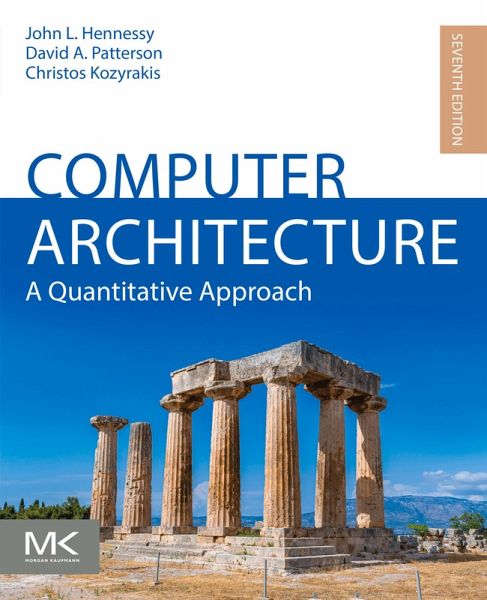
Computer Architecture: A Quantitative Approach, has been considered essential reading by instructors, students and practitioners of computer design for nearly 30 years. The seventh edition of this classic textbook from John Hennessy and David Patterson, w - Winner of a 2019 Textbook Excellence Award (Texty) from the Textbook and Academic Authors Association - Each chapter follows a consistent framework: explanation of the ideas in each chapter; a "crosscutting issues" section, which presents how the concepts covered in one chapter connect with those given in other chapters; a "putting it all…mehr
Computer Architecture: A Quantitative Approach, has been considered essential reading by instructors, students and practitioners of computer design for nearly 30 years. The seventh edition of this classic textbook from John Hennessy and David Patterson, w - Winner of a 2019 Textbook Excellence Award (Texty) from the Textbook and Academic Authors Association - Each chapter follows a consistent framework: explanation of the ideas in each chapter; a "crosscutting issues" section, which presents how the concepts covered in one chapter connect with those given in other chapters; a "putting it all together" section that links these concepts by discussing how they are applied in real machine; and detailed examples of misunderstandings and architectural traps commonly encountered by developers and architects - Includes "Putting It All Together" sections near the end of every chapter, providing real-world technology examples that demonstrate the principles covered in each chapter - Covers new developments in GPU and CPU architectures, as well as domain specific architectures - Features more comprehensive coverage of systems on chip and heterogeneity
Dieser Download kann aus rechtlichen Gründen nur mit Rechnungsadresse in A, B, BG, CY, CZ, D, DK, EW, E, FIN, F, GR, HR, H, IRL, I, LT, L, LR, M, NL, PL, P, R, S, SLO, SK ausgeliefert werden.
Die Herstellerinformationen sind derzeit nicht verfügbar.
Autorenporträt
ACM named John L. Hennessy a recipient of the 2017 ACM A.M. Turing Award for pioneering a systematic, quantitative approach to the design and evaluation of computer architectures with enduring impact on the microprocessor industry. John L. Hennessy is a Professor of Electrical Engineering and Computer Science at Stanford University, where he has been a member of the faculty since 1977 and was, from 2000 to 2016, its tenth President. Prof. Hennessy is a Fellow of the IEEE and ACM; a member of the National Academy of Engineering, the National Academy of Science, and the American Philosophical Society; and a Fellow of the American Academy of Arts and Sciences. Among his many awards are the 2001 Eckert-Mauchly Award for his contributions to RISC technology, the 2001 Seymour Cray Computer Engineering Award, and the 2000 John von Neumann Award, which he shared with David Patterson. He has also received seven honorary doctorates.David Patterson is the Pardee Professor of Computer Science, Emeritus at the University of California at Berkeley, which he joined after graduating from UCLA in 1977.His teaching has been honored by the Distinguished Teaching Award from the University of California, the Karlstrom Award from ACM, and the Mulligan Education Medal and Undergraduate Teaching Award from IEEE. Prof. Patterson received the IEEE Technical Achievement Award and the ACM Eckert-Mauchly Award for contributions to RISC, and he shared the IEEE Johnson Information Storage Award for contributions to RAID. He also shared the IEEE John von Neumann Medal and the C & C Prize with John Hennessy. Like his co-author, Prof. Patterson is a Fellow of the American Academy of Arts and Sciences, the Computer History Museum, ACM, and IEEE, and he was elected to the National Academy of Engineering, the National Academy of Sciences, and the Silicon Valley Engineering Hall of Fame. He served on the Information Technology Advisory Committee to the U.S. President, as chair of the CS division in the Berkeley EECS department, as chair of the Computing Research Association, and as President of ACM. This record led to Distinguished Service Awards from ACM, CRA, and SIGARCH.Christos Kozyrakis is a Professor of Electrical Engineering and Computer Science at Stanford University. His primary research areas are computer architecture and computer systems. His current work focuses on cloud computing, systems for machine learning, and machine learning for systems. Christos holds a BS degree from the University of Crete and a PhD degree from the University of California at Berkeley. He is a fellow of the ACM and the IEEE. He has received the ACM SIGARCH Maurice Wilkes Award, the ISCA Influential Paper Award, the NSF Career Award, the Okawa Foundation Research Grant, and faculty awards by IBM, Microsoft, and Google.
Inhaltsangabe
Printed Text 1. Fundamentals of Quantitative Design and Analysis 2. Memory Hierarchy Design 3. Instruction-Level Parallelism and Its Exploitation 4. Data-Level Parallelism in Vector, SIMD, and GPU Architectures 5. Thread-Level Parallelism 6. Warehouse-Scale Systems for Utility Computing 7. Domain Specific Architectures A. Instruction Set Principles B. Review of Memory Hierarchy C. Pipelining: Basic and Intermediate Concepts Online D. Storage Systems E. Embedded Systems F. Interconnection Networks G. Vector Processors H. Hardware and Software for VLIW and EPIC I. Large-Scale Multiprocessors and Scientific Applications J. Computer Arithmetic K. Survey of Instruction Set Architectures L. Advanced Concepts on Address Translation M. Historical Perspectives and References
Printed Text 1. Fundamentals of Quantitative Design and Analysis 2. Memory Hierarchy Design 3. Instruction-Level Parallelism and Its Exploitation 4. Data-Level Parallelism in Vector, SIMD, and GPU Architectures 5. Thread-Level Parallelism 6. Warehouse-Scale Systems for Utility Computing 7. Domain Specific Architectures A. Instruction Set Principles B. Review of Memory Hierarchy C. Pipelining: Basic and Intermediate Concepts Online D. Storage Systems E. Embedded Systems F. Interconnection Networks G. Vector Processors H. Hardware and Software for VLIW and EPIC I. Large-Scale Multiprocessors and Scientific Applications J. Computer Arithmetic K. Survey of Instruction Set Architectures L. Advanced Concepts on Address Translation M. Historical Perspectives and References
Es gelten unsere Allgemeinen Geschäftsbedingungen: www.buecher.de/agb
Impressum
www.buecher.de ist ein Internetauftritt der buecher.de internetstores GmbH
Geschäftsführung: Monica Sawhney | Roland Kölbl | Günter Hilger
Sitz der Gesellschaft: Batheyer Straße 115 - 117, 58099 Hagen
Postanschrift: Bürgermeister-Wegele-Str. 12, 86167 Augsburg
Amtsgericht Hagen HRB 13257
Steuernummer: 321/5800/1497
USt-IdNr: DE450055826