78,95 €
78,95 €
inkl. MwSt.
Sofort per Download lieferbar

39 °P sammeln
78,95 €
Als Download kaufen
78,95 €
inkl. MwSt.
Sofort per Download lieferbar
39 °P sammeln
Jetzt verschenken
Alle Infos zum eBook verschenken
78,95 €
inkl. MwSt.
Sofort per Download lieferbar
Alle Infos zum eBook verschenken
39 °P sammeln

Andere Kunden interessierten sich auch für
") Handbook of Cereal Science and Technology, Revised and Expanded (eBook, ePUB)392,95 €
Handbook of Cereal Science and Technology, Revised and Expanded (eBook, ePUB)392,95 €") Cereal Grains (eBook, ePUB)186,95 €
Cereal Grains (eBook, ePUB)186,95 €") Cereal Processing Technologies (eBook, ePUB)167,95 €
Cereal Processing Technologies (eBook, ePUB)167,95 €") Cereals and Cereal-Based Foods (eBook, ePUB)145,95 €
Cereals and Cereal-Based Foods (eBook, ePUB)145,95 €") Cereal Grains (eBook, ePUB)64,95 €
Cereal Grains (eBook, ePUB)64,95 €") Engineering Aspects of Cereal and Cereal-Based Products (eBook, ePUB)82,95 €
Engineering Aspects of Cereal and Cereal-Based Products (eBook, ePUB)82,95 €") The Chemistry of Cereal Proteins (eBook, ePUB)255,95 €
The Chemistry of Cereal Proteins (eBook, ePUB)255,95 €
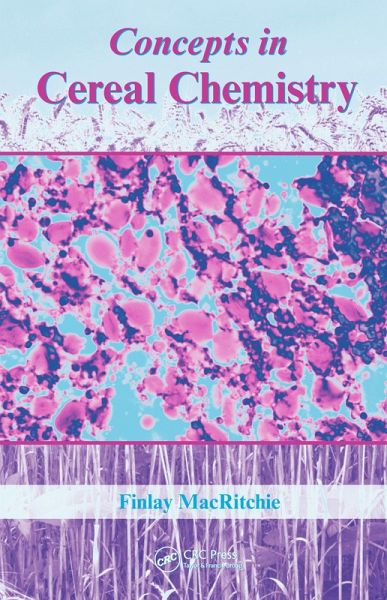
Concepts in Cereal Chemistry stimulates critical thinking by emphasizing the important concepts related to the science. Written by distinguished researcher and teacher Dr. Finlay MacRitchie, this compact and reader-friendly book focuses mainly on cereal chemistry, but also incorporates relevant theory from the basic sciences, such as physics and genetics.
A Targeted Approach, Rather than an Exhaustive Review
The book discusses milling and some of the sciences that are relevant to wheat dry milling. It explains how to measure the efficiency of the dry milling process and provides explanations for grain hardness variation. The book also looks at the composition and structure of dough and how this determines the performance of a baked aerated product. It then covers dough rheology and some important aspects of processing.
Logically Organized with Exercises at the End of Most Chapters
Next, the book explores cereal shelf life and the well-known phenomenon of bread staling and its underlying causes. Coverage then shifts to proteins and the relationship between cereal composition and functionality. A discussion of strategies to manipulate end-use properties is followed by chapters on non-wheat cereals and health-related aspects of cereals. Suggested solutions to end-of-chapter questions and exercises round out the book's solid coverage. These solutions require critical thinking and, in some cases, searches of the literature. Demonstrations are included to further illustrate principles. This well-organized resource provides students and researchers in both academia and industry with the information they need to tackle problems likely to arise in cereal research.
A Targeted Approach, Rather than an Exhaustive Review
The book discusses milling and some of the sciences that are relevant to wheat dry milling. It explains how to measure the efficiency of the dry milling process and provides explanations for grain hardness variation. The book also looks at the composition and structure of dough and how this determines the performance of a baked aerated product. It then covers dough rheology and some important aspects of processing.
Logically Organized with Exercises at the End of Most Chapters
Next, the book explores cereal shelf life and the well-known phenomenon of bread staling and its underlying causes. Coverage then shifts to proteins and the relationship between cereal composition and functionality. A discussion of strategies to manipulate end-use properties is followed by chapters on non-wheat cereals and health-related aspects of cereals. Suggested solutions to end-of-chapter questions and exercises round out the book's solid coverage. These solutions require critical thinking and, in some cases, searches of the literature. Demonstrations are included to further illustrate principles. This well-organized resource provides students and researchers in both academia and industry with the information they need to tackle problems likely to arise in cereal research.
Dieser Download kann aus rechtlichen Gründen nur mit Rechnungsadresse in A, B, BG, CY, CZ, D, DK, EW, E, FIN, F, GR, HR, H, IRL, I, LT, L, LR, M, NL, PL, P, R, S, SLO, SK ausgeliefert werden.