56,95 €
56,95 €
inkl. MwSt.
Sofort per Download lieferbar

28 °P sammeln
56,95 €
Als Download kaufen
56,95 €
inkl. MwSt.
Sofort per Download lieferbar
28 °P sammeln
Jetzt verschenken
Alle Infos zum eBook verschenken
56,95 €
inkl. MwSt.
Sofort per Download lieferbar
Alle Infos zum eBook verschenken
28 °P sammeln

Andere Kunden interessierten sich auch für
 (eBook, ePUB)") Retrieval and Organizational Strategies in Conceptual Memory (PLE: Memory) (eBook, ePUB)45,95 €
Retrieval and Organizational Strategies in Conceptual Memory (PLE: Memory) (eBook, ePUB)45,95 €") Mathematical Principles of Human Conceptual Behavior (eBook, ePUB)41,95 €
Mathematical Principles of Human Conceptual Behavior (eBook, ePUB)41,95 €") Conceptual Metaphor in Social Psychology (eBook, ePUB)56,95 €
Conceptual Metaphor in Social Psychology (eBook, ePUB)56,95 €") Conceptual Development (eBook, ePUB)55,95 €
Conceptual Development (eBook, ePUB)55,95 €") The Truth Behind Errors of Reasoning. Cognitive Fallacies as a Matter of Conceptual Coherency (eBook, ePUB)13,99 €
The Truth Behind Errors of Reasoning. Cognitive Fallacies as a Matter of Conceptual Coherency (eBook, ePUB)13,99 €") Cognitive Psychology (eBook, ePUB)67,95 €
Cognitive Psychology (eBook, ePUB)67,95 €") Cognitive Psychology in a Changing World (eBook, ePUB)49,95 €
Cognitive Psychology in a Changing World (eBook, ePUB)49,95 €




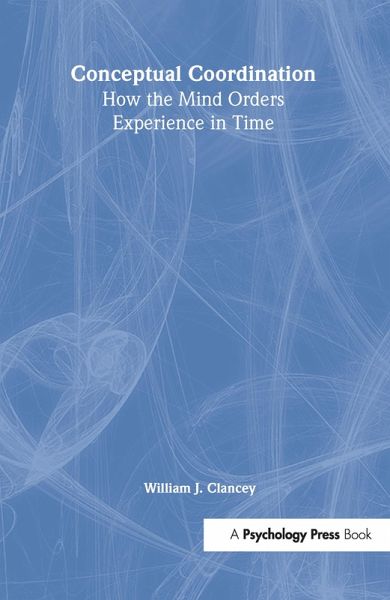
This book bridges the gap between models of human behavior that are based on cognitive task analysis and those based on neural networks. The author argues that these approaches are incomplete and not properly related to each other. His synthesis reconciles the very different conceptualizations of human memory assumed by these two approaches by assuming that 'what the brain remembers' is not a collection of symbols or neurons or even networks of either of these, but rather how to coordinate behavior in time, relating different modalities of conception and movement. A second premise is that behavior sequences are categorized, with perceptual categorizations (sounds, images) comprising the first order of categorization and conceptual categorizations of perceptions and actions in time comprising the second order. The conceptual categorizations are themselves sequenced and categorized, corresponding to the familiar classification hierarchies in cognitive models.
Inspired by Bartlett's work, the author seeks to develop a theory of "process memory"--memory for experience in time. Following the methodology of situated cognition, he finds clues in the particulars of human activity, such as typing errors, how a computer interface is used, how a child learns to play in a swimming pool, odd limitations in language comprehension, and so on. Throughout, he examines existing (and often famous) cognitive and neural models with respect to these phenomena. In each case, he attempts to show that the experienced behavior can be understood as sequences of categories being reactivated, substituted, and composed. Ultimately, this analysis is shown to be the link that may lead to improvement of both symbolic and neurally based models of memory and behavior, with concomitant implications for cognitive psychology, artificial intelligence, and cognitive science as a whole.
Inspired by Bartlett's work, the author seeks to develop a theory of "process memory"--memory for experience in time. Following the methodology of situated cognition, he finds clues in the particulars of human activity, such as typing errors, how a computer interface is used, how a child learns to play in a swimming pool, odd limitations in language comprehension, and so on. Throughout, he examines existing (and often famous) cognitive and neural models with respect to these phenomena. In each case, he attempts to show that the experienced behavior can be understood as sequences of categories being reactivated, substituted, and composed. Ultimately, this analysis is shown to be the link that may lead to improvement of both symbolic and neurally based models of memory and behavior, with concomitant implications for cognitive psychology, artificial intelligence, and cognitive science as a whole.
Dieser Download kann aus rechtlichen Gründen nur mit Rechnungsadresse in A, B, BG, CY, CZ, D, DK, EW, E, FIN, F, GR, HR, H, IRL, I, LT, L, LR, M, NL, PL, P, R, S, SLO, SK ausgeliefert werden.