Sie sind bereits eingeloggt. Klicken Sie auf 2. tolino select Abo, um fortzufahren.
Bitte loggen Sie sich zunächst in Ihr Kundenkonto ein oder registrieren Sie sich bei bücher.de, um das eBook-Abo tolino select nutzen zu können.
In Congress and U.S. Foreign Policy, leading scholars examine the foreign policy activity, role and influence of the U.S. Congress in the current polarized and partisan political context. Challenging conventional views, the contributors reveal how members of Congress have been active and assertive, utilizing numerous different means to influence US foreign policy, sometimes supporting and sometimes opposing the President. The contributors provide in-depth analysis and expert perspectives on the issues, decisions, and debates that have arisen across multiple presidential administrations in the…mehr
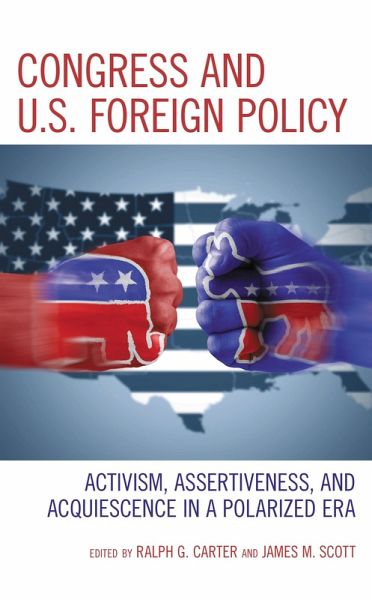
In Congress and U.S. Foreign Policy, leading scholars examine the foreign policy activity, role and influence of the U.S. Congress in the current polarized and partisan political context. Challenging conventional views, the contributors reveal how members of Congress have been active and assertive, utilizing numerous different means to influence US foreign policy, sometimes supporting and sometimes opposing the President. The contributors provide in-depth analysis and expert perspectives on the issues, decisions, and debates that have arisen across multiple presidential administrations in the polarized political context since the end of the Cold War. This polarized environment greatly increases the conflict among, and complicates the ability of, policymakers to reach compromises, much less consensus, on the appropriate ends and means of US foreign policy. This timely and cohesive reassessment of the tumultuous years of the most recent presidential administrations focuses analytical attention on the patterns of engagement between Congress and the President and the range of avenues and influence by the collective institution and its individual members. It thus sheds light on the role and behavior of Congress and its members in US foreign policy as a vital aspect of understanding how and why the US chooses its policy courses toward the world.
Die Herstellerinformationen sind derzeit nicht verfügbar.
Autorenporträt
Ralph G. Carter is Piper Professor of Texas, professor, and former chair of the department of Political Science at Texas Christian University. His areas of specialization include international relations and comparative foreign policy analysis, with a particular emphasis on the domestic sources of foreign policy. James M. Scott is the Herman Brown chair and professor of Political Science at Texas Christian University. His primary research and teaching interests are in international relations and foreign policy analysis, and he has special interests in US foreign policymaking, the role of Congress, and US democracy promotion.
Inhaltsangabe
Introduction: Understanding Congress and Foreign Policy Ralph G. Carter and James M. Scott Chapter 1 - Shifting Constellations of Congressional Foreign Policy During the Trump Era Patrick Homan, Dominican University, and Scott LaDeur, North Central Michigan College Chapter 2 - Anti-Presidential Bipartisanship in Foreign Policy in the Trump Era Jordan Tama, American University Chapter 3 - The Polarization of the Defense and Foreign Policy Committees William Bendix, Keene State College and Gyung-Ho Jeong, University of British Columbia Chapter 4 - The Continued Decline of Congressional Oversight of US Foreign Policy Linda L. Fowler, Dartmouth College Chapter 5 - The Conditional Nature of Congressional Support for the President During Wartime Susanne Schorpp, Jeffrey Lazarus, and Micayla Clark, Georgia State University Chapter 6 - The Congressional Role in US Diplomacy in an Era of Presidential Unilateralism: The End of the Treaty Power Jeffrey S. Peake, Clemson University Chapter 7 - Opening Wi
Es gelten unsere Allgemeinen Geschäftsbedingungen: www.buecher.de/agb
Impressum
www.buecher.de ist ein Internetauftritt der buecher.de internetstores GmbH
Geschäftsführung: Monica Sawhney | Roland Kölbl | Günter Hilger
Sitz der Gesellschaft: Batheyer Straße 115 - 117, 58099 Hagen
Postanschrift: Bürgermeister-Wegele-Str. 12, 86167 Augsburg
Amtsgericht Hagen HRB 13257
Steuernummer: 321/5800/1497
USt-IdNr: DE450055826