49,95 €
49,95 €
inkl. MwSt.
Sofort per Download lieferbar

25 °P sammeln
49,95 €
Als Download kaufen
49,95 €
inkl. MwSt.
Sofort per Download lieferbar
25 °P sammeln
Jetzt verschenken
Alle Infos zum eBook verschenken
49,95 €
inkl. MwSt.
Sofort per Download lieferbar
Alle Infos zum eBook verschenken
25 °P sammeln

Andere Kunden interessierten sich auch für
") Hope Under Oppression (eBook, PDF)13,95 €
Hope Under Oppression (eBook, PDF)13,95 €") Sexual Ethics and Problematic Consent (eBook, PDF)56,95 €
Sexual Ethics and Problematic Consent (eBook, PDF)56,95 €") Consent Matters (eBook, PDF)55,95 €
Consent Matters (eBook, PDF)55,95 €") Pedophilia and Adult-Child Sex (eBook, PDF)34,95 €
Pedophilia and Adult-Child Sex (eBook, PDF)34,95 €") The Routledge Handbook of the Ethics of Consent (eBook, PDF)44,95 €
The Routledge Handbook of the Ethics of Consent (eBook, PDF)44,95 €") Surrounding Self-Control (eBook, PDF)27,95 €
Surrounding Self-Control (eBook, PDF)27,95 €") Explaining Norms (eBook, PDF)16,95 €
Explaining Norms (eBook, PDF)16,95 €





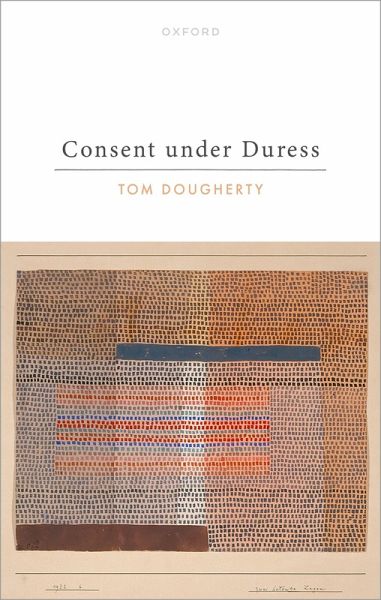
Consent can make actions morally permissible. But consent can be deprived of its moral force when it is given under duress. Understanding how this happens requires answering the question of which types of duress undermine consent. It is uncontroversial that severe coercion, like threats of violence, can prevent consent from creating moral permissions. But what about minor duress? Duress from natural causes? Duress from social norms? Duress that is merely apparent to the consent-giver with no objective basis in reality? To answer these questions, Consent under Duress defends an account that follows two key approaches. First, it adopts an expansive approach that broadens the class of misconduct that is constituted by acting on someone's consent that is given under duress. Second, it adopts a scalar approach that allows that consent can be invalidated to varying degrees, which in turn can track the degrees of the severity of the duress to which the consent-giver is subject. The expansive and scalar approaches work in tandem. Once there is an expansion of the aforementioned class of misconduct, additional theoretical resources are needed to draw moral distinctions within this heterogeneous class. By providing these resources, the scalar approach supplements the expansive approach. Meanwhile, once it is recognized that consent can be partially invalidated by minor duress, it is necessary to expand the class of what constitutes misconduct that is constituted by acting on someone's consent that is given under duress. By developing independent arguments for these mutually reinforcing approaches, Consent Under Duress offers a robust defense of their combination.
Dieser Download kann aus rechtlichen Gründen nur mit Rechnungsadresse in A, B, BG, CY, CZ, D, DK, EW, E, FIN, F, GR, HR, H, IRL, I, LT, L, LR, M, NL, PL, P, R, S, SLO, SK ausgeliefert werden.