42,95 €
inkl. MwSt.
Sofort per Download lieferbar
21 °P sammeln

Andere Kunden interessierten sich auch für
") Tradition, Literature and Politics in East-Central Europe (eBook, PDF)42,95 €
Tradition, Literature and Politics in East-Central Europe (eBook, PDF)42,95 €") Historicizing Roma in Central Europe (eBook, PDF)42,95 €
Historicizing Roma in Central Europe (eBook, PDF)42,95 €") The Sovietization of Rural Hungary, 1945-1980 (eBook, PDF)39,95 €
The Sovietization of Rural Hungary, 1945-1980 (eBook, PDF)39,95 €") Contemporary Hungarian Society (eBook, ePUB)42,95 €
Contemporary Hungarian Society (eBook, ePUB)42,95 €") East Central Europe and Communism (eBook, PDF)0,00 €
East Central Europe and Communism (eBook, PDF)0,00 €") Image, History and Memory (eBook, PDF)39,95 €
Image, History and Memory (eBook, PDF)39,95 €") 1989 and the West (eBook, PDF)0,00 €
1989 and the West (eBook, PDF)0,00 €

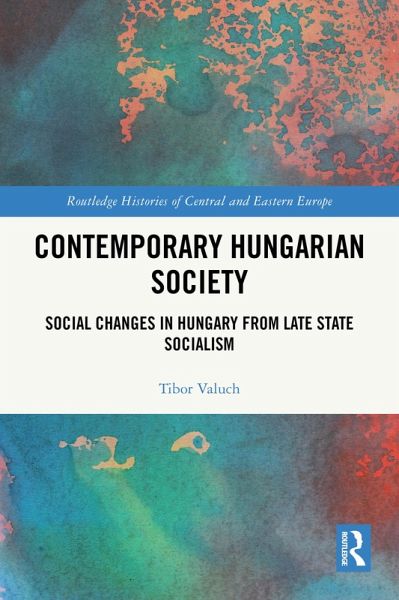
This book examines social change in Hungary, commencing with the period of late-stage socialism, the country's immediate post-communist transition, its subsequent consolidation, and the emergence of authoritarian leadership since 2010. The volume seeks to employ a longitudinal and comparative perspective and provides comparison to other central and East European states that emerged from state socialism.
The Hungarian regime change of 1989-1990 led to previously unimaginable social and economic transition. In recent decades, regime change and socioeconomic transition in Central and Eastern Europe have produced a library of literature, and transition studies has periodically become a discipline in its own right. The author uses an interdisciplinary approach - drawing from social history, sociology, statistics, and contemporary history - in order to understand and analyse social change in all its complexity.
The book will be of interest to undergraduate and postgraduate students, social scientists, historians, experts, and those interested in Hungarian and Central and Eastern European history and social change.
The Hungarian regime change of 1989-1990 led to previously unimaginable social and economic transition. In recent decades, regime change and socioeconomic transition in Central and Eastern Europe have produced a library of literature, and transition studies has periodically become a discipline in its own right. The author uses an interdisciplinary approach - drawing from social history, sociology, statistics, and contemporary history - in order to understand and analyse social change in all its complexity.
The book will be of interest to undergraduate and postgraduate students, social scientists, historians, experts, and those interested in Hungarian and Central and Eastern European history and social change.
Dieser Download kann aus rechtlichen Gründen nur mit Rechnungsadresse in A, B, BG, CY, CZ, D, DK, EW, E, FIN, F, GR, HR, H, IRL, I, LT, L, LR, M, NL, PL, P, R, S, SLO, SK ausgeliefert werden.