Sie sind bereits eingeloggt. Klicken Sie auf 2. tolino select Abo, um fortzufahren.
Bitte loggen Sie sich zunächst in Ihr Kundenkonto ein oder registrieren Sie sich bei bücher.de, um das eBook-Abo tolino select nutzen zu können.
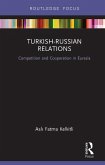
The Syrian Civil War started in March 2011 and still continues. It causes death, turmoil, humanitarian crisis, and mass migration in the region. Numerous state and non-state actors are involved in this multi-sided armed conflict. On 24 November 2015, Turkey shoots down a Russian fighter jet on its border and this event becomes the turning point in Russo-Turkish relations. An economic and psychological war starts between Moscow and Ankara which damages their good relations existed before the crisis. Despite the crisis, the sides to the conflict understand that they need each other for their own…mehr
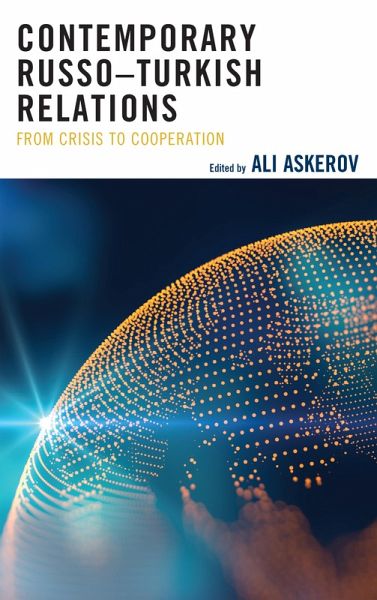
The Syrian Civil War started in March 2011 and still continues. It causes death, turmoil, humanitarian crisis, and mass migration in the region. Numerous state and non-state actors are involved in this multi-sided armed conflict. On 24 November 2015, Turkey shoots down a Russian fighter jet on its border and this event becomes the turning point in Russo-Turkish relations. An economic and psychological war starts between Moscow and Ankara which damages their good relations existed before the crisis. Despite the crisis, the sides to the conflict understand that they need each other for their own benefits and look for reconciliation. Russia, a supporter of the Assad government in Syria, does not want to lose Turkey as a friend. Turkey, an energy partner of Russia, needs Russia to balance the power relations in the region. They are two neighboring countries with strong historical socio-economic ties that need to be restored. The reconciliation process is not easy and requires some third party role. The PYD/YPG-centered US policy in Syria affects Turkey's strategies.
Die Herstellerinformationen sind derzeit nicht verfügbar.
Autorenporträt
Ali Askerov is assistant professor of peace studies at the University of North Carolina, Greensboro.
Inhaltsangabe
Foreword, by Stefan D. Brooks Acknowledgments Introduction, by Ali Askerov 1. A History of Russian-Turkish Relations: From the Ottoman Empire period to the end of the Soviet Era, by Ilyas Topsakal 2. Main Lines of Turkey-Russia Relations in the 2000s, by Cemre Pekcan 3. Contending Policies of Russia and Turkey: The Syrian Crisis, by Ali Askerov and Lasha Tchantouridze 4. Turkey-Russia Relations After the Shooting Down of a Russian Warplane, by Togrul Ismayil 5. Effects of US PYD/YPG Policy on Russo-Turkish Relations, by Ali Askerov, Sean Byrne, and Thomas Matyok 6. The Military-Strategic Dimensions of Turkey-Russian Relations, by Aydin Çetiner 7. The Black Sea Question in Russo-Turkish Relations, by Lasha Tchantouridze 8. Restrictions on a Possible Rapprochement between Turkey, Russia, and Iran, by Ibrahim Arslan 9. Central Asia at the Crossroads of Russian-Turkish Cooperation and Competition, by Kamala Valiyeva 10. The Turkish-Russian Relations in The Context of Energy Cooperation, by Tugce Varol 11. A Comparison of the EU Policies of Turkey and Russia, by Soner Karagül 12. A Proposal for Sustainable Peace in the Sykes-Picot Agreement's Hundredth Year: the Middle East Peace and Stability Pact, by Ibrahim Arslan and Mithat Baydur 13. Social Dynamics of Modern Russian and Turkish Societies, by Abulfaz Suleymanov, Gali Galiev, and Chulpan Ildarhanova 14. The Future of the Black Sea Economic Cooperation Organization in the Context of Contemporary Developments, by Sergey A. Kizima 15. A Third Party Role in the Normalization of Russo-Turkish Relations, by Ali Askerov and Stefan D. Brooks Conclusion About the Author
Es gelten unsere Allgemeinen Geschäftsbedingungen: www.buecher.de/agb
Impressum
www.buecher.de ist ein Internetauftritt der buecher.de internetstores GmbH
Geschäftsführung: Monica Sawhney | Roland Kölbl | Günter Hilger
Sitz der Gesellschaft: Batheyer Straße 115 - 117, 58099 Hagen
Postanschrift: Bürgermeister-Wegele-Str. 12, 86167 Augsburg
Amtsgericht Hagen HRB 13257
Steuernummer: 321/5800/1497
USt-IdNr: DE450055826