17,95 €
17,95 €
inkl. MwSt.
Sofort per Download lieferbar

9 °P sammeln
17,95 €
Als Download kaufen
17,95 €
inkl. MwSt.
Sofort per Download lieferbar
9 °P sammeln
Jetzt verschenken
Alle Infos zum eBook verschenken
17,95 €
inkl. MwSt.
Sofort per Download lieferbar
Alle Infos zum eBook verschenken
9 °P sammeln

Andere Kunden interessierten sich auch für
") Seeking Allah's Hierarchy (eBook, ePUB)23,95 €
Seeking Allah's Hierarchy (eBook, ePUB)23,95 €") After Work (eBook, ePUB)18,95 €
After Work (eBook, ePUB)18,95 €") Surviving the Sanctuary City (eBook, ePUB)22,95 €
Surviving the Sanctuary City (eBook, ePUB)22,95 €") Spawning Modern Fish (eBook, ePUB)25,95 €
Spawning Modern Fish (eBook, ePUB)25,95 €") Jungle Passports (eBook, ePUB)25,95 €
Jungle Passports (eBook, ePUB)25,95 €") Crafting a Tibetan Terroir (eBook, ePUB)25,95 €
Crafting a Tibetan Terroir (eBook, ePUB)25,95 €") Painting Thangkas on the Tibetan Plateau (eBook, ePUB)29,95 €
Painting Thangkas on the Tibetan Plateau (eBook, ePUB)29,95 €





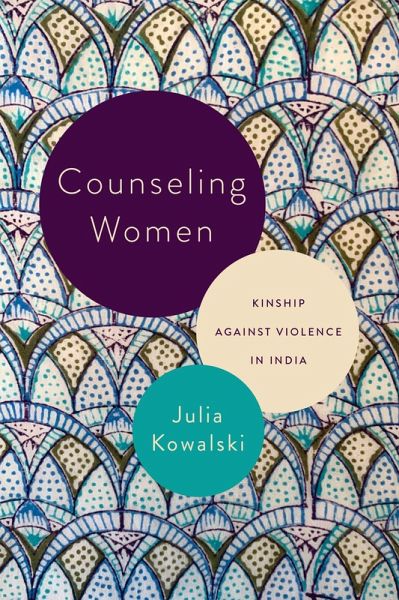
Women's rights activists around the world have commonly understood gendered violence as the product of so-called traditional family structures, from which women must be liberated. Counseling Women contends that this perspective overlooks the social and cultural contexts in which women understand and navigate their relationships with kin.
This book follows frontline workers in India, called family counselors, as they support women who have experienced violence at home in the context of complex shifting legal and familial systems. Drawing on ethnographic research at counseling centers in Jaipur, Rajasthan, Julia Kowalski shows how an individualistic notion of women's rights places already vulnerable women into even more precarious positions by ignoring the reality of the social relations that shape lives within and beyond the family. Thus, rather than focusing on attaining independence from kin, family counselors in India instead strive to help women cultivate relationships of interdependence in order to reimagine family life in the wake of violence. Counselors mobilize the beliefs, concepts, and frameworks of kinship to offer women interactive strategies to gain agency within the family, including multigenerational kin networks encompassing parents, in-laws, and other extended family. Through this work, kinship becomes a resource through which people imagine and act on new familial futures.
In viewing this reliance on kinship as part of, rather than a deviation from, global women's rights projects, Counseling Women reassesses Western liberal feminism's notions of what it means to have agency and what constitutes violence, and retheorizes the role of interdependence in gendered violence and inequality as not only a site of vulnerability but a potential source of strength.
This book follows frontline workers in India, called family counselors, as they support women who have experienced violence at home in the context of complex shifting legal and familial systems. Drawing on ethnographic research at counseling centers in Jaipur, Rajasthan, Julia Kowalski shows how an individualistic notion of women's rights places already vulnerable women into even more precarious positions by ignoring the reality of the social relations that shape lives within and beyond the family. Thus, rather than focusing on attaining independence from kin, family counselors in India instead strive to help women cultivate relationships of interdependence in order to reimagine family life in the wake of violence. Counselors mobilize the beliefs, concepts, and frameworks of kinship to offer women interactive strategies to gain agency within the family, including multigenerational kin networks encompassing parents, in-laws, and other extended family. Through this work, kinship becomes a resource through which people imagine and act on new familial futures.
In viewing this reliance on kinship as part of, rather than a deviation from, global women's rights projects, Counseling Women reassesses Western liberal feminism's notions of what it means to have agency and what constitutes violence, and retheorizes the role of interdependence in gendered violence and inequality as not only a site of vulnerability but a potential source of strength.
Dieser Download kann aus rechtlichen Gründen nur mit Rechnungsadresse in A, D ausgeliefert werden.