24,95 €
24,95 €
inkl. MwSt.
Sofort per Download lieferbar

12 °P sammeln
24,95 €
Als Download kaufen
24,95 €
inkl. MwSt.
Sofort per Download lieferbar
12 °P sammeln
Jetzt verschenken
Alle Infos zum eBook verschenken
24,95 €
inkl. MwSt.
Sofort per Download lieferbar
Alle Infos zum eBook verschenken
12 °P sammeln

Andere Kunden interessierten sich auch für
") Counterfact (eBook, ePUB)24,95 €
Counterfact (eBook, ePUB)24,95 €") Political Leaders, the Display of Emotions, and the Public (eBook, PDF)69,00 €
Political Leaders, the Display of Emotions, and the Public (eBook, PDF)69,00 €") Springboards to Inquiry (eBook, PDF)31,95 €
Springboards to Inquiry (eBook, PDF)31,95 €") Practicing Intellectual Freedom in Libraries (eBook, PDF)37,95 €
Practicing Intellectual Freedom in Libraries (eBook, PDF)37,95 €") The Reinvention of the U.S. Academic Library (eBook, PDF)23,95 €
The Reinvention of the U.S. Academic Library (eBook, PDF)23,95 €") Copyright (eBook, PDF)40,95 €
Copyright (eBook, PDF)40,95 €") Inglorious Pedagogy (eBook, PDF)73,95 €
Inglorious Pedagogy (eBook, PDF)73,95 €




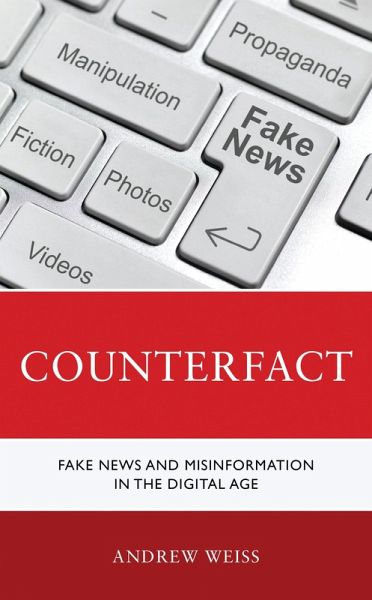
For as long as there has been a press, fake news has played a role in the disruption of how factual information is shared among people. Misinformation goes back even further, spreading through the use of lies and rumors, spoken or written, for various political and social purposes. In this book, we will trace a brief history of fake news, examine its antecedents and precursors, before looking at the way it is currently employed using digital information technologies. The current consensus on what comprises fake news is somewhat contested; as such, a more detailed look at the phenomenon is in order. Not only does fake news include false news stories spread with the intent to deceive, its purpose can be instructive and parodic, providing the very tools needed to puncture misinformation bubbles. This book will examine in detail a comprehensive model for fake news that might be used to help predict and neutralize its negative effects, as well as examine the traits that contribute to a person's susceptibility to falling for false stories, conspiracies, and other misinformation. In this regard, the book is unique in its approach to fake news, seeing it as situated within a matrix of behaviors, conditions, and contexts that must be accounted for before its effects can be completely neutralized. The context also explores the relationship of the creator and the user of fake news, speculating on the intertwined actions and motives of both. It is hypothesized that specific conditions exploited by 'bad actors' would contribute to the spread of fake news and that low levels or lack of certain identifiable characteristics in users (i.e. ability to scaffold, conduct parallel thinking, be aware of one's ignorance, know one's strengths and weaknesses) would also make it more likely to be consumed and shared. This book also examines the wider impacts of fake news on societies, especially in the areas of education, politics, and public policy. This book makes the case for developing strategies that rely not merely upon information literacy to help individuals deal with fake news, but also on wider national and international policies that specifically aid users of information and address human behavioral characteristics. As in information behavior research, the scale and scope of examining fake news requires both a local focus and a large-scale inquiry into societal and cultural norms