0,49 €
inkl. MwSt.
Sofort per Download lieferbar
0 °P sammeln

Andere Kunden interessierten sich auch für
") Courage to Stand Alone (eBook, ePUB)1,99 €
Courage to Stand Alone (eBook, ePUB)1,99 €") Courage to Stand Alone (eBook, ePUB)1,99 €
Courage to Stand Alone (eBook, ePUB)1,99 €") Watkins Masters of Wisdom: Osho (eBook, ePUB)4,99 €
Watkins Masters of Wisdom: Osho (eBook, ePUB)4,99 € (eBook, ePUB)") No Way Out (Summarized Edition) (eBook, ePUB)0,49 €
No Way Out (Summarized Edition) (eBook, ePUB)0,49 € (eBook, ePUB)") Chuang Tzu: Mystic, Moralist, and Social Reformer (Summarized Edition) (eBook, ePUB)0,49 €
Chuang Tzu: Mystic, Moralist, and Social Reformer (Summarized Edition) (eBook, ePUB)0,49 €") Death to Deathless (eBook, ePUB)0,00 €
Death to Deathless (eBook, ePUB)0,00 €") Reason, the Only Oracle of Man; Or, A Compendius System of Natural Religion (eBook, ePUB)0,49 €
Reason, the Only Oracle of Man; Or, A Compendius System of Natural Religion (eBook, ePUB)0,49 €
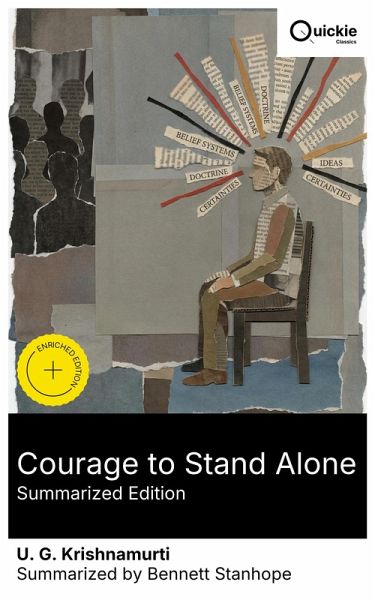
Courage to Stand Alone gathers U. G. Krishnamurti's uncompromising letters and conversations, a sustained dismantling of spiritual authority, self-improvement, and the ideal of "enlightenment." Terse, aphoristic, and unsentimental, the prose refuses system or method, exposing belief as habit and craving. Set against late twentieth-century critiques of guru culture, the book advances his stark claim that the so-called natural state is physiological rather than mystical, and that genuine freedom requires no second-hand certainties. Raised in Theosophical circles in South India, later traveling widely and debating celebrated teachers, Krishnamurti turned iconoclast after the 1960s "calamity" he described as a purely physical upheaval. His anti-guru stance, refusal to teach, and conversational practice shape these pages: dryly exact, resistant to consolation, and suspicious of any system that promises transformation. Recommended to skeptical seekers, scholars of religion and modern Indian thought, and readers fatigued by techniques, this volume is best read slowly, without expectation. It offers not a path but a bracing clarity about the limits of paths, a summons to think-and stand-alone. Quickie Classics summarizes timeless works with precision, preserving the author's voice and keeping the prose clear, fast, and readable-distilled, never diluted. Enriched Edition extras: Introduction · Synopsis · Historical Context · Brief Analysis · 4 Reflection Q&As · Editorial Footnotes.
Dieser Download kann aus rechtlichen Gründen nur mit Rechnungsadresse in A, B, BG, CY, CZ, D, DK, EW, E, FIN, F, GR, H, IRL, I, LT, L, LR, M, NL, PL, P, R, S, SLO, SK ausgeliefert werden.