6,02 €
inkl. MwSt.
Sofort per Download lieferbar
0 °P sammeln

Andere Kunden interessierten sich auch für
") CPA USA Financial Accounting and Reporting (eBook, ePUB)6,02 €
CPA USA Financial Accounting and Reporting (eBook, ePUB)6,02 €") CPA USA Financial Reporting (eBook, ePUB)5,49 €
CPA USA Financial Reporting (eBook, ePUB)5,49 €") CPA USA Business Analysis and Reporting (eBook, ePUB)5,49 €
CPA USA Business Analysis and Reporting (eBook, ePUB)5,49 €") CPA USA Auditing and Attestation (eBook, ePUB)6,02 €
CPA USA Auditing and Attestation (eBook, ePUB)6,02 €") CPA USA Audit (eBook, ePUB)5,49 €
CPA USA Audit (eBook, ePUB)5,49 €") CPA USA Tax Compliance and Planning (eBook, ePUB)6,02 €
CPA USA Tax Compliance and Planning (eBook, ePUB)6,02 €") CPA USA Taxation and Regulation (eBook, ePUB)6,02 €
CPA USA Taxation and Regulation (eBook, ePUB)6,02 €
The era of the "number cruncher" is over; welcome to the age of the Data-Enabled Advisor.
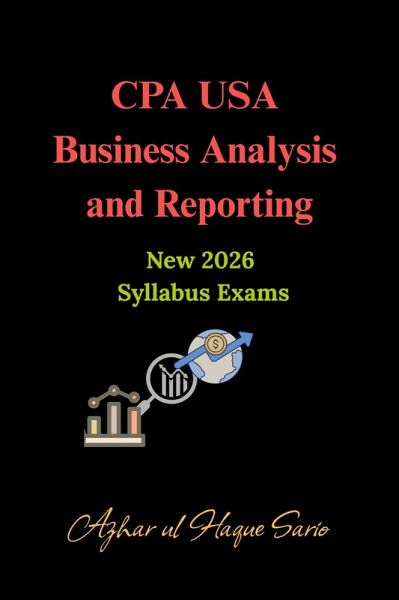
This comprehensive guide is your essential blueprint for mastering the 2026 CPA Business Analysis and Reporting (BAR) exam. It covers the complete syllabus for the new exam evolution. You will dive deep into Area I regarding Business Analysis. The book explains how to use big data. You will learn about the Data Supply Chain. We cover Financial Statement Analysis in detail. You will master variance analysis and forecasting. The text breaks down Cost Accounting methods. You will understand Capital Structure and WACC. We explore Risk Management using COSO ERM. You will learn about ESG reporting risks. The book moves to Area II on Technical Accounting. It simplifies Revenue Recognition under ASC 606. You will master Leases under ASC 842. We explain Stock Compensation and ASC 718. You will understand Business Combinations under ASC 805. The book clarifies Derivatives and Hedge Accounting. It covers R&D and Software costs. We explain Public Company Reporting and SEC rules. You will master Segment Reporting. The text covers Area III on State and Local Governments. You will understand the Government-Wide statements. We explain Governmental, Proprietary, and Fiduciary funds. You will learn the specific GASB 101, 103, and 104 standards. It explains the reconciliation process clearly. The book uses simple English for complex topics. It is designed for the modern professional.
This book provides distinct value where others fail by treating the CPA candidate not as a historian of past transactions, but as a "Value Architect" of the future. While traditional guides rely on rote memorization of static rules, this book integrates the philosophy of the "Algorithmic Accountant," merging technical accounting with modern data analytics. It offers a competitive advantage by contextualizing complex standards-like the shift from "risks and rewards" to "control" in revenue recognition-within the real-world landscape of AI, high-interest rates, and sustainability mandates. We don't just teach you the journal entries for a lease; we explain the economic strategy behind the "Right-of-Use" model. By framing concepts like "Ghost Assets" and "Data Fabric" in a narrative style, this book bridges the gap between academic theory and the strategic decision-making required in 2026, ensuring you are ready to engineer profitability rather than just record it.
Disclaimer: This publication is independently produced by Azhar ul Haque Sario and is not affiliated with, endorsed by, or sponsored by the American Institute of Certified Public Accountants (AICPA), the National Association of State Boards of Accountancy (NASBA), the Financial Accounting Standards Board (FASB), the Governmental Accounting Standards Board (GASB), or any other official testing or standard-setting body. Any reference to specific exams, standards, or trademarks is for nominative fair use purposes only to describe the subject matter of the work.
This comprehensive guide is your essential blueprint for mastering the 2026 CPA Business Analysis and Reporting (BAR) exam. It covers the complete syllabus for the new exam evolution. You will dive deep into Area I regarding Business Analysis. The book explains how to use big data. You will learn about the Data Supply Chain. We cover Financial Statement Analysis in detail. You will master variance analysis and forecasting. The text breaks down Cost Accounting methods. You will understand Capital Structure and WACC. We explore Risk Management using COSO ERM. You will learn about ESG reporting risks. The book moves to Area II on Technical Accounting. It simplifies Revenue Recognition under ASC 606. You will master Leases under ASC 842. We explain Stock Compensation and ASC 718. You will understand Business Combinations under ASC 805. The book clarifies Derivatives and Hedge Accounting. It covers R&D and Software costs. We explain Public Company Reporting and SEC rules. You will master Segment Reporting. The text covers Area III on State and Local Governments. You will understand the Government-Wide statements. We explain Governmental, Proprietary, and Fiduciary funds. You will learn the specific GASB 101, 103, and 104 standards. It explains the reconciliation process clearly. The book uses simple English for complex topics. It is designed for the modern professional.
This book provides distinct value where others fail by treating the CPA candidate not as a historian of past transactions, but as a "Value Architect" of the future. While traditional guides rely on rote memorization of static rules, this book integrates the philosophy of the "Algorithmic Accountant," merging technical accounting with modern data analytics. It offers a competitive advantage by contextualizing complex standards-like the shift from "risks and rewards" to "control" in revenue recognition-within the real-world landscape of AI, high-interest rates, and sustainability mandates. We don't just teach you the journal entries for a lease; we explain the economic strategy behind the "Right-of-Use" model. By framing concepts like "Ghost Assets" and "Data Fabric" in a narrative style, this book bridges the gap between academic theory and the strategic decision-making required in 2026, ensuring you are ready to engineer profitability rather than just record it.
Disclaimer: This publication is independently produced by Azhar ul Haque Sario and is not affiliated with, endorsed by, or sponsored by the American Institute of Certified Public Accountants (AICPA), the National Association of State Boards of Accountancy (NASBA), the Financial Accounting Standards Board (FASB), the Governmental Accounting Standards Board (GASB), or any other official testing or standard-setting body. Any reference to specific exams, standards, or trademarks is for nominative fair use purposes only to describe the subject matter of the work.
Dieser Download kann aus rechtlichen Gründen nur mit Rechnungsadresse in A, B, BG, CY, CZ, D, DK, EW, E, FIN, F, GR, H, IRL, I, LT, L, LR, M, NL, PL, P, R, S, SLO, SK ausgeliefert werden.